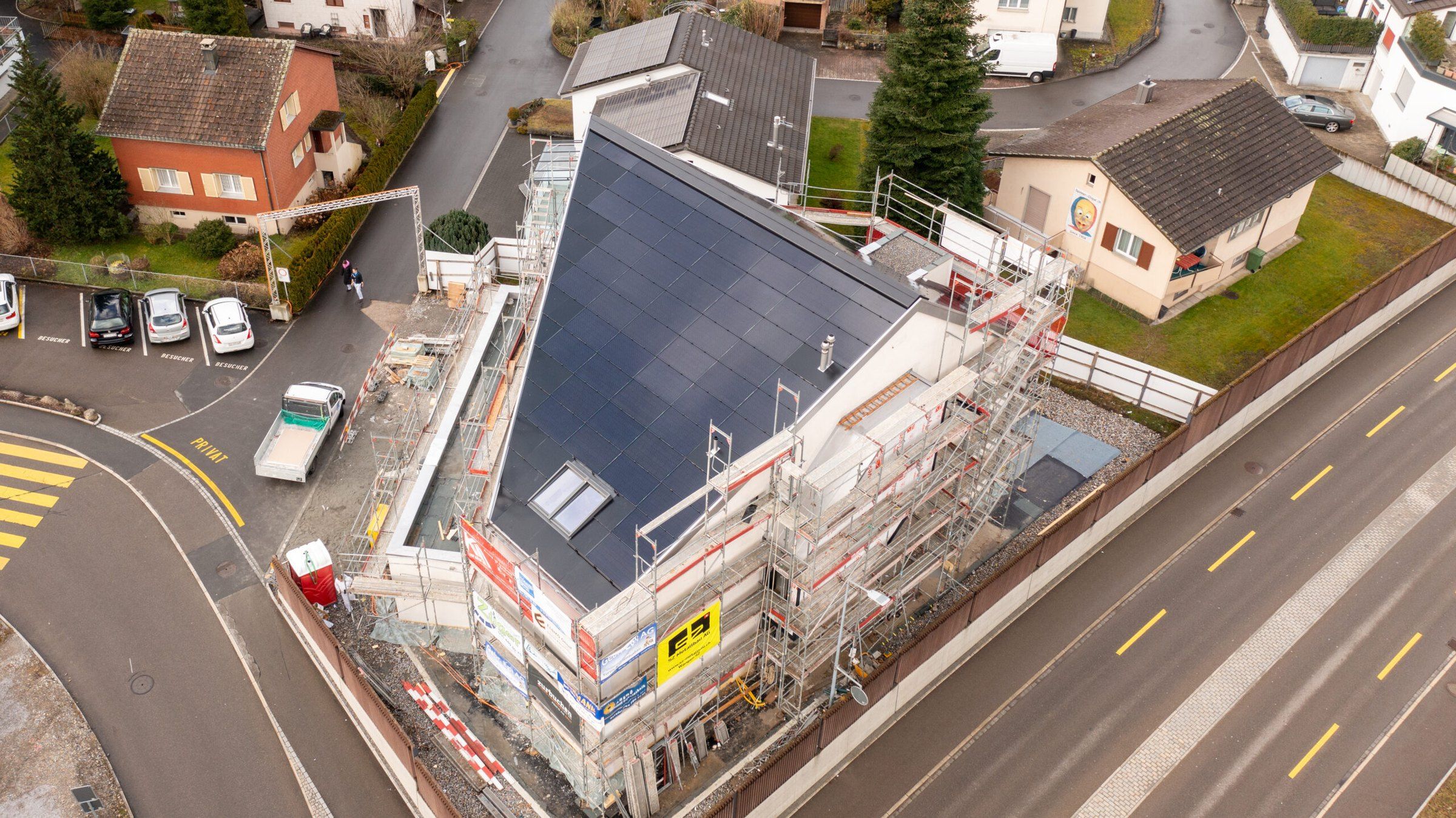
ZEV and solar power for property managers and owners
ZEV, vZEV and LEGSolar power for all.
We clarify which form suits your building and plan the solar system, metering and billing from one provider. Then you receive a binding quote within 72 hours.
- Site visit: free and with no obligation
- Binding quote within 72 hours
- Subsidies pre-financed on request
Prefer to talk?044 980 08 80
Request a free site visit
Takes 1 minute. No obligation.
- Building
- Location
- Contact
Thank you. We have your request.
We will call you within one working day to arrange the appointment.
Add details Optional
Prefer to talk now? 044 980 08 80
- documented reference systems
- 29
- output of these systems
- 718.1kWp
- to a binding quote
- 72h
- is what the site visit costs
- 0CHF
- Member of
 smart-me
Partner 2025
ZEV and vZEV
Sharing solar power in an apartment building
A solar system on an apartment building produces a lot of power. Without a special arrangement, only the communal part of the building uses it, and the rest flows into the grid. With a self-consumption community (Zusammenschluss zum Eigenverbrauch, ZEV), all parties in the building share the solar power from their own roof. What is left over goes into the public grid.
For owners and property managers, this is a strong argument: the solar power is sold internally for less than grid electricity, and a larger share stays in the building. That clearly improves the economics of the system.
We plan the solar system, metering and contracts, and show you how the billing works.
ZEV, vZEV and LEG: what is the difference?
The three terms are often confused. They describe different models:
| Model | In brief | Grid connection |
|---|---|---|
| ZEV | Self-consumption community. Several parties on one plot share the system. | one shared connection to the grid |
| vZEV | Virtual ZEV. Each party keeps its own connection, and the grid operator allocates the solar power through its metering. | separate connections |
| LEG | Local electricity community, possible since 1 January 2026. Participants nearby exchange solar power over the public grid, including across plot boundaries. | use of the public grid |
The ZEV is the classic. It suits cases where all flats are in the same building or on the same plot. It needs a shared grid connection and its own metering behind that connection.
The vZEV is the solution when a shared connection does not make sense structurally. Each party keeps its meter, and the grid operator allocates the solar power by calculation. This saves alterations to the main distribution board. It does require that the grid operator supports the vZEV and supplies the metering data.
The LEG is new. It allows solar power to be shared between neighbouring buildings too, as long as all are in the same grid area. A reduced grid fee applies. The exact framework depends on federal rules and on the grid operator. If you are thinking about a LEG, we tell you what is possible with your grid operator today.
Which model suits your building depends on the building, the grid connection and the grid operator. We clarify this during the site visit.
How does a ZEV work in daily life?
The principle is simple. The solar system supplies power to the building, and each flat has its own meter.
- The system produces electricity.
- The power goes first to the flats and the communal loads.
- What nobody needs flows into the grid, and the grid operator pays for it.
- When the sun is not shining, grid electricity flows in.
The solar power has an internal price that is below the grid tariff. This way all parties benefit: residents pay less, and the owners sell more of their own power.
What does a ZEV bring to those involved?
Owners: A larger share of the solar power is sold in the building instead of being fed into the grid at the lower feed-in tariff. This makes the system more economical and the investment easier to justify. There is also an advantage in letting: flats with low-cost solar power are more attractive.
Residents: They buy part of their electricity at a tariff below the grid price and know where it comes from. If you charge an electric car, you benefit twice.
Property management: The effort is predictable if metering and billing are set up properly from the start. That is exactly where we come in.
A ZEV also has limits. The metering costs money, and property management has to handle the billing. In very small buildings or with weak self-consumption, the benefit can be small. We calculate it honestly before you decide.
Metering, contracts and billing
Three things have to be right for a ZEV to work in daily life.
Metering. Each party needs a meter that records solar power and grid power separately. In addition, there is a meter for the grid connection and one for the system. The metering must meet the requirements of the grid operator. We plan it so that the data later flows automatically into the billing.
Contracts. A set of rules or an agreement covers the internal tariff, participation and termination. In condominium ownership, the owners’ meeting decides, and for rented flats the tenancy agreement is the starting point. We supply templates and prepare the documents. This does not replace a legal review by your lawyer.
Billing. Consumption is recorded regularly, and solar power and grid power are billed separately. Property management does the billing itself or appoints a service provider. Digital metering saves a lot of effort here. As a smart-me Partner 2025, we rely on meters and software that provide the data cleanly.
For property managers and condominium ownership
Property managers need a clear process so that the ZEV does not become a burden in daily life. We pay attention to the following:
- One contact person for planning, installation, grid operator and metering.
- Documents for the meeting: quote, economics, process and contract templates, so that the owners can decide.
- A clear split of costs and income between the parties.
- Little effort in operation: The metering data runs digitally, and the billing can be automated.
In condominium ownership, the resolution of the owners’ meeting is added. We support you with documents and, if you wish, answer questions at the meeting.
If you do not have a system yet, start with the solar system. If you have electric cars in the building, complement the ZEV with EV chargers or EV charging in the underground car park. A battery storage system increases the share of solar power that stays in the building.
What applies to an existing building?
Many apartment buildings already have a solar system that only supplies the communal electricity. Or they have a roof that is still free. In both cases, a ZEV can be added later.
For existing systems, we check whether the inverter and meters suit the ZEV or have to be replaced. For a free roof, we design the system for the consumption of the flats from the start. During renovations, it is worth renewing the meter positions and risers at the same time. The flats are then ready for metering and billing.
What does a ZEV cost?
A ZEV has no flat price. The costs are made up of the solar system, metering and administration. All figures here are guide values.
| Item | Guide value |
|---|---|
| Solar system for an apartment building, typically 20 to 60 kWp | depending on roof and size, price after the site visit |
| Metering and conversion of meter positions | a few hundred francs per flat, depending on the existing state |
| Billing | depending on provider, usually per flat and year |
You receive the exact figures in the binding quote within 72 hours, with yield, metering concept and subsidies.
Subsidies: For the solar system, there is the one-off payment (Einmalvergütung, EIV) from Pronovo, and depending on the canton and commune, further contributions. We register the system for you. On request, we pre-finance the subsidy.
How your project works
- Enquiry: Online in a minute or by phone.
- Site visit: We check the roof, electrical distribution, meter positions and consumption. Free of charge.
- Quote in 72 hours: binding, with system, metering concept, yield and subsidies.
- Resolution and contracts: In condominium ownership, the meeting decides. We supply the documents.
- Notification and grid operator: We submit everything to the commune and the grid operator and register the ZEV.
- Installation: Our own installers, with a fixed appointment. They also install the meters.
- Commissioning: We show you the system and the metering data.
ZEV in your region
Our locations are in Zumikon ZH and Lachen SZ. We plan and build ZEV solar systems throughout German-speaking Switzerland, most often in the Cantons of Zurich, St. Gallen, Schwyz and Aargau. The requirements for metering and registration differ by grid operator. We know the local rules and clarify them for you.
Enter your postcode in the appointment card. We will get in touch and arrange the free site visit.
The free site visit
One appointment at your home. Then you know everything.
A project manager from our team visits you and checks three things. No sales show, no obligation. Afterwards you receive a binding quote with yield, subsidies and payback.
 01
01Roof
Area, orientation, pitch, condition of the roof covering and shading.
 02
02Electrical system
Grid connection, distribution board and space for inverter and battery.
 03
03Your consumption
Electricity bill, car, heating, plans. From this we calculate yield and subsidies.
How your project runs
Request
Tell us briefly about your building and your goal. Online or by phone.
Site visit
We check your roof, electrical system and consumption at your home. Free of charge.
Quote in 72 hours
Binding and transparent, with yield, subsidies and payback.
Permit and subsidies
We handle the notification procedure, the grid operator and Pronovo.
Installation and commissioning
Our own installers, a fixed date, final inspection with you on the roof.
Step 1 takes one minute. We take care of the rest.
Google reviews
What our customers say about us.
5.0
Unabridged and unedited, straight from our Google profile. The reviews are in German.
All reviews on GoogleWir sind sehr zufrieden mit unserer Wallbox für unser E-Auto.
Cemil B. · October 2026
Wir können Solarinnovation.ch und insbesondere Jordan für seine kompetente Beratung und perfekte Umsetzung als zuverlässigen Partner für nachhaltige Energielösungen aus einer Hand von Herzen weiterempfehlen. Er hat uns mit seinem umfangreichen Fachwissen von der ersten Beratung bis und mit der Umsetzung kompetent begleitet. Er hat alle Fragen immer verständlich erklärt. Wir sind mit der Indach-Solaranlage, kombiniert mit einem Speicher sehr zufrieden.
Daniel · August 2026
Die SolarInnovation GmbH hat mich durch ihre sehr flexible und kompetente Beratung und Arbeitsausführung sehr überzeugt!
Frederic L. · September 2025
Eine sehr seriöses Firma. Danke Aulson, Danke Jorden.
Alex I. · August 2025
Top Service und super Beratung! Unsere Solaranlage am linken Zürichseeufer läuft perfekt, produziert mehr Strom als erwartet und sieht auch noch toll aus. Absolut empfehlenswert!
Marc W. · August 2025
Built near you.
29 projects, 718.1 kWp in total. From Zumikon and Lachen we work all over German-speaking Switzerland, most often in the cantons of Zurich, St. Gallen, Schwyz and Aargau.
Canton of Zurich
- Rüti41.1 kWp
- Zürich26.6 kWp
- Zürich6.8 kWp
- Zürich10.9 kWp
- Gossau ZH7.7 kWp
- Zollikerberg17.7 kWp
- Ebmatingen16.9 kWp
- Ebmatingen17 kWp
- Zürich7.5 kWp
- Maur6.9 kWp
- Herrliberg14.8 kWp
- Herrliberg12 kWp
- Meilen17.2 kWp
- Bachs10.2 kWp
Canton of St. Gallen
Canton of Schwyz
Canton of Aargau
- Staffelbach16 kWp
- Reinach AG20.7 kWp
- Berikon19.8 kWp
- Oberkulm20.7 kWp
Canton of Lucerne
Canton of Zug
Frequently asked questions
Before you get in touch.
Is the site visit really free?
Yes. The visit and the quote cost you nothing and commit you to nothing. You only decide once you hold the binding quote in your hands.
Do all tenants have to take part in a ZEV?
No. Anyone who does not want to take part stays with the electricity utility. Participation must be voluntary, and the solar power must not cost more than grid electricity. We set out how this is handled in your building in the concept.
What can the solar power cost in a ZEV?
The internal tariff must be below the grid operator's price for comparable customers. As an industry guide value, a discount of about 20 per cent applies. The rules can change. We check the current status during planning.
Do I need a new solar system for a ZEV?
Usually yes, or at least an extension. Existing systems can often be integrated if the metering and distribution are adapted. We check this during the site visit.
Who does the billing in a ZEV?
That is up to you. Property management does the billing itself, or a service provider takes it over. We plan the metering so that both routes work, and show you the options with their costs.
What happens when a tenant moves out?
The contract ends with the tenancy. Participation is offered to the next party. With one meter per flat, the change is simple, because only the allocation is adjusted.
Can I set up a ZEV in condominium ownership?
Yes. Usually a resolution of the owners' meeting is needed, because the system stands on the shared roof. We prepare the documents and the quote so that the meeting can decide on it.
Is a ZEV worthwhile with only a few flats?
That depends on roof area, consumption and metering costs. It can pay off even in a small apartment building. We calculate it with your figures and tell you openly if it does not suit your building.
Which regions do you cover?
All of German-speaking Switzerland. We build most often in the cantons of Zurich, St. Gallen, Schwyz and Aargau. Our locations are in Zumikon ZH and Lachen SZ.
From one company
Goes well with

The first step
We come to you. Free of charge.
We check your roof, electrical system and consumption. Afterwards you know what is possible on your roof, what it costs and which subsidies you receive. The binding quote follows within 72 hours.
- Free and with no obligation
- Quote within 72 hours
- Subsidies pre-financed on request
