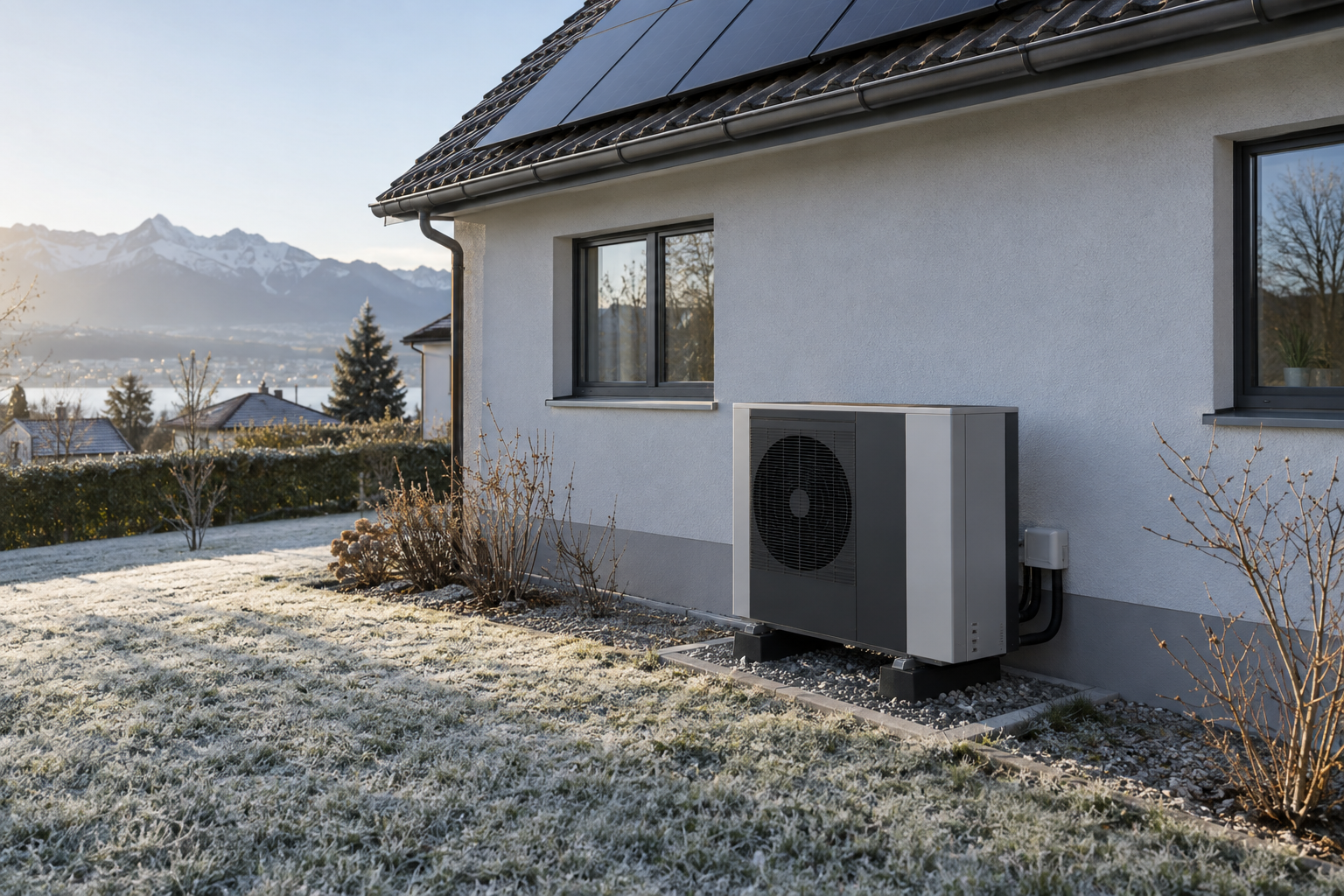
Air-to-water heat pumps across German-speaking Switzerland
Air-to-water heat pumpNo drilling, with sun.
We check the site, noise and heating system on the spot and calculate the running costs with your solar system. The binding quote follows within 72 hours.
- Site visit: free and with no obligation
- Binding quote within 72 hours
- Subsidies pre-financed on request
Prefer to talk?044 980 08 80
Request a free site visit
Takes 1 minute. No obligation.
- Building
- Location
- Contact
Thank you. We have your request.
We will call you within one working day to arrange the appointment.
Add details Optional
Prefer to talk now? 044 980 08 80
- documented reference systems
- 29
- output of these systems
- 718.1kWp
- to a binding quote
- 72h
- is what the site visit costs
- 0CHF
- Member of
 smart-me
Partner 2025
Air-to-water heat pump
Air-to-water heat pump: what it can do and what it needs
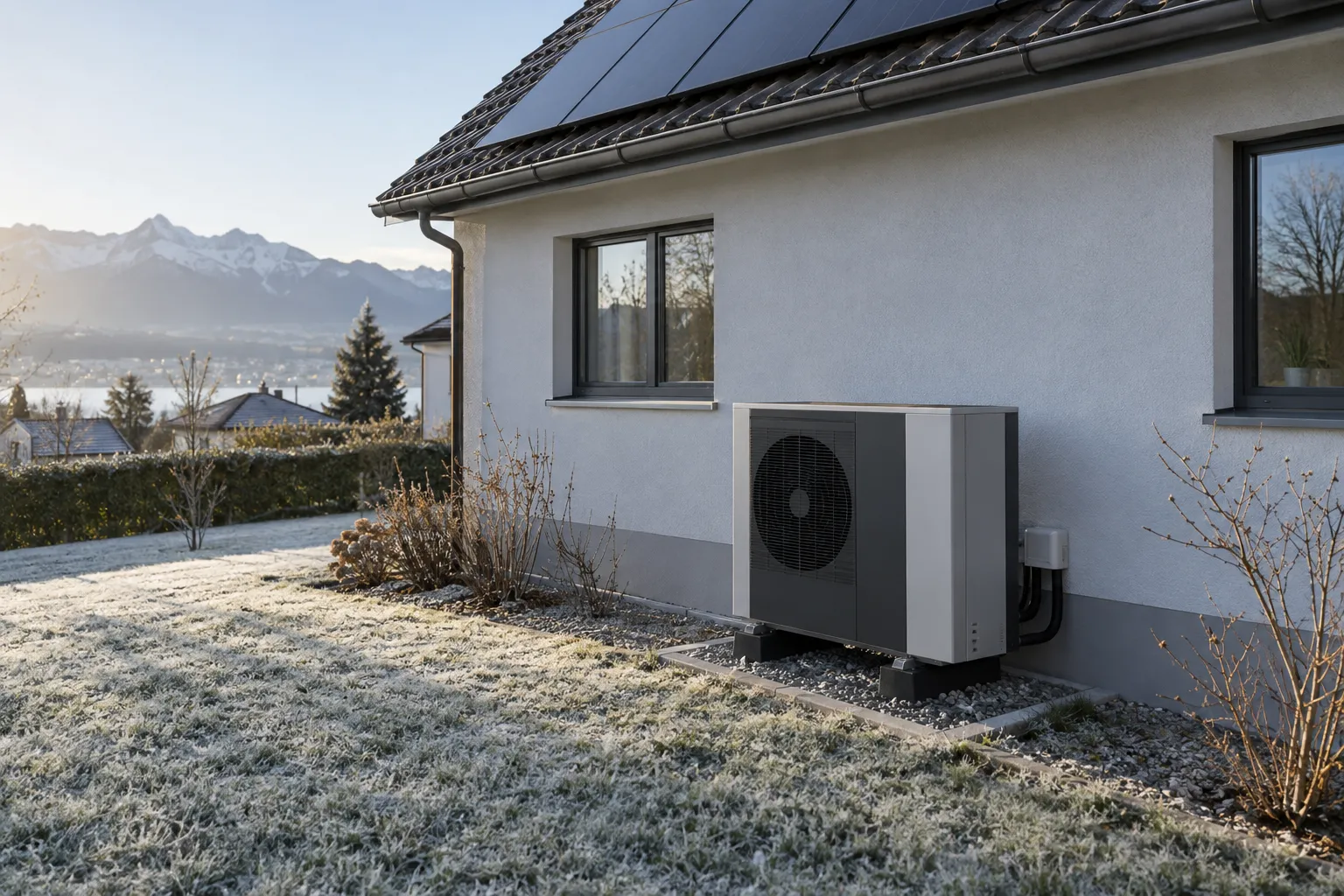
An air-to-water heat pump draws heat from the outside air and passes it to your heating system and your hot water. Even at sub-zero temperatures, the air still holds usable energy. The unit needs electricity for this, but delivers several times as much as heat.
It is the most common heat pump in Switzerland. The reason: it needs no drilling, is quick to install and suits both new builds and existing buildings. Together with a solar system, it covers part of its electricity needs from your own roof.
You will find an overview of all systems under heat pump. This page is only about the air-to-water type.
How does an air-to-water heat pump work?
A fan draws outside air through an evaporator. A refrigerant absorbs the heat, and a compressor raises the temperature. In the condenser, the heat passes to the heating water.
The measure of efficiency is the seasonal performance factor (SPF, JAZ). It tells you how many kilowatt-hours of heat the unit delivers per kilowatt-hour of electricity over the year. For air-to-water units, it is around 3 to 4. The lower the flow temperature of your heating system, the better the value.
Indoors or outdoors?
Where to put the unit is the most important planning question.
| Option | How it works | Suitable when |
|---|---|---|
| Outdoor siting (monobloc) | The whole unit stands outside. Two pipes lead into the house. | There is space in the garden or by the house wall. |
| Split unit | Evaporator outside, hydraulics and storage tank in the house. | There is little space outside, or the hydraulics inside should be frost-protected. |
| Indoor siting | The unit stands in the house, air comes through ducts. | A suitable room and wall openings are available. |
There are also practical points: keeping it clear of snow, condensate drainage, access for servicing and the view from your seating area. We look at the site during the site visit and show you what is possible.
How loud is the heat pump? Noise protection and neighbours
Air-to-water units make noise. The fan and compressor produce a level that falls with distance. On your own property this is rarely a problem. At the neighbour’s, the limit values of the Noise Abatement Ordinance apply.
This is how we proceed:
- We choose a quiet model and, where useful, a night mode with reduced output.
- We choose the site so that bedroom windows, terraces and neighbouring plots are not in the direction of the sound.
- We prepare the noise protection assessment if your commune requires it.
We would rather clear up noise concerns before the purchase than after. So we calculate the level already during planning.
Air-to-water heat pump with solar system
The heat pump uses electricity, the solar system produces it. This fits especially well in the shoulder seasons: in spring and autumn, the heat pump heats with solar power during the day.
- Hot water: The storage tank is heated during sunny hours.
- Self-consumption: Electricity from the roof is more likely to be used by you, rather than flowing into the grid.
- Running costs: Every kilowatt-hour you use yourself is one you do not have to buy.
- Extension: A battery storage unit shifts solar power into the evening.
In winter, the system delivers less and the heat pump needs more. Then part of the electricity comes from the grid. So we do not size the system for the summer, but for your total demand.
Who is the air-to-water heat pump suitable for?
It fits in most cases, but not every one. It is well suited to:
- Single-family homes, including older ones, if the flow temperature is not too high.
- Replacing an oil or gas heating system, where there is no space or no permit for drilling.
- New builds with underfloor heating, where very low flow temperatures are possible.
- Plots with space for an outdoor unit and enough distance from the neighbours.
It gets tricky on very narrow terraced-house plots, with high flow temperatures without adjustment, or where the noise towards the neighbour is hard to limit. Then we recommend a different siting or a different technology. We will tell you openly.
What role does the flow temperature play?
The lower the temperature your heating system works at, the less electricity the heat pump needs. Underfloor heating manages with about 30 to 35 degrees, older radiators often need more. At the site visit, we check what temperature your house really needs on cold days. Often it can be lowered with a few changes, for example a few larger radiators or a clean hydraulic adjustment.
What does an air-to-water heat pump cost?
For a single-family home, the total cost for the unit, storage tank, installation, removal of the old heating and electrical work is roughly CHF 30,000 to 50,000, before subsidies. This is a guide, not a price.
What moves the price up or down:
- Heating output: A larger house needs a more powerful unit.
- Removal: Taking out the oil tank, chimney and boiler takes time.
- Heating system: If radiators have to be replaced, costs are added.
- Electrics: A new meter cabinet or a stronger supply line is needed in some houses.
- Siting: Foundations, ducts or long pipes make the project more expensive.
You receive the binding quote within 72 hours of the site visit. It contains all items, the subsidies and the expected running costs.
Subsidies
Replacing a fossil heating system with a heat pump is subsidised, primarily through the cantonal buildings programme. Some communes and energy suppliers pay on top. The amount, conditions and deadlines differ from canton to canton.
Often the application must be made before work starts. We handle the subsidy application for replacing your heating system as part of the service. The subsidies can be pre-financed on request.
How the installation runs
- Enquiry and site visit: We check the heating, radiators, site and electrical system. Free of charge.
- Quote within 72 hours: binding, with subsidies.
- Applications: Subsidy application, notification to the commune, noise protection assessment, registration with the grid operator.
- Removal: The old heating and tank are taken out and disposed of.
- Installation: Unit, storage tank, hydraulics and electrics. For a single-family home, this often takes only a few days.
- Commissioning: We set the heating curve and explain how to use the system.
Planning through to commissioning is in our hands, from one source.
Air-to-water heat pump in your region
Our locations are in Zumikon ZH and Lachen SZ. We build across German-speaking Switzerland. Noise rules and subsidy programmes differ by canton and commune. We know the procedures and tell you at the site visit what applies at your address.
If you have a plot with good space in the ground, it is worth looking at the ground-source heat pump. We calculate both options for you.
The free site visit
One appointment at your home. Then you know everything.
A project manager from our team visits you and checks three things. No sales show, no obligation. Afterwards you receive a binding quote with yield, subsidies and payback.
 01
01Roof
Area, orientation, pitch, condition of the roof covering and shading.
 02
02Electrical system
Grid connection, distribution board and space for inverter and battery.
 03
03Your consumption
Electricity bill, car, heating, plans. From this we calculate yield and subsidies.
How your project runs
Request
Tell us briefly about your building and your goal. Online or by phone.
Site visit
We check your roof, electrical system and consumption at your home. Free of charge.
Quote in 72 hours
Binding and transparent, with yield, subsidies and payback.
Permit and subsidies
We handle the notification procedure, the grid operator and Pronovo.
Installation and commissioning
Our own installers, a fixed date, final inspection with you on the roof.
Step 1 takes one minute. We take care of the rest.
Google reviews
What our customers say about us.
5.0
Unabridged and unedited, straight from our Google profile. The reviews are in German.
All reviews on GoogleWir sind sehr zufrieden mit unserer Wallbox für unser E-Auto.
Cemil B. · October 2026
Wir können Solarinnovation.ch und insbesondere Jordan für seine kompetente Beratung und perfekte Umsetzung als zuverlässigen Partner für nachhaltige Energielösungen aus einer Hand von Herzen weiterempfehlen. Er hat uns mit seinem umfangreichen Fachwissen von der ersten Beratung bis und mit der Umsetzung kompetent begleitet. Er hat alle Fragen immer verständlich erklärt. Wir sind mit der Indach-Solaranlage, kombiniert mit einem Speicher sehr zufrieden.
Daniel · August 2026
Die SolarInnovation GmbH hat mich durch ihre sehr flexible und kompetente Beratung und Arbeitsausführung sehr überzeugt!
Frederic L. · September 2025
Eine sehr seriöses Firma. Danke Aulson, Danke Jorden.
Alex I. · August 2025
Top Service und super Beratung! Unsere Solaranlage am linken Zürichseeufer läuft perfekt, produziert mehr Strom als erwartet und sieht auch noch toll aus. Absolut empfehlenswert!
Marc W. · August 2025
Built near you.
29 projects, 718.1 kWp in total. From Zumikon and Lachen we work all over German-speaking Switzerland, most often in the cantons of Zurich, St. Gallen, Schwyz and Aargau.
Canton of Zurich
- Rüti41.1 kWp
- Zürich26.6 kWp
- Zürich6.8 kWp
- Zürich10.9 kWp
- Gossau ZH7.7 kWp
- Zollikerberg17.7 kWp
- Ebmatingen16.9 kWp
- Ebmatingen17 kWp
- Zürich7.5 kWp
- Maur6.9 kWp
- Herrliberg14.8 kWp
- Herrliberg12 kWp
- Meilen17.2 kWp
- Bachs10.2 kWp
Canton of St. Gallen
Canton of Schwyz
Canton of Aargau
- Staffelbach16 kWp
- Reinach AG20.7 kWp
- Berikon19.8 kWp
- Oberkulm20.7 kWp
Canton of Lucerne
Canton of Zug
Frequently asked questions
Before you get in touch.
Is the site visit really free?
Yes. The visit and the quote cost you nothing and commit you to nothing. You only decide once you hold the binding quote in your hands.
How loud is an air-to-water heat pump really?
That depends on the model, the site and the operating mode. Modern units have a sound power somewhere between a quiet conversation and an air conditioner. What matters is the level at your neighbour's. We calculate it beforehand and set it out in the noise protection assessment.
How far from the neighbour must the unit stand?
There is no fixed distance for everyone. The Noise Abatement Ordinance sets limit values, and the cantons have their own guidance. Depending on the unit, the wall and the surroundings, a few metres may be enough, or another location is needed. We check this at your address.
Does the unit stand outside or inside the house?
Both are possible. Monobloc units stand outside. With split units the main unit is inside and only the evaporator is outside. Indoor siting needs space and air ducts. We choose what suits your house.
Do I need a building permit?
The canton and the commune regulate this. Often a notification procedure (Meldeverfahren) is enough, sometimes with a noise protection assessment, and sometimes a building application is needed. We clarify this for your address and submit the documents.
Does the heat pump work in severe cold?
Yes. Modern units also heat at sub-zero temperatures. But electricity use rises with the cold, because the air gives up less heat. We take that into account in the sizing.
Do I need an electric heating element as a backup?
Usually it is already built into the unit or the storage tank. It only switches in at very low temperatures or for the legionella cycle. With correct sizing, it rarely runs.
Which regions do you cover?
All of German-speaking Switzerland. We build most often in the cantons of Zurich, St. Gallen, Schwyz and Aargau. Our locations are in Zumikon ZH and Lachen SZ.
From one company
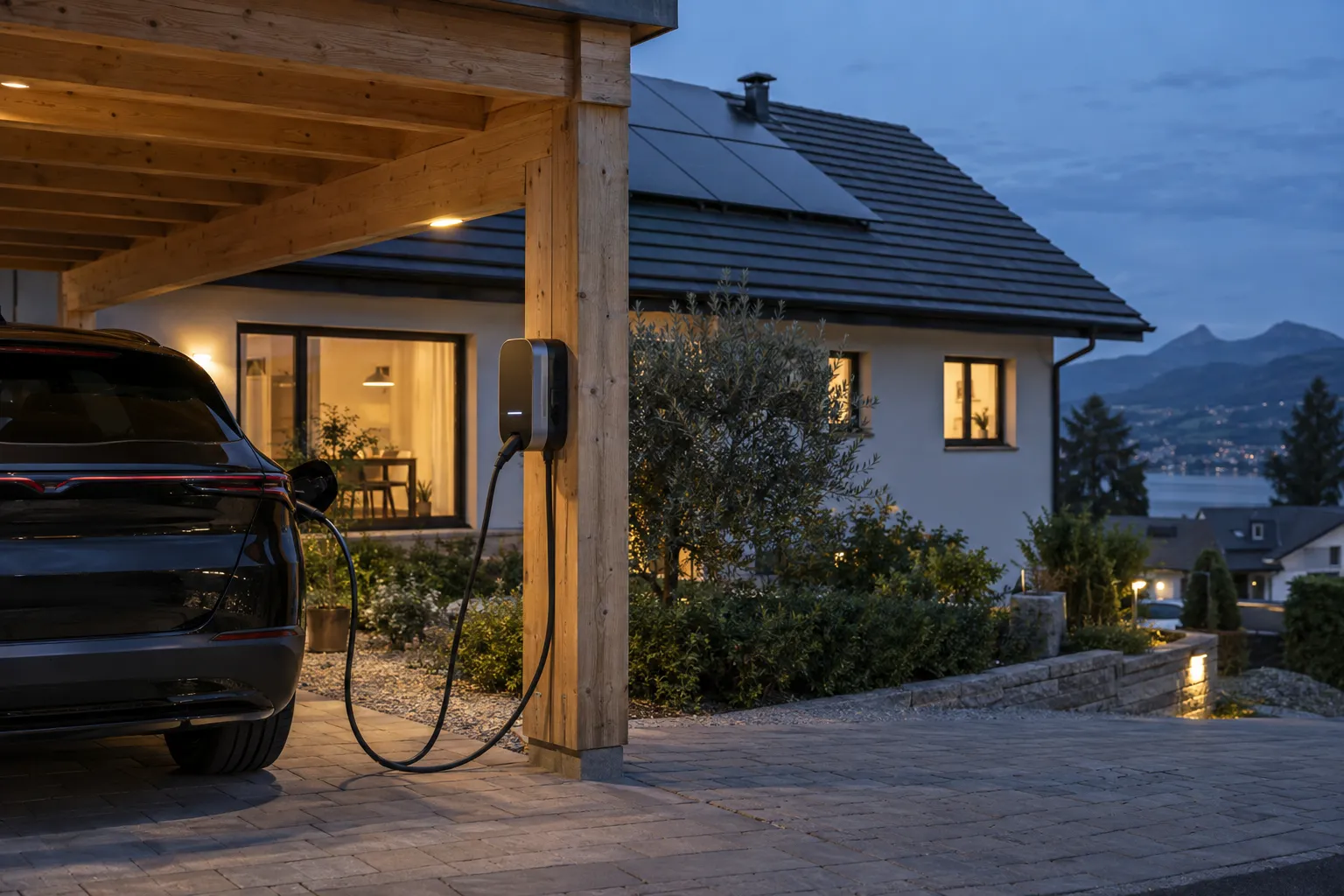
Goes well with

The first step
We come to you. Free of charge.
We check your roof, electrical system and consumption. Afterwards you know what is possible on your roof, what it costs and which subsidies you receive. The binding quote follows within 72 hours.
- Free and with no obligation
- Quote within 72 hours
- Subsidies pre-financed on request
