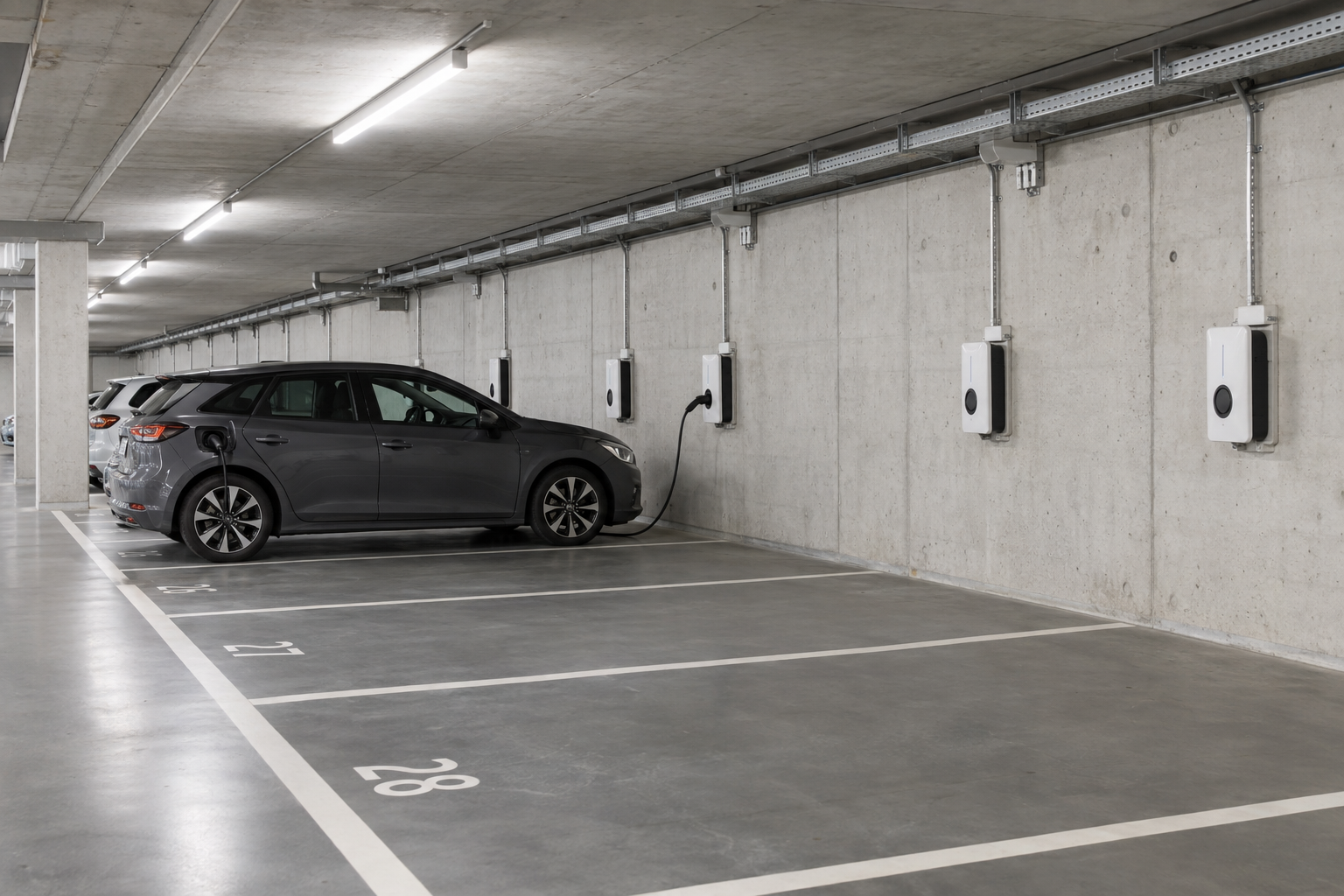
EV charging infrastructure for property managers and owners
EV chargers for underground car parks and apartment buildingsFor every parking space.
We plan the supply line, load management and billing so that every parking space can charge. Then you receive a binding quote within 72 hours.
- Site visit: free and with no obligation
- Binding quote within 72 hours
- Subsidies pre-financed on request
Prefer to talk?044 980 08 80
Request a free site visit
Takes 1 minute. No obligation.
- Building
- Location
- Contact
Thank you. We have your request.
We will call you within one working day to arrange the appointment.
Add details Optional
Prefer to talk now? 044 980 08 80
- documented reference systems
- 29
- output of these systems
- 718.1kWp
- to a binding quote
- 72h
- is what the site visit costs
- 0CHF
- Member of
 smart-me
Partner 2025
EV charging for car parks
Charging in an apartment building without overloading the connection
If you live in an apartment building, you want to charge your electric car at your own parking space. This is technically solvable, but more demanding than in a single-family home. Many cars hang on the same house connection, the cables in the underground car park are often old, and each household wants to pay only for its own electricity.
We plan EV charging infrastructure for underground car parks, outdoor parking and apartment buildings. From the supply line to the billing, with our own installers. For individual wallboxes in a single-family home, read EV charger and wallbox.
What does EV charging infrastructure in an underground car park include?
A good solution has four building blocks:
- Basic installation: Supply line from the distribution board, cable routes, fusing and space for all parking spaces.
- EV chargers: Wallboxes at the parking spaces that are to charge.
- Load management: Controls that share the available power among the cars that are charging.
- Metering and billing: Each user pays for their own electricity.
Load management: why it is needed
A house connection has only limited capacity. If ten cars charged at 11 kW at the same time, that would be 110 kW. The connection would be overloaded, or the fuse would blow. Load management prevents that.
It measures how much power the building is using at the moment and allocates the rest to the EV chargers. In the evening, when the kitchen and heating need a lot of electricity, the cars charge more slowly. At night, when the building needs little, they charge faster. By morning the cars are full, without the connection having to be reinforced.
This often saves high costs. Reinforcing the house connection is expensive and involves the grid operator. With good load management, many buildings manage without it. We calculate whether this applies to you at the site visit, using your load data.
Load management can also be linked to a solar system. The cars then charge preferably with electricity from your own roof. In a self-consumption community (ZEV) this works together with the apartments.
Preparing all parking spaces
Often only two or three households want to charge at first. A few years later it is more. If you plan anew each time, you pay several times over for groundwork, cable routes and distribution boards.
So we recommend the basic installation for all parking spaces right at the start:
- Cable trays and supply line are already in place.
- The distribution board is sized for all spaces.
- Wallboxes are added as needed, without new groundwork.
- The costs are shared fairly among everyone who joins later.
This is the calmest solution for property management and owners. As a guide, the basic installation per parking space usually costs clearly less than a single installation added later. The exact figures depend on the building and cable routes and are set out in the quote.
Retrofitting an existing underground car park
Most underground car parks were built before electric cars were a topic. When retrofitting, we meet typical obstacles: narrow cable shafts, full distribution boards, fire compartments and ceilings with little room for cable trays.
This can be solved. Before planning, we check:
- Distribution board and house connection: How much reserve is there?
- Cable routes: Where do trays run along the ceiling or wall, and what do fire protection and the cantonal building insurance say about it?
- Parking spaces: Do they belong to the apartments, or are they rented? That determines who pays and who decides.
- Access: How do users reach their EV charger, and how do we stop outsiders from charging?
The result is a concept you can present to property management or the owners’ meeting, with a plan, costs and process.
Billing per user
Whoever charges pays for their own electricity. There are two common ways to do this:
- Meter per EV charger: Each wallbox measures the consumption. The data goes automatically to a billing system.
- Apartment meter: The charging electricity runs through the apartment’s meter. This is simple, but only possible with suitable wiring.
Property management sets the tariff. It usually consists of the electricity price and a small share for operation and administration. As a smart-me Partner 2025, we rely on metering and software that deliver data without manual effort. Property management receives the billing digitally.
The split of costs matters too. The basic installation is usually part of the shared parts and is borne by everyone. The wallbox itself is paid for by whoever uses it. How exactly this is arranged in the building is decided by the owners’ meeting or property management. We show you examples of how other buildings solve it.
What does the charging infrastructure cost?
The costs depend heavily on the building. All figures are guide values, not prices:
| Item | Guide value |
|---|---|
| Wallbox per parking space | around CHF 800 to 2,500 |
| Basic installation per parking space | depends heavily on cable route and distribution board |
| Load management and metering | one-off for the building, plus costs per charging point |
Subsidies for EV chargers in apartment buildings exist depending on the canton, commune and energy supplier. We check what currently applies for your address. On request, we pre-finance the contributions we apply for. You receive the binding quote within 72 hours of the site visit.
How the project runs with property management and the owners’ association (STWEG)
- Enquiry: Online in one minute or by phone.
- Site visit: We check the distribution board, house connection, cable routes and parking spaces. Free of charge.
- Quote within 72 hours: binding, with a concept for load management, metering and billing.
- Decision: In condominium ownership, the owners’ meeting decides. We provide documents, cost split and process, so that the proposal is clear.
- Registration with the grid operator: We submit the necessary documents.
- Installation: Our own installers, in agreement with property management, to disturb the underground car park as little as possible.
- Commissioning: We test the EV chargers and load management and brief property management on the billing.
EV charging infrastructure in your region
Our locations are in Zumikon ZH and Lachen SZ. We plan EV charging infrastructure for apartment buildings across German-speaking Switzerland, most often in the Cantons of Zurich, St. Gallen, Schwyz and Aargau.
Enter your postcode in the appointment card. We will get in touch and arrange the free site visit.
The free site visit
One appointment at your home. Then you know everything.
A project manager from our team visits you and checks three things. No sales show, no obligation. Afterwards you receive a binding quote with yield, subsidies and payback.
 01
01Roof
Area, orientation, pitch, condition of the roof covering and shading.
 02
02Electrical system
Grid connection, distribution board and space for inverter and battery.
 03
03Your consumption
Electricity bill, car, heating, plans. From this we calculate yield and subsidies.
How your project runs
Request
Tell us briefly about your building and your goal. Online or by phone.
Site visit
We check your roof, electrical system and consumption at your home. Free of charge.
Quote in 72 hours
Binding and transparent, with yield, subsidies and payback.
Permit and subsidies
We handle the notification procedure, the grid operator and Pronovo.
Installation and commissioning
Our own installers, a fixed date, final inspection with you on the roof.
Step 1 takes one minute. We take care of the rest.
Google reviews
What our customers say about us.
5.0
Unabridged and unedited, straight from our Google profile. The reviews are in German.
All reviews on GoogleWir sind sehr zufrieden mit unserer Wallbox für unser E-Auto.
Cemil B. · October 2026
Wir können Solarinnovation.ch und insbesondere Jordan für seine kompetente Beratung und perfekte Umsetzung als zuverlässigen Partner für nachhaltige Energielösungen aus einer Hand von Herzen weiterempfehlen. Er hat uns mit seinem umfangreichen Fachwissen von der ersten Beratung bis und mit der Umsetzung kompetent begleitet. Er hat alle Fragen immer verständlich erklärt. Wir sind mit der Indach-Solaranlage, kombiniert mit einem Speicher sehr zufrieden.
Daniel · August 2026
Die SolarInnovation GmbH hat mich durch ihre sehr flexible und kompetente Beratung und Arbeitsausführung sehr überzeugt!
Frederic L. · September 2025
Eine sehr seriöses Firma. Danke Aulson, Danke Jorden.
Alex I. · August 2025
Top Service und super Beratung! Unsere Solaranlage am linken Zürichseeufer läuft perfekt, produziert mehr Strom als erwartet und sieht auch noch toll aus. Absolut empfehlenswert!
Marc W. · August 2025
Built near you.
29 projects, 718.1 kWp in total. From Zumikon and Lachen we work all over German-speaking Switzerland, most often in the cantons of Zurich, St. Gallen, Schwyz and Aargau.
Canton of Zurich
- Rüti41.1 kWp
- Zürich26.6 kWp
- Zürich6.8 kWp
- Zürich10.9 kWp
- Gossau ZH7.7 kWp
- Zollikerberg17.7 kWp
- Ebmatingen16.9 kWp
- Ebmatingen17 kWp
- Zürich7.5 kWp
- Maur6.9 kWp
- Herrliberg14.8 kWp
- Herrliberg12 kWp
- Meilen17.2 kWp
- Bachs10.2 kWp
Canton of St. Gallen
Canton of Schwyz
Canton of Aargau
- Staffelbach16 kWp
- Reinach AG20.7 kWp
- Berikon19.8 kWp
- Oberkulm20.7 kWp
Canton of Lucerne
Canton of Zug
Frequently asked questions
Before you get in touch.
Is the site visit really free?
Yes. The visit and the quote cost you nothing and commit you to nothing. You only decide once you hold the binding quote in your hands.
Must property management allow every tenant an EV charger?
There is no clear legal entitlement. In practice, many property managers agree if the tenant bears the cost and the solution suits the building. A shared solution for all parking spaces is usually cheaper than many individual installations.
Who decides on EV chargers in condominium ownership?
That depends on the regulations and the scope. Work on shared parts such as the supply line and distribution board usually needs a resolution of the owners' meeting. We provide the documents for the vote.
Is the house connection enough for several electric cars?
Often yes, if load management shares out the power. Then not all cars charge at full power at the same time. We calculate whether the connection is enough using the load data of your building.
How is charging electricity paid for in the underground car park?
It is metered and billed per user. The owners or the property management set the price per kWh. We explain the options and what to bear in mind.
Can we build just a few EV chargers first?
Yes. We plan the basic installation for all parking spaces and first fit only the wallboxes that are needed now. More can be added later without opening up the supply line again.
Is charging in the underground car park a fire risk?
Professionally installed EV chargers are safe. What matters is correct fusing, clean cable routing and a concept that fits the building's fire protection. We check this during planning and, where needed, agree it with the cantonal building insurance.
Which regions do you cover?
All of German-speaking Switzerland. We build most often in the cantons of Zurich, St. Gallen, Schwyz and Aargau. Our locations are in Zumikon ZH and Lachen SZ.
From one company
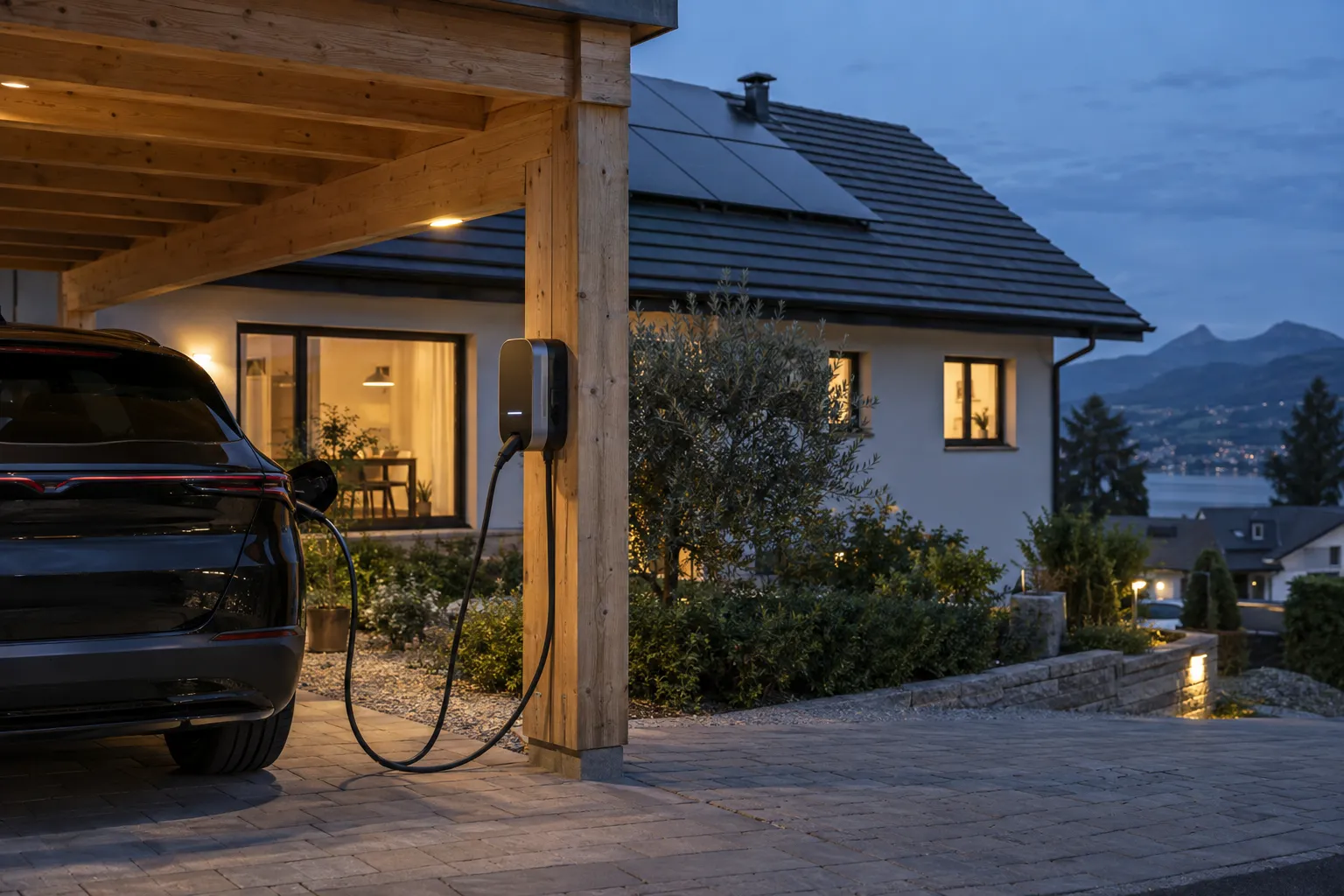
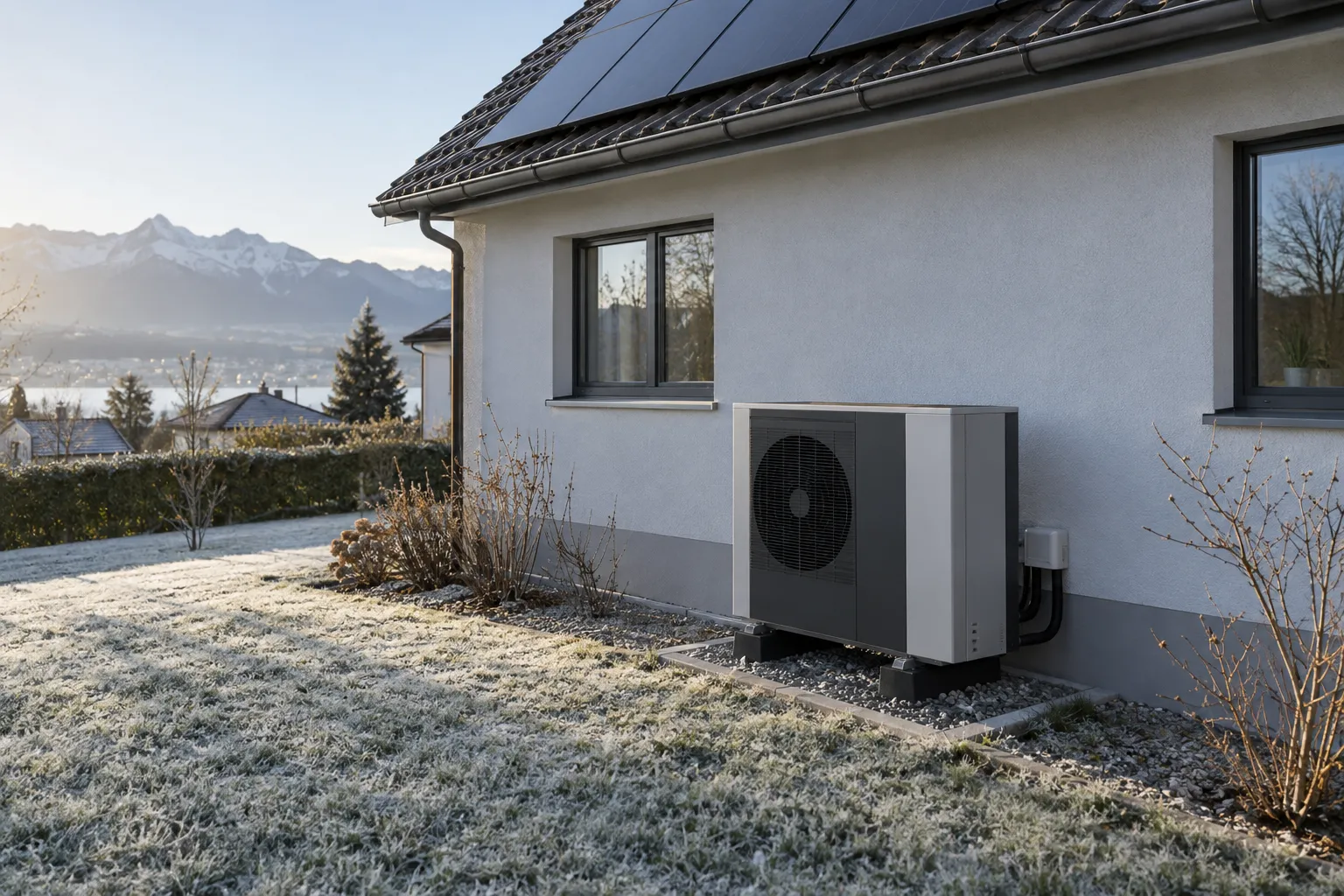
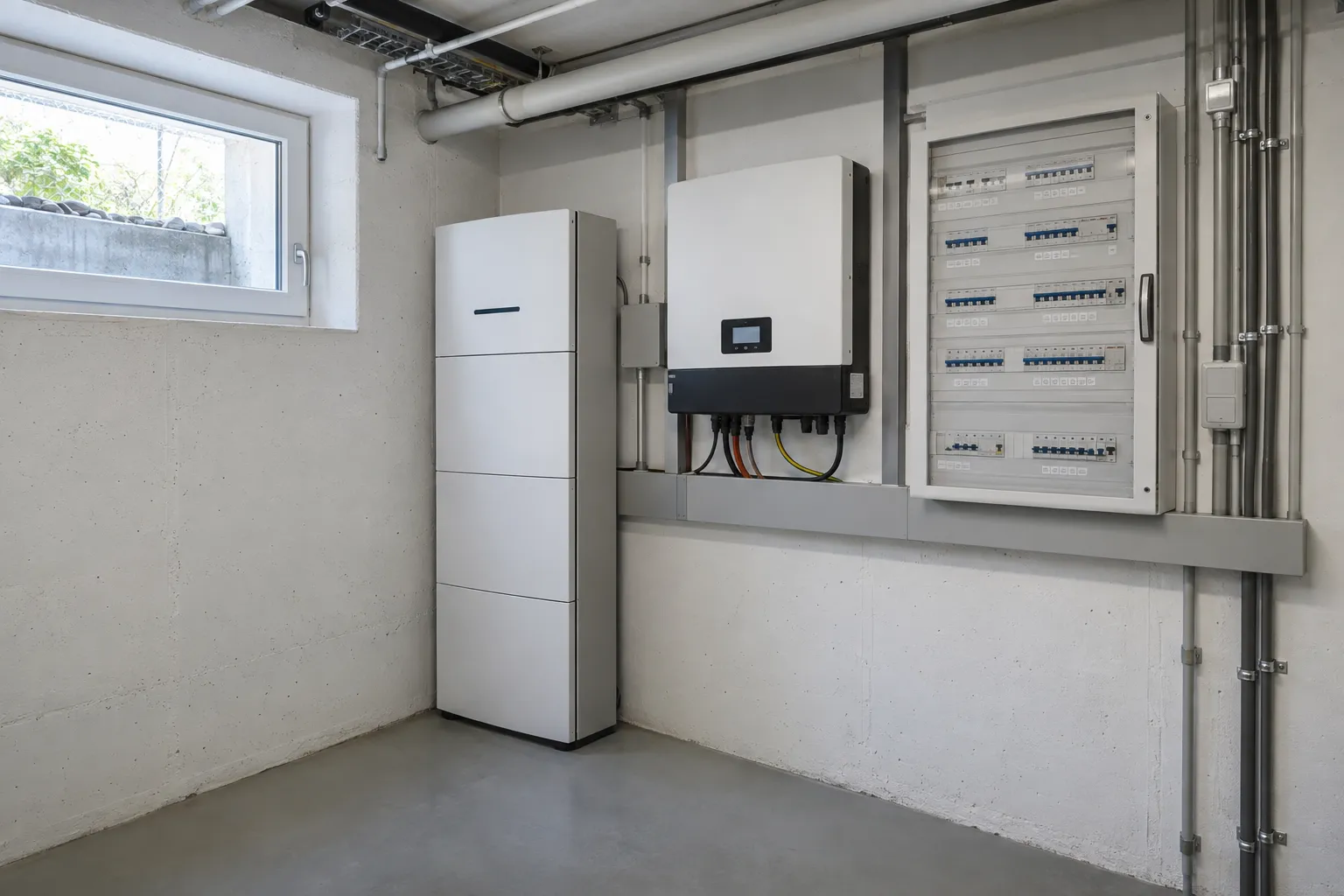
Goes well with

The first step
We come to you. Free of charge.
We check your roof, electrical system and consumption. Afterwards you know what is possible on your roof, what it costs and which subsidies you receive. The binding quote follows within 72 hours.
- Free and with no obligation
- Quote within 72 hours
- Subsidies pre-financed on request
