Home batteries from Zumikon and Lachen for German-speaking Switzerland
Battery storage for your solar systemKeep your own power.
We use your consumption to work out whether a battery makes sense for you and how large it should be. Then you receive a binding quote within 72 hours.
- Site visit: free and with no obligation
- Binding quote within 72 hours
- Subsidies pre-financed on request
Prefer to talk?044 980 08 80
Request a free site visit
Takes 1 minute. No obligation.
- Building
- Location
- Contact
Thank you. We have your request.
We will call you within one working day to arrange the appointment.
Add details Optional
Prefer to talk now? 044 980 08 80
- documented reference systems
- 29
- output of these systems
- 718.1kWp
- to a binding quote
- 72h
- is what the site visit costs
- 0CHF
- Member of
 smart-me
Partner 2025
Battery storage
What a battery storage system does
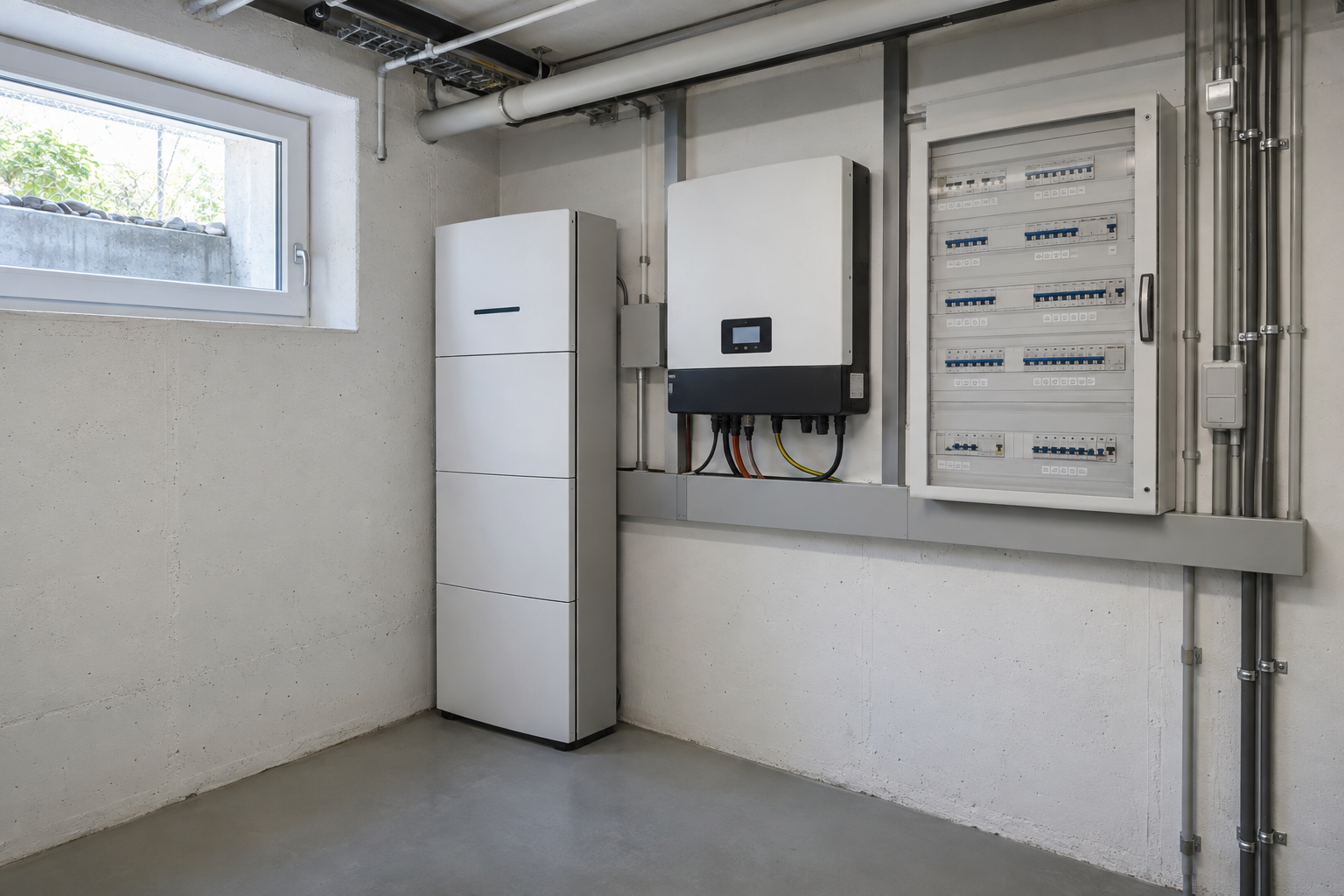
A battery storage system (also called a home battery or solar battery) stores the solar power you do not use during the day. In the evening and at night, you use it yourself instead of buying electricity. The battery belongs with the solar system: it charges from your rooftop power and releases it again when needed.
If you are building new and plan the system and battery together, you save effort. If you already have a system, you will find the solution under retrofitting a battery.
Why a battery with a solar system?
A solar system produces the most when you are at home the least: at midday and in summer. Without a battery, a household uses about 30 to 35 per cent of its own solar power itself. The rest flows into the grid.
With a suitably chosen battery, self-consumption often rises to 60 to 70 per cent. These values are guide figures. How high they are for you depends on the size of the system, the size of the battery and your daily routine.
Self-consumption pays off because power you use yourself is worth more than power you feed in. You pay the full tariff for grid electricity, but you only receive the feed-in tariff for power fed into the grid.
How large should the battery be?
Too small helps little, and too large stays empty in winter and costs more than necessary. This is how we proceed:
- We read your annual consumption and daily profile from your electricity bills and, if available, from smart meter data.
- We take your heat pump, electric car and home office into account.
- We calculate several battery sizes and compare self-consumption and price.
For single-family homes, 8 to 15 kWh of usable capacity is typical. A four-person household without a heat pump or electric car uses about 4,500 kWh a year, and a third of that falls in the evening and at night. With a heat pump and electric car, demand rises significantly, and so does the sensible battery size.
Backup power: electricity even during a grid failure
A system without a backup power function switches off during a grid failure, even with a battery. With a backup-capable battery, part of the house keeps running. There are two levels of installation:
| Option | What stays powered | Suitability |
|---|---|---|
| Backup power for individual circuits | Fridge, lighting, internet, heating controls | Standard, less effort |
| Backup power for the whole house | All loads, limited by the output | More work on the distribution board and inverter |
Backup power has to be planned from the start. It needs a suitable inverter and an adapted electrical distribution. In backup mode, a heat pump or wallbox only runs if the battery output is sufficient.
What types of battery are there?
- DC-coupled: The battery is connected to the direct-current side of the hybrid inverter. This is the usual solution for new systems, because there are fewer conversion losses.
- AC-coupled: The battery has its own inverter and is connected to the house’s alternating-current network. This is the common choice for existing systems.
- Technology: Lithium iron phosphate (LFP) cells are mostly used. They are considered durable and thermally stable.
More on the coupling types and on retrofitting is under retrofitting a battery.
Battery, EV charger and heat pump together
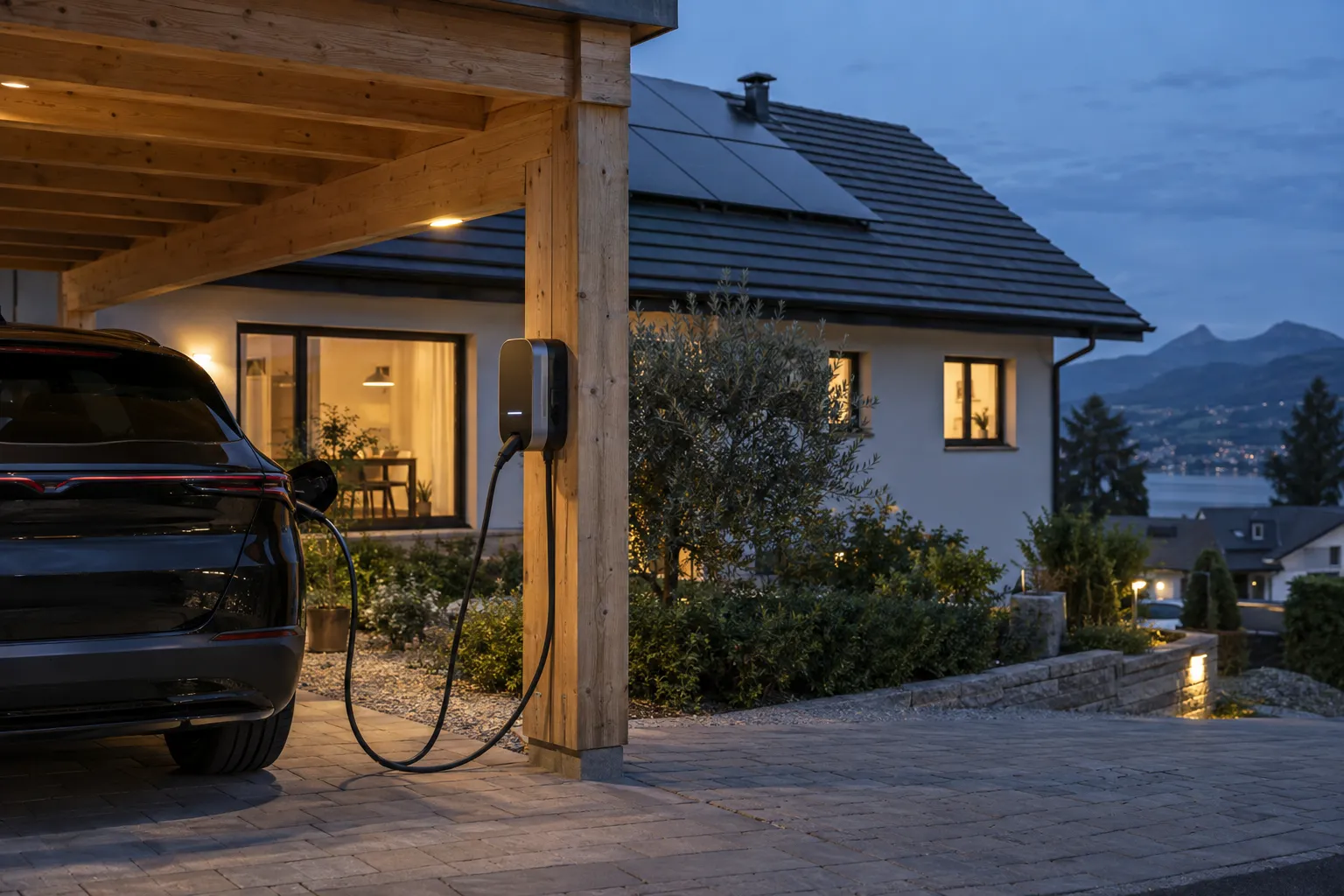
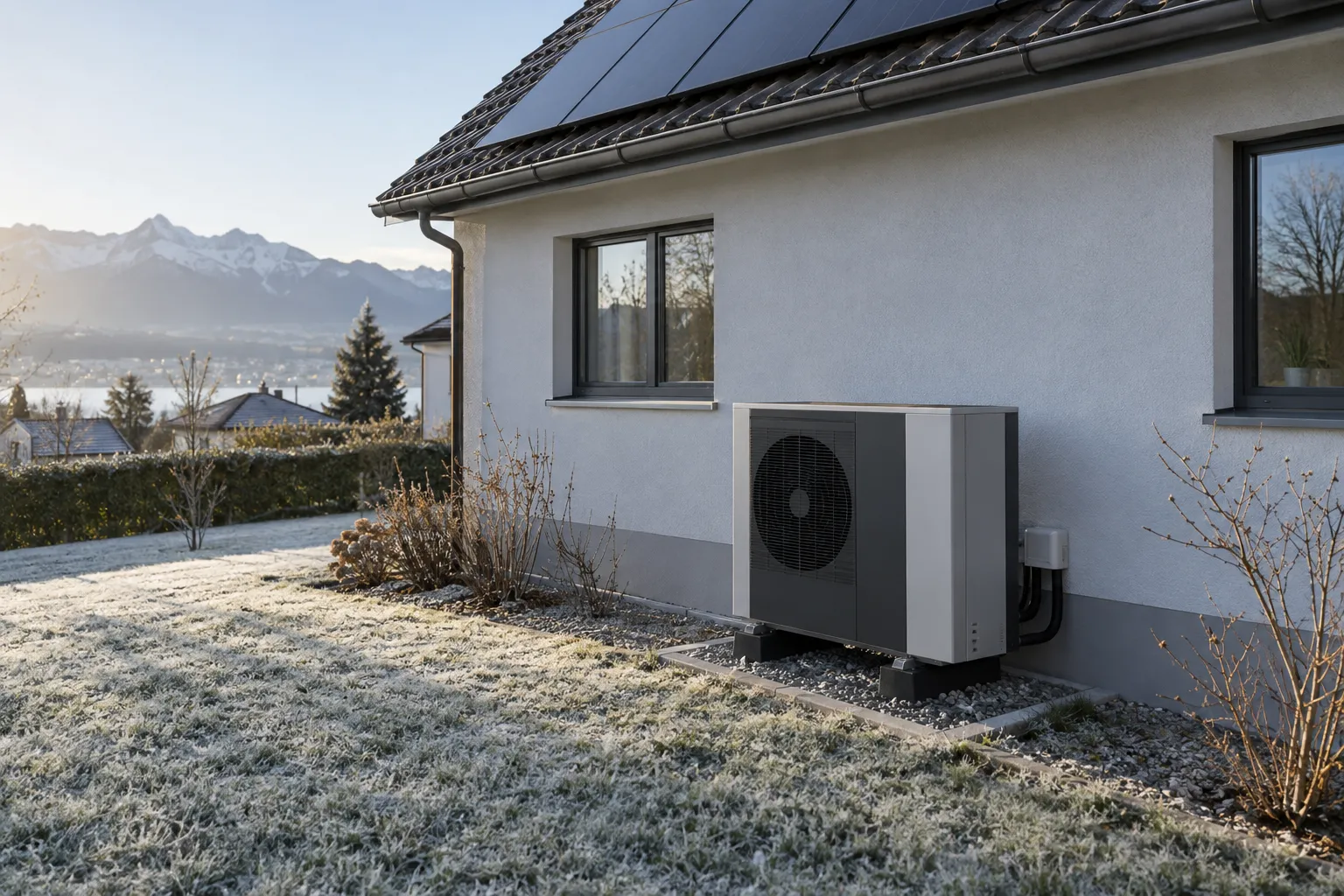
A battery shows its value when many loads work together. We connect the system to an EV charger and a heat pump and control them through an energy management system. The car then charges first with surplus power from the roof, and the heat pump runs when the sun is shining. As a smart-me Partner 2025, we also integrate the metering for this.
What does a battery cost?
The price depends on capacity, output, backup power function and installation effort. As a rough guide value, a battery of 8 to 12 kWh for a single-family home costs about CHF 8,000 to 15,000 including installation. Because systems and houses vary so much, we do not quote a flat rate. After the site visit, you receive a binding quote within 72 hours, with and without a battery, so that you can see the difference.
A rule of thumb for when a battery is more likely to pay off:
- The feed-in tariff of your grid operator is low.
- You use a lot of electricity in the evening and at night.
- You have an electric car or a heat pump.
- You want to keep having power during a grid failure.
If you already use a lot of electricity during the day, a battery is less worthwhile. We will tell you that too.
How long does a battery last?
The service life depends on the number of charge cycles. One cycle is one full charge and discharge. Modern LFP batteries are designed for several thousand cycles. At one cycle a day, that often means 10 to 15 years or more. These figures are guide values from the manufacturers. What is binding is the warranty stated in the quote.
Capacity decreases slowly over the years. Manufacturers usually guarantee a remaining capacity after a certain time or amount of energy. We tell you the conditions of the unit we propose before you sign.
Heat and cold put stress on cells. That is why we install the battery inside the house, not outdoors, and pay attention to ventilation and clearances.
Economics: is a battery worthwhile?
The honest answer is: it depends. A battery costs money and brings more self-consumption in return. Whether that pays off is determined by three figures:
- Your electricity price: the higher the tariff for grid electricity, the more each kilowatt-hour from the battery saves.
- The feed-in tariff: the lower it is, the less you lose by storing power instead of feeding it in.
- Your evening consumption: if you use a lot in the evening and at night, you empty the battery every day and use it fully.
A battery also has a benefit that the calculation only partly captures: independence from the grid and backup power. Whether that is worth the extra price to you is your decision. We show both options in the quote so that the difference is visible, and we will advise against a battery if it brings you hardly anything.
Where is the battery installed?
The battery is usually installed in the utility room, the cellar or the garage, close to the inverter and the electrical distribution. It needs a dry, frost-free room with enough space for ventilation, and the floor must carry the weight. Depending on the model, there are wall-mounted or floor-standing units. During the site visit, we measure the space and mark the cable route.
The battery in winter: what to expect
In winter, the system produces less power, and the battery is full less often. On sunny winter days and in spring and autumn, it still helps to bridge the evening. It is most useful from March to October. A battery does not make you independent of the grid in winter. We tell you that clearly before you buy.
Which brand?
We choose the battery to match the inverter, power demand and backup power requirements. What matters is a warranty you understand, a good connection to the energy metering and a manufacturer that will still provide support in ten years. Which units we propose is stated in the quote, with warranty and datasheet.
Battery and electricity price
If you have a dynamic electricity tariff, you can also use the battery to charge from the grid in cheap hours. This is an additional function that we discuss with you if your grid operator offers such a tariff. The main purpose remains self-consumption of your solar power.
Subsidies
- Federal government: The Pronovo one-off payment (Einmalvergütung, EIV) applies to the solar system. The battery itself is not directly subsidised by the federal government.
- Canton and commune: Some cantons, communes and energy suppliers pay contributions towards batteries, often in connection with a solar system or heat pump. The conditions differ by location. We check what is possible for your address.
- Taxes: In most cantons, you can deduct the investment in an existing building from your taxable income.
On request, we pre-finance the subsidy we handle for you.
How your project works
- Enquiry: Online in a minute or by phone.
- Site visit: We check the roof, electrical installation, installation location and consumption. Free of charge.
- Quote in 72 hours: binding, with battery size, self-consumption and economics.
- Notification and grid operator: We handle the registration of the system and the battery.
- Installation: Our own installers fit the system, battery and electrical connection.
- Commissioning: We explain the app, where you see charge level, yield and consumption.
Planning, notification, installation and commissioning come from one provider.
Battery storage in your region
Our locations are in Zumikon ZH and Lachen SZ. We build throughout German-speaking Switzerland, most often in the Cantons of Zurich, St. Gallen, Schwyz and Aargau. You can read more about the system itself under solar system.
The free site visit
One appointment at your home. Then you know everything.
A project manager from our team visits you and checks three things. No sales show, no obligation. Afterwards you receive a binding quote with yield, subsidies and payback.
 01
01Roof
Area, orientation, pitch, condition of the roof covering and shading.
 02
02Electrical system
Grid connection, distribution board and space for inverter and battery.
 03
03Your consumption
Electricity bill, car, heating, plans. From this we calculate yield and subsidies.
How your project runs
Request
Tell us briefly about your building and your goal. Online or by phone.
Site visit
We check your roof, electrical system and consumption at your home. Free of charge.
Quote in 72 hours
Binding and transparent, with yield, subsidies and payback.
Permit and subsidies
We handle the notification procedure, the grid operator and Pronovo.
Installation and commissioning
Our own installers, a fixed date, final inspection with you on the roof.
Step 1 takes one minute. We take care of the rest.
Google reviews
What our customers say about us.
5.0
Unabridged and unedited, straight from our Google profile. The reviews are in German.
All reviews on GoogleWir sind sehr zufrieden mit unserer Wallbox für unser E-Auto.
Cemil B. · October 2026
Wir können Solarinnovation.ch und insbesondere Jordan für seine kompetente Beratung und perfekte Umsetzung als zuverlässigen Partner für nachhaltige Energielösungen aus einer Hand von Herzen weiterempfehlen. Er hat uns mit seinem umfangreichen Fachwissen von der ersten Beratung bis und mit der Umsetzung kompetent begleitet. Er hat alle Fragen immer verständlich erklärt. Wir sind mit der Indach-Solaranlage, kombiniert mit einem Speicher sehr zufrieden.
Daniel · August 2026
Die SolarInnovation GmbH hat mich durch ihre sehr flexible und kompetente Beratung und Arbeitsausführung sehr überzeugt!
Frederic L. · September 2025
Eine sehr seriöses Firma. Danke Aulson, Danke Jorden.
Alex I. · August 2025
Top Service und super Beratung! Unsere Solaranlage am linken Zürichseeufer läuft perfekt, produziert mehr Strom als erwartet und sieht auch noch toll aus. Absolut empfehlenswert!
Marc W. · August 2025
Built near you.
29 projects, 718.1 kWp in total. From Zumikon and Lachen we work all over German-speaking Switzerland, most often in the cantons of Zurich, St. Gallen, Schwyz and Aargau.
Canton of Zurich
- Rüti41.1 kWp
- Zürich26.6 kWp
- Zürich6.8 kWp
- Zürich10.9 kWp
- Gossau ZH7.7 kWp
- Zollikerberg17.7 kWp
- Ebmatingen16.9 kWp
- Ebmatingen17 kWp
- Zürich7.5 kWp
- Maur6.9 kWp
- Herrliberg14.8 kWp
- Herrliberg12 kWp
- Meilen17.2 kWp
- Bachs10.2 kWp
Canton of St. Gallen
Canton of Schwyz
Canton of Aargau
- Staffelbach16 kWp
- Reinach AG20.7 kWp
- Berikon19.8 kWp
- Oberkulm20.7 kWp
Canton of Lucerne
Canton of Zug
Frequently asked questions
Before you get in touch.
Is the site visit really free?
Yes. The visit and the quote cost you nothing and commit you to nothing. You only decide once you hold the binding quote in your hands.
How large does the battery storage need to be?
As a rule of thumb, about 1 kWh of storage capacity per 1 kWp of solar output, usually 8 to 15 kWh for single-family homes. What matters is your consumption in the evening and at night. We read it from your electricity bills and calculate the right size.
Is a battery financially worthwhile?
That depends on the electricity price, the feed-in tariff of your grid operator and the price of the battery. The lower the feed-in tariff, the more each kilowatt-hour you use yourself is worth. In the quote, we calculate both options, with and without a battery, side by side.
How long does a battery last?
Modern lithium iron phosphate batteries are designed for several thousand charge cycles, which often means 10 to 15 years or more. Warranty terms differ by manufacturer. We state them in the quote.
Does the battery work during a power cut?
Only with a backup power function. Without it, even a battery switches off when the grid fails. With backup power, it keeps important loads running, for example the fridge, lighting and heating controls. We agree with you whether the whole house or only individual circuits are covered.
Where is the battery installed?
Usually in the utility room, cellar or garage. The room should be dry and frost-free, and the battery needs enough clearance for ventilation. During the site visit, we check the space and the cable route.
Can I add a battery later?
Yes. It is important that the inverter is compatible. We plan new systems with this in mind. For existing systems, you will find the details under Speicher nachrüsten (retrofitting a battery).
Does the battery need a permit?
As a rule, there is no separate building permit. However, the battery is registered with the grid operator like the solar system, and the installation must be carried out and inspected by a licensed electrical installer. We take care of that.
Which regions do you cover?
All of German-speaking Switzerland. We build most often in the cantons of Zurich, St. Gallen, Schwyz and Aargau. Our locations are in Zumikon ZH and Lachen SZ.
From one company
Goes well with

The first step
We come to you. Free of charge.
We check your roof, electrical system and consumption. Afterwards you know what is possible on your roof, what it costs and which subsidies you receive. The binding quote follows within 72 hours.
- Free and with no obligation
- Quote within 72 hours
- Subsidies pre-financed on request
