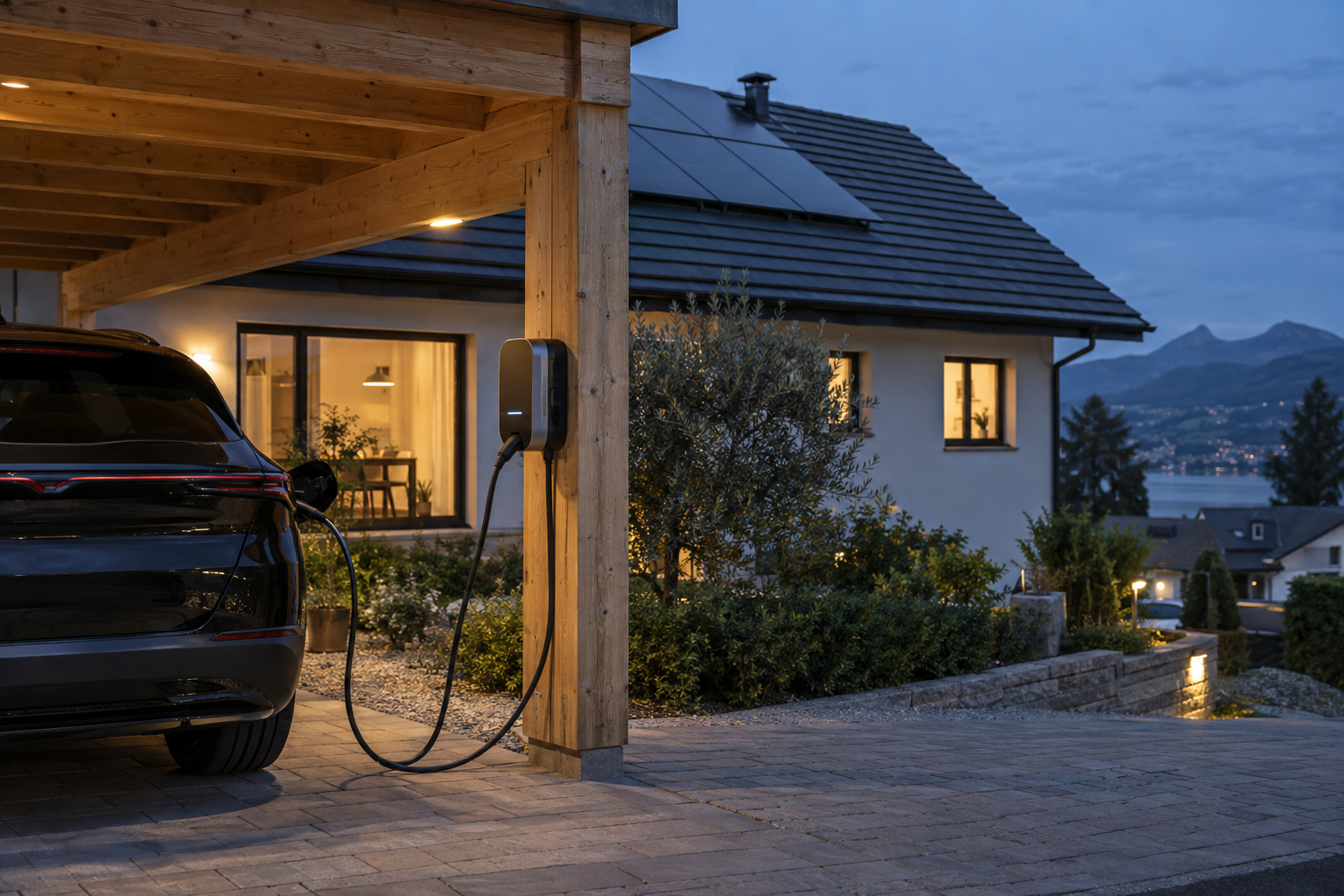
EV chargers from Zumikon and Lachen for German-speaking Switzerland
EV charger and wallbox for your electric carPlanned for your home.
We check your electrical installation and your parking space, recommend the right wallbox and install it. Then you receive a binding quote within 72 hours.
- Site visit: free and with no obligation
- Binding quote within 72 hours
- Subsidies pre-financed on request
Prefer to talk?044 980 08 80
Request a free site visit
Takes 1 minute. No obligation.
- Building
- Location
- Contact
Thank you. We have your request.
We will call you within one working day to arrange the appointment.
Add details Optional
Prefer to talk now? 044 980 08 80
- documented reference systems
- 29
- output of these systems
- 718.1kWp
- to a binding quote
- 72h
- is what the site visit costs
- 0CHF
- Member of
 smart-me
Partner 2025
EV charger
An EV charger that suits your home and your car
First, a quick note: Are you looking for a public charging station on the road? Then you are in the wrong place. This page is about your own EV charger at home, in the garage, at the carport or in the company car park. You can find public charging points on the map of your charging card provider.
An EV charger, often called a wallbox, charges your electric car faster and more safely than a normal socket. It is mounted on the wall or stands on a pedestal and is connected directly to your electrical installation. Charging at home is convenient: you plug in when you arrive, and in the morning the car is full.
We plan, register, install and commission your EV charger. Everything from one provider, with our own installers. As a solar installer, we plan the wallbox together with your solar system from the start. For single-family homes, apartment buildings and company car parks.
Which wallbox is right? 11 kW or 22 kW
The charging power decides how quickly your car is full. Three values are common:
| Power | Connection | Range per hour (guide value) |
|---|---|---|
| 3.7 kW | single-phase, 16 A | about 20 km |
| 11 kW | three-phase, 16 A | about 60 to 70 km |
| 22 kW | three-phase, 32 A | about 120 to 130 km, only if the car can do it |
For most households, an 11 kW wallbox is enough. Overnight, it adds enough electricity for several hundred kilometres. That is almost always sufficient for everyday use.
A 22 kW wallbox only helps if your car can also charge at 22 kW. Many models accept only 11 kW on alternating current, and some less. You would then pay for power that the car does not use. In addition, more power needs a stronger supply line, and the grid operator sets higher requirements. We check this with your vehicle and your connection before we recommend anything.
What else we look at:
- Type 2 plug: This is the standard in Europe. The charging cable belongs to the wallbox or to the car.
- Fixed cable or socket: A fixed cable is practical. With a Type 2 socket, you use your own cable.
- Access: With a key, card or app, you lock out other users.
- Control: A wallbox with an interface can later be connected to a solar system and load management.
EV charger with solar system: charging with your own solar power
If you have a solar system, charging the car with your own electricity is cheapest. An electric car needs about 15 to 20 kWh per 100 kilometres. At 15,000 kilometres a year, that is roughly 2,500 to 3,000 kWh. A solar system on a single-family home can easily supply this amount.
The problem: the sun shines during the day, and the car often only stands at the door in the evening. There are three ways around this:
- Surplus charging: The wallbox only charges when the solar system produces more power than the house needs. It adjusts the power continuously. Single-phase charging starts at about 1.4 kW, three-phase at about 4.1 kW. If the roof produces less, the wallbox pauses.
- With a battery: A battery storage system collects the solar power from the day and passes it to the car in the evening.
- Charging during the day: If you work from home or are at home during the day, you charge directly from the roof.
For this to work, the wallbox, inverter and energy management have to work together. We are a smart-me Partner 2025 and plan the metering and control so that you can see how much solar power ends up in the car. If you do not have a system yet, we still plan the wallbox supply line so that it can be integrated later.
What does an EV charger with installation cost?
The following figures are guide values, not prices. What your EV charger costs is only determined by the site visit.
| Item | Guide value in CHF |
|---|---|
| Wallbox (unit) | about 800 to 2,500 |
| Installation, supply line, protective devices | about 1,000 to 3,000 |
| Total cost, typical installation | about 2,000 to 5,500 |
The installation is often the larger part. What matters is the length of the cable route from the distribution board to the parking space. Wall openings, digging work in the garden and sometimes a larger distribution board or a reinforcement of the house supply line come on top.
What lowers the price:
- The parking space is close to the distribution board.
- The supply line was already prepared during a renovation.
- You combine the installation with a solar system or a battery. The effort then arises only once.
Subsidies and taxes: The federal government does not subsidise private EV chargers. However, some communes, cantons and energy suppliers pay a contribution, especially for load management or in combination with solar power. The programmes change often. We check what currently applies for your address. In many cantons, you can deduct the cost of an EV charger in an existing building from your taxes. Ask your tax office about this.
What to clarify before installation
A few questions save time and money later:
- Where does the car stand? Garage, carport or outdoor parking space determine whether the wallbox has to be weatherproof and how long the cable route will be.
- How old is the electrical installation? With older distribution boards, an additional residual-current device or a new distribution board is often needed.
- How many cars will charge in future? If you expect a second electric car in two to three years, plan a larger supply line from the start.
- Who is the owner? In a rental or condominium ownership, the consent of property management or the owners’ association is needed before installation.
- Is there a solar system or is one planned? Then we choose a wallbox that can be integrated into the control system.
During the site visit, we go through these points with you and record them in the quote.
Bidirectional charging: the car as a battery
Bidirectional charging means that the car does not only take in electricity, it also gives it back. For example, to the house in the evening (vehicle-to-home) or to the grid (vehicle-to-grid). The car battery then becomes your storage, and it is often larger than any home battery.
The situation today: there are first cars and wallboxes that can do this. The choice is still small, though, and not every combination works. The manufacturer decides whether the battery warranty remains valid. The rules of the grid operators and the remuneration are also still being developed.
Our advice: if you install an EV charger today, choose a model with an open interface and plan the supply line generously. That way you are ready when your next car can charge bidirectionally. We tell you openly what is possible for your vehicle today and what is not.
In an apartment building or underground car park
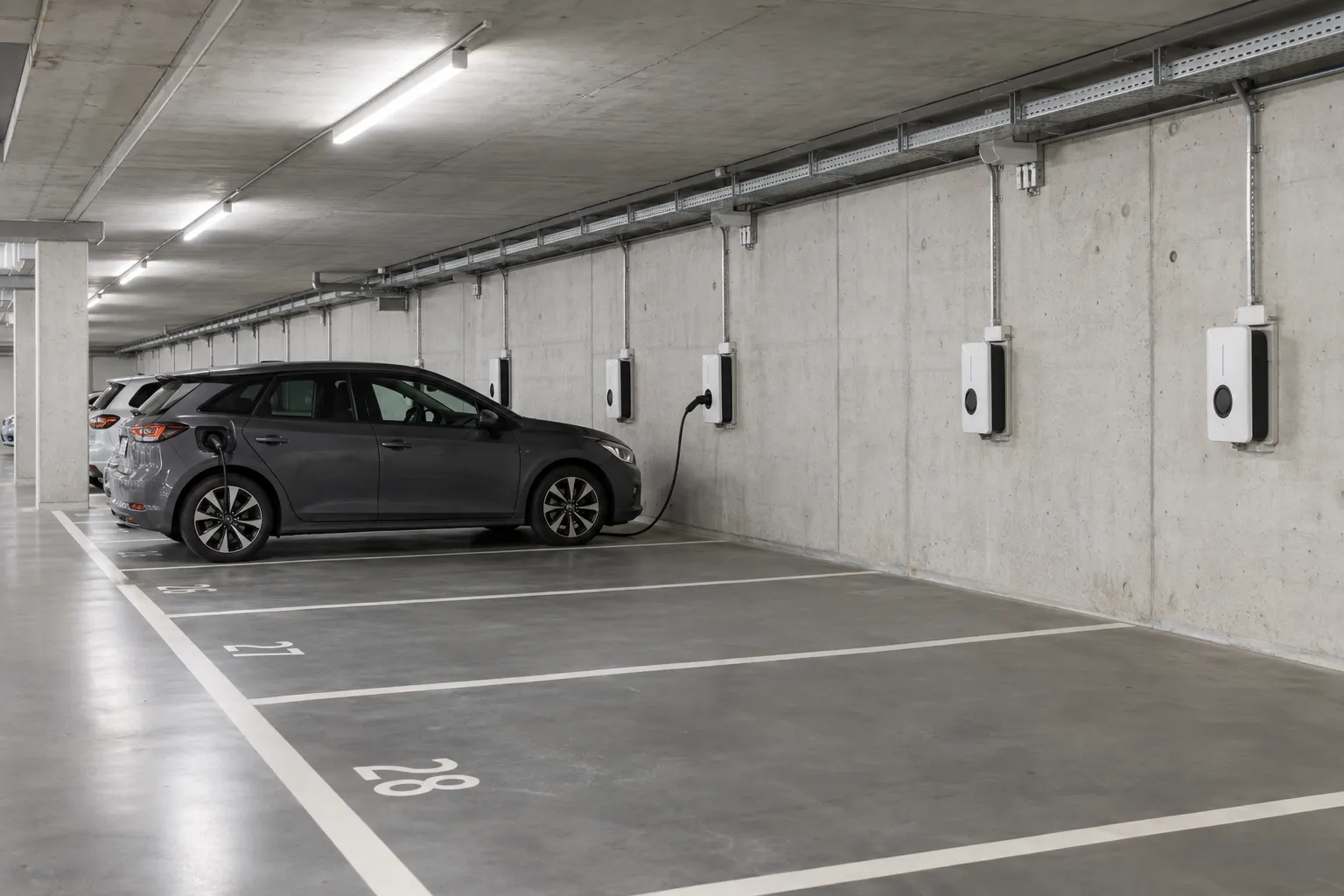
Several EV chargers on one house connection are a different task from a single wallbox. It is then about load management, billing per user and the owners’ decision. We plan this for property managers, condominium owners and tenants. More under EV charging infrastructure for underground car parks and apartment buildings.
If you want to share solar power in the building, a self-consumption community (ZEV) helps. The EV chargers then also charge with power from your own roof.
How the installation works
- Enquiry: Online in a minute or by phone. Tell us your car if you already know it.
- Site visit: We check the distribution board, supply line, parking space and cable route. Free of charge.
- Quote in 72 hours: binding, with unit, installation and possible subsidies.
- Registration with the grid operator: We submit the necessary documents. Depending on the grid operator, a permit is required, especially for higher power. We take care of that.
- Installation: Our own installers, with a fixed appointment. It usually takes half a day to a full day.
- Commissioning and introduction: We test the system, issue the safety certificate and show you the wallbox and the app.
Subsidies that we apply for on your behalf can be pre-financed on request.
EV chargers in your region
Our locations are in Zumikon ZH and Lachen SZ. We install EV chargers and wallboxes throughout German-speaking Switzerland, most often in the Cantons of Zurich, St. Gallen, Schwyz and Aargau. The requirements differ by grid operator: some require a permit for higher charging power, others already for lower power. We know the local rules and clarify them for you.
Enter your postcode in the appointment card. We will get in touch and arrange the free site visit.
The free site visit
One appointment at your home. Then you know everything.
A project manager from our team visits you and checks three things. No sales show, no obligation. Afterwards you receive a binding quote with yield, subsidies and payback.
 01
01Roof
Area, orientation, pitch, condition of the roof covering and shading.
 02
02Electrical system
Grid connection, distribution board and space for inverter and battery.
 03
03Your consumption
Electricity bill, car, heating, plans. From this we calculate yield and subsidies.
How your project runs
Request
Tell us briefly about your building and your goal. Online or by phone.
Site visit
We check your roof, electrical system and consumption at your home. Free of charge.
Quote in 72 hours
Binding and transparent, with yield, subsidies and payback.
Permit and subsidies
We handle the notification procedure, the grid operator and Pronovo.
Installation and commissioning
Our own installers, a fixed date, final inspection with you on the roof.
Step 1 takes one minute. We take care of the rest.
Google reviews
What our customers say about us.
5.0
Unabridged and unedited, straight from our Google profile. The reviews are in German.
All reviews on GoogleWir sind sehr zufrieden mit unserer Wallbox für unser E-Auto.
Cemil B. · October 2026
Wir können Solarinnovation.ch und insbesondere Jordan für seine kompetente Beratung und perfekte Umsetzung als zuverlässigen Partner für nachhaltige Energielösungen aus einer Hand von Herzen weiterempfehlen. Er hat uns mit seinem umfangreichen Fachwissen von der ersten Beratung bis und mit der Umsetzung kompetent begleitet. Er hat alle Fragen immer verständlich erklärt. Wir sind mit der Indach-Solaranlage, kombiniert mit einem Speicher sehr zufrieden.
Daniel · August 2026
Die SolarInnovation GmbH hat mich durch ihre sehr flexible und kompetente Beratung und Arbeitsausführung sehr überzeugt!
Frederic L. · September 2025
Eine sehr seriöses Firma. Danke Aulson, Danke Jorden.
Alex I. · August 2025
Top Service und super Beratung! Unsere Solaranlage am linken Zürichseeufer läuft perfekt, produziert mehr Strom als erwartet und sieht auch noch toll aus. Absolut empfehlenswert!
Marc W. · August 2025
Built near you.
29 projects, 718.1 kWp in total. From Zumikon and Lachen we work all over German-speaking Switzerland, most often in the cantons of Zurich, St. Gallen, Schwyz and Aargau.
Canton of Zurich
- Rüti41.1 kWp
- Zürich26.6 kWp
- Zürich6.8 kWp
- Zürich10.9 kWp
- Gossau ZH7.7 kWp
- Zollikerberg17.7 kWp
- Ebmatingen16.9 kWp
- Ebmatingen17 kWp
- Zürich7.5 kWp
- Maur6.9 kWp
- Herrliberg14.8 kWp
- Herrliberg12 kWp
- Meilen17.2 kWp
- Bachs10.2 kWp
Canton of St. Gallen
Canton of Schwyz
Canton of Aargau
- Staffelbach16 kWp
- Reinach AG20.7 kWp
- Berikon19.8 kWp
- Oberkulm20.7 kWp
Canton of Lucerne
Canton of Zug
Frequently asked questions
Before you get in touch.
Is the site visit really free?
Yes. The visit and the quote cost you nothing and commit you to nothing. You only decide once you hold the binding quote in your hands.
Do I need a three-phase power connection for a wallbox?
An 11 kW wallbox runs on a three-phase connection with 16 amps. Most houses have one. However, it often needs its own supply line and a protective device in the distribution board. We check during the site visit whether your installation is sufficient.
Can I connect the wallbox myself?
No. In Switzerland, only a licensed electrician may carry out the fixed connection. They also issue the safety certificates that the grid operator and the insurer require.
How long does it take to install an EV charger?
With a short cable route, usually half a day to a full day. If we have to run a cable through a wall, garden or garage, it takes longer. We tell you the duration beforehand in the quote.
Can I take the EV charger with me when I move?
Technically this is usually possible. However, the supply line and protective devices stay in the house. In a rented flat, we first clarify with the landlord or property management who pays for the installation and who owns it.
I rent my home. Can I have an EV charger installed?
There is no clear entitlement. Property management has to agree to the installation. Many do so if you bear the costs. We prepare a quote that you can show to property management.
Does the EV charger also work without a solar system?
Yes. You then charge with grid electricity, ideally at night at the cheaper tariff. If you add a solar system later, the wallbox can be integrated if it is suitable for that.
Which EV charger suits my car?
Almost all electric cars in Europe charge at home with a Type 2 plug. What matters more is how much power your car can accept. Many models charge at 11 kW, some at less, and only a few at more. We check this with your vehicle model.
Which regions do you cover?
All of German-speaking Switzerland. We build most often in the cantons of Zurich, St. Gallen, Schwyz and Aargau. Our locations are in Zumikon ZH and Lachen SZ.
From one company
Goes well with

The first step
We come to you. Free of charge.
We check your roof, electrical system and consumption. Afterwards you know what is possible on your roof, what it costs and which subsidies you receive. The binding quote follows within 72 hours.
- Free and with no obligation
- Quote within 72 hours
- Subsidies pre-financed on request
