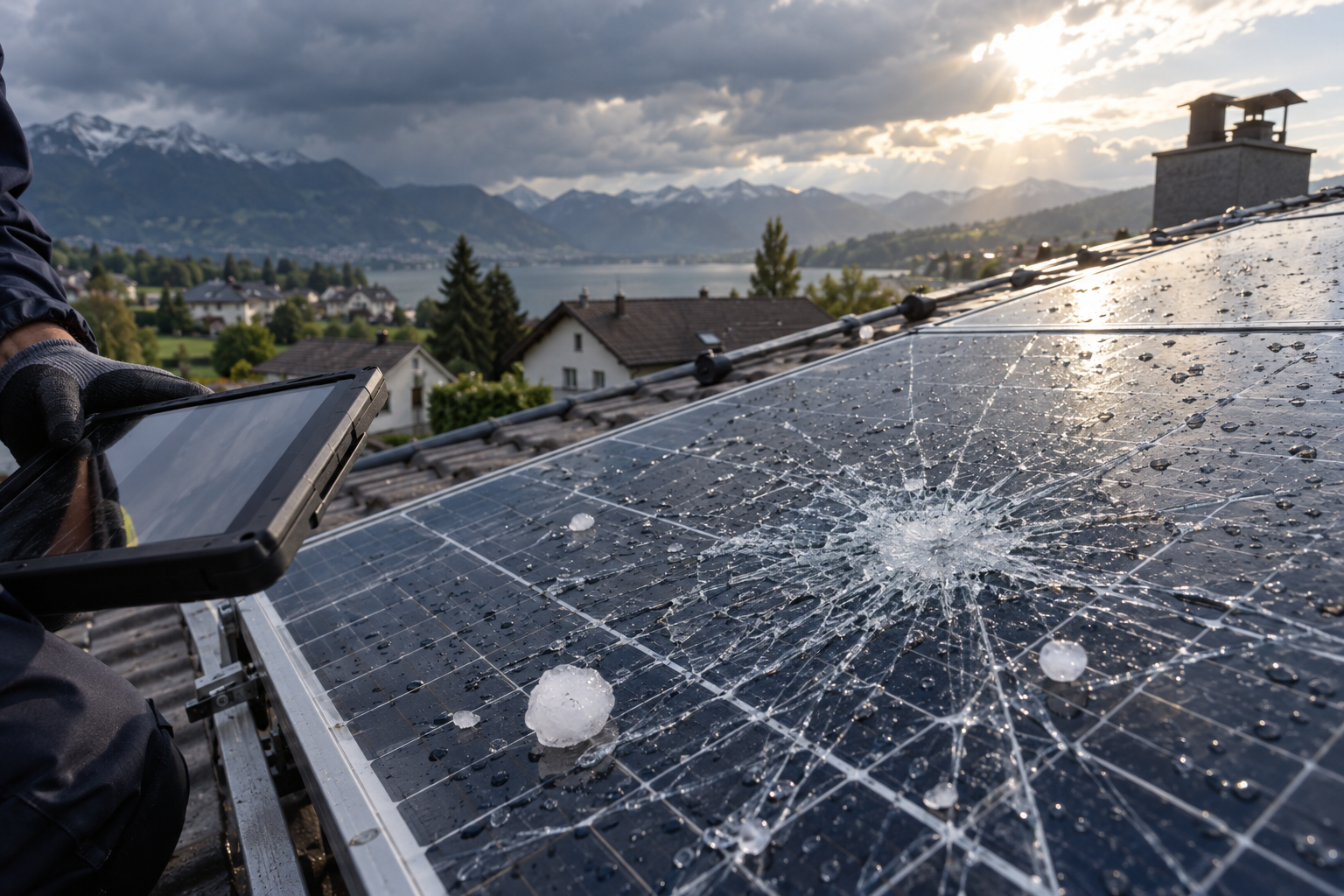
Help after hail across German-speaking Switzerland
Hail damage to your solar systemWe inspect and help.
After hail, we inspect the modules, cabling and inverter on site, document the damage for your insurer and replace faulty modules.
- Site visit: free and with no obligation
- Binding quote within 72 hours
- Subsidies pre-financed on request
Prefer to talk?044 980 08 80
Request a free site visit
Takes 1 minute. No obligation.
- Building
- Location
- Contact
Thank you. We have your request.
We will call you within one working day to arrange the appointment.
Add details Optional
Prefer to talk now? 044 980 08 80
- documented reference systems
- 29
- output of these systems
- 718.1kWp
- to a binding quote
- 72h
- is what the site visit costs
- 0CHF
- Member of
 smart-me
Partner 2025
Hail damage
What to do after hail damage
Hail can damage solar modules. Mostly they withstand the impact, but not always. If your system was hit: stay calm, keep your distance, report the damage, have the system checked. This page explains how to proceed.
What should I do first after hail?
- Do not climb onto the roof. Wet roofs are slippery, and damaged modules can be live. The risks are not visible.
- Observe from the ground. Look for broken glass, cracks, loose modules and hanging cables. Touch nothing.
- Switch the system off if you can safely reach the inverter or the switch. If in doubt, leave it and call us.
- Take photos of what you can see from the ground. More on this shortly.
- Inform your insurer. Report the damage to your cantonal building insurance.
- Call us: 044 980 08 80. We arrange an inspection on site.
How do we inspect the system?
Even if the modules look undamaged from the outside, cells may be cracked. For the inspection, we proceed systematically:
- Visual inspection of the modules for broken glass, frame damage and discolouration
- Check of the cabling and connectors
- Electrical measurement of the strings and check of the output values
- Check of the inverter and the mounting structure
- Findings with pictures: which modules are faulty, what can be replaced, what cannot
You receive the result in writing. It is the basis for your insurance file.
How do I document the damage for the insurer?
Good documentation makes claims handling easier. This is what belongs in it:
- Photos of the system and the visible damage, with the date
- Date and time of the hail event, if possible with the hailstone size, for example photos of hailstones next to a ruler
- System data: module type, number, year of construction and the invoice for the system
- Technical findings from the inspection
- Cost estimate for replacing modules and labour
We put together the findings, photos and quote as an insurance file for you. The claim itself and the decision on payment are up to your insurer.
How does the module replacement work?
If the insurer accepts the damage, or you want the replacement done directly, we replace the faulty modules. Our own installers do this, usually in one day. We:
- remove the damaged modules,
- fit suitable replacement modules,
- test the strings and the system electrically,
- put the system back into operation.
If the old model is no longer available, we look for a module that matches the system electrically and in size. In some cases it makes more sense to renew a whole string. We discuss this with you beforehand.
What do the inspection and the replacement cost?
That depends on the scope: how many modules are affected, how accessible the roof is and whether scaffolding or a lifting platform is needed. We do not give a fixed price without seeing the system. After the inspection you receive a binding quote within 72 hours, which you can pass directly to your insurer.
What applies to tenants, condominium ownership and businesses?
If the system belongs to an owners’ association or a business, the report usually goes through property management or the management board. We agree the findings and file with the responsible body. For larger systems at businesses or on apartment buildings, many modules are often involved. We then plan the replacement in stages, so that operations continue. You will find more on large systems under solar systems for business.
How hail-resistant are solar modules?
Solar modules are built for hail. In tests, they are bombarded with ice balls. Mostly they withstand normal hail. With large hailstones and wind from an unfavourable direction, that is not always enough.
In Switzerland there is a hail register with hail resistance classes (HW) for hail resistance. It is kept by the cantonal building insurers. The class says what hailstone size a material can withstand. For new systems, we look for modules with a good class, especially in hail-prone locations. How you assess the risk for your roof, we are glad to discuss on site.
What if a module or inverter is simply faulty?
Not every damage comes from hail. Modules, cabling or inverters can also fail without a storm. Signs of this are:
- a yield that is clearly below the previous year
- error messages in the app or on the inverter
- a module that looks conspicuously discoloured, hot or damaged
We inspect the system, find the cause and fix it. This applies to modules, inverters, cabling and mounting structure, including systems we did not build. We are also glad to check the system as part of servicing and cleaning.
After the repair: improving the system
Once the system is open, it is worth looking ahead. Perhaps you would like to add a battery storage unit or extend the system. This can often be combined with the repair. We advise you on this, without pressure.
Hail damage in your region
Our locations are in Zumikon ZH and Lachen SZ. We come anywhere in German-speaking Switzerland. In the appointment card, choose the date for the inspection on site and enter your postcode. For damage involving broken glass, it is best to call us directly: 044 980 08 80.
The free site visit
One appointment at your home. Then you know everything.
A project manager from our team visits you and checks three things. No sales show, no obligation. Afterwards you receive a binding quote with yield, subsidies and payback.
 01
01Roof
Area, orientation, pitch, condition of the roof covering and shading.
 02
02Electrical system
Grid connection, distribution board and space for inverter and battery.
 03
03Your consumption
Electricity bill, car, heating, plans. From this we calculate yield and subsidies.
How your project runs
Request
Tell us briefly about your building and your goal. Online or by phone.
Site visit
We check your roof, electrical system and consumption at your home. Free of charge.
Quote in 72 hours
Binding and transparent, with yield, subsidies and payback.
Permit and subsidies
We handle the notification procedure, the grid operator and Pronovo.
Installation and commissioning
Our own installers, a fixed date, final inspection with you on the roof.
Step 1 takes one minute. We take care of the rest.
Google reviews
What our customers say about us.
5.0
Unabridged and unedited, straight from our Google profile. The reviews are in German.
All reviews on GoogleWir sind sehr zufrieden mit unserer Wallbox für unser E-Auto.
Cemil B. · October 2026
Wir können Solarinnovation.ch und insbesondere Jordan für seine kompetente Beratung und perfekte Umsetzung als zuverlässigen Partner für nachhaltige Energielösungen aus einer Hand von Herzen weiterempfehlen. Er hat uns mit seinem umfangreichen Fachwissen von der ersten Beratung bis und mit der Umsetzung kompetent begleitet. Er hat alle Fragen immer verständlich erklärt. Wir sind mit der Indach-Solaranlage, kombiniert mit einem Speicher sehr zufrieden.
Daniel · August 2026
Die SolarInnovation GmbH hat mich durch ihre sehr flexible und kompetente Beratung und Arbeitsausführung sehr überzeugt!
Frederic L. · September 2025
Eine sehr seriöses Firma. Danke Aulson, Danke Jorden.
Alex I. · August 2025
Top Service und super Beratung! Unsere Solaranlage am linken Zürichseeufer läuft perfekt, produziert mehr Strom als erwartet und sieht auch noch toll aus. Absolut empfehlenswert!
Marc W. · August 2025
Built near you.
29 projects, 718.1 kWp in total. From Zumikon and Lachen we work all over German-speaking Switzerland, most often in the cantons of Zurich, St. Gallen, Schwyz and Aargau.
Canton of Zurich
- Rüti41.1 kWp
- Zürich26.6 kWp
- Zürich6.8 kWp
- Zürich10.9 kWp
- Gossau ZH7.7 kWp
- Zollikerberg17.7 kWp
- Ebmatingen16.9 kWp
- Ebmatingen17 kWp
- Zürich7.5 kWp
- Maur6.9 kWp
- Herrliberg14.8 kWp
- Herrliberg12 kWp
- Meilen17.2 kWp
- Bachs10.2 kWp
Canton of St. Gallen
Canton of Schwyz
Canton of Aargau
- Staffelbach16 kWp
- Reinach AG20.7 kWp
- Berikon19.8 kWp
- Oberkulm20.7 kWp
Canton of Lucerne
Canton of Zug
Frequently asked questions
Before you get in touch.
Is the site visit really free?
Yes. The visit and the quote cost you nothing and commit you to nothing. You only decide once you hold the binding quote in your hands.
Can I always see hail damage on the modules?
No. Broken glass or cracks are visible. Fine cell cracks inside cannot be seen with the naked eye. They can reduce output or later lead to hotspots. So an inspection is worthwhile even if the modules look intact from the outside.
May I leave the system running after the hail?
Not if there is broken glass or visibly damaged cables. Broken modules can carry voltage. Switch the system off at the inverter switch if you can reach it safely, and keep away from the modules. Then call us.
Does cantonal building insurance pay for hail damage to a solar system?
Often yes, depending on the policy and the canton. Fixed-mounted systems are often covered by the cantonal building insurance, sometimes extra cover is needed. Check your policy and report the damage promptly. We supply the technical documents.
How quickly must I report the damage?
As soon as possible. Most policies set a reporting deadline. It is in your contract terms. Report first and have repairs done afterwards, so that the insurer can assess the damage.
Can individual faulty modules be replaced?
Yes. We replace individual modules as long as suitable replacement modules are available. If the old models can no longer be supplied, we check which module fits electrically and mechanically, or whether a string has to be renewed.
Can you also repair systems you did not build?
Yes. We also inspect systems built by others. During the inspection we see what is faulty and what can be repaired.
Which regions do you cover?
All of German-speaking Switzerland. We build most often in the cantons of Zurich, St. Gallen, Schwyz and Aargau. Our locations are in Zumikon ZH and Lachen SZ.
From one company
Goes well with
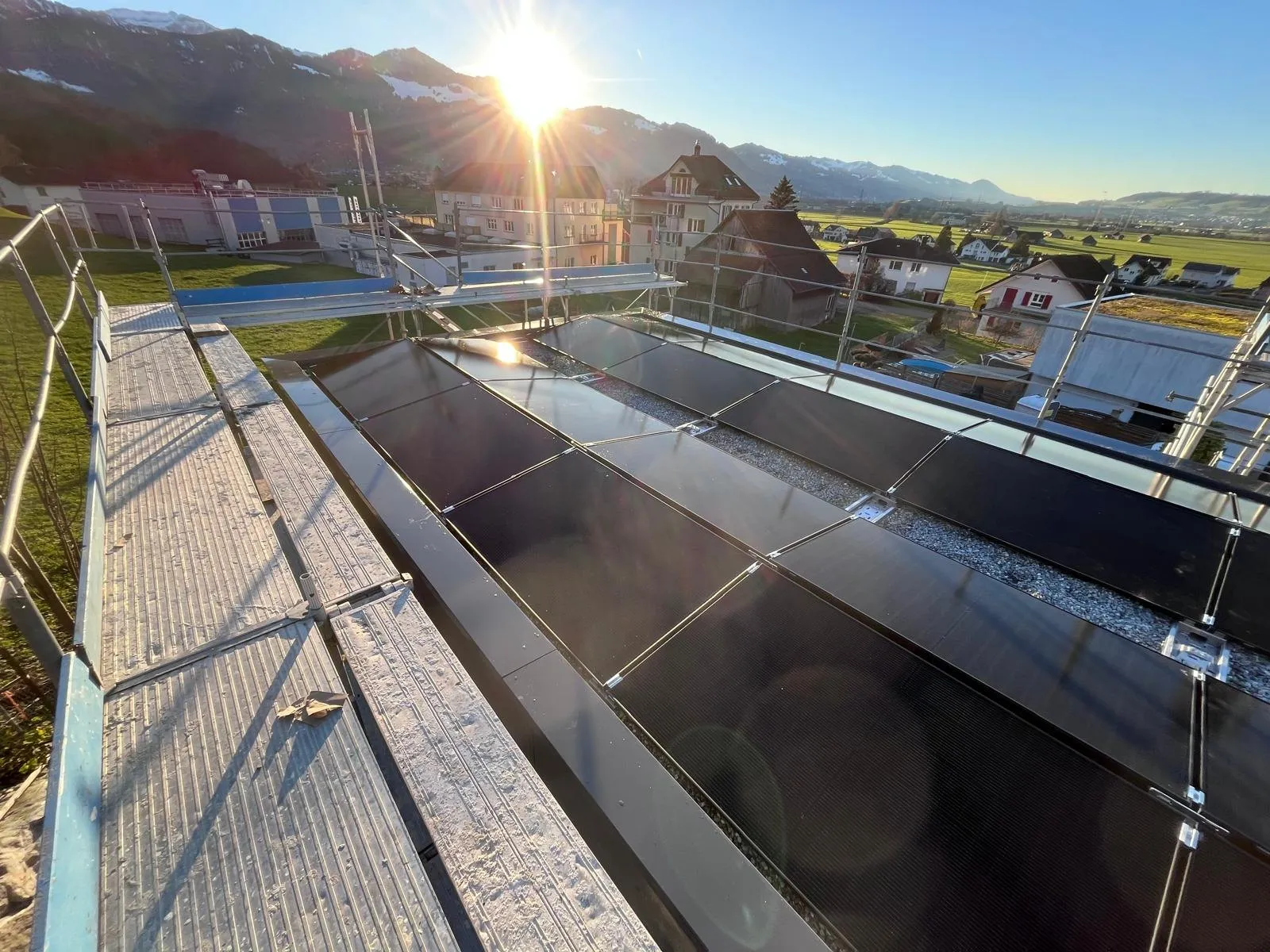

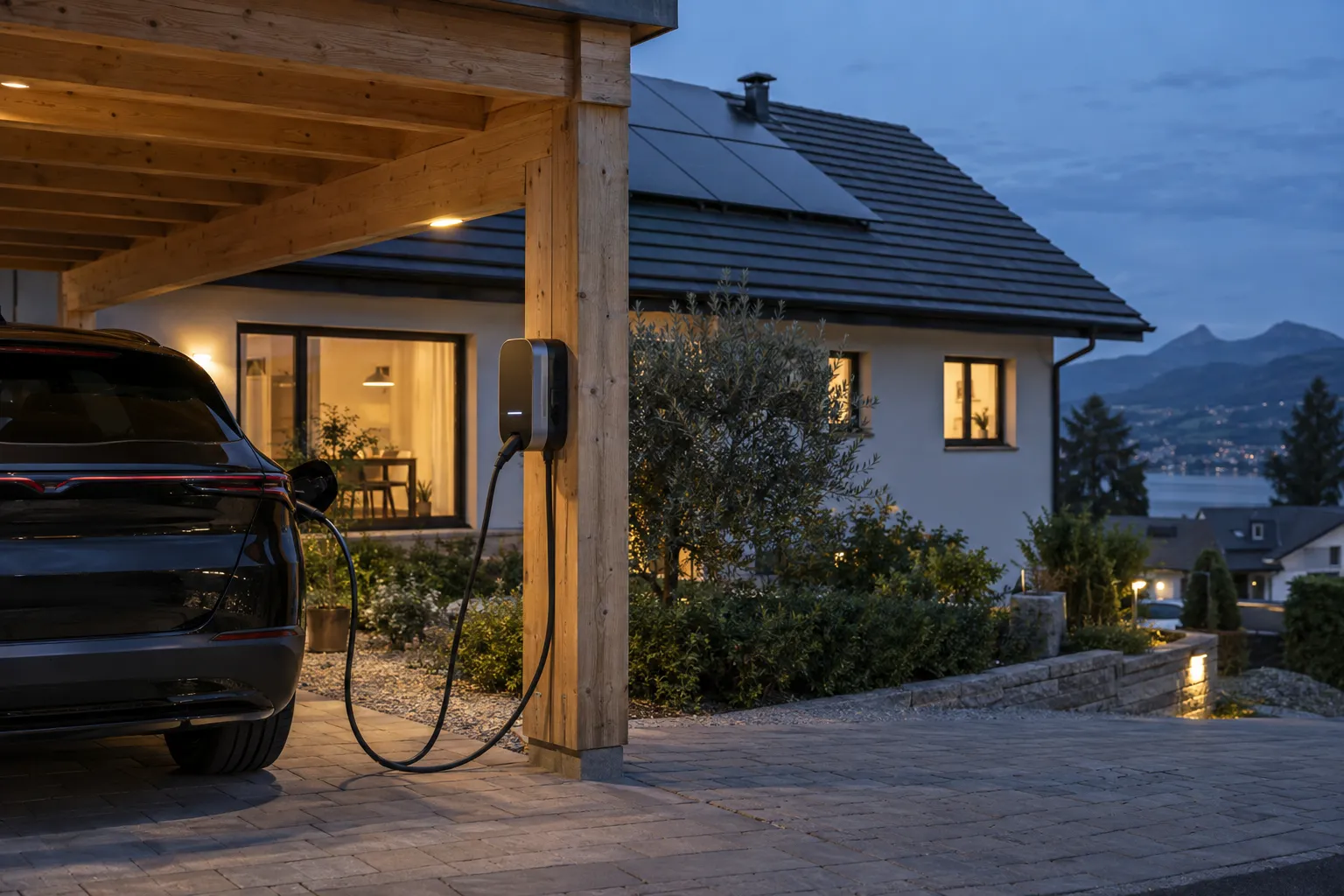
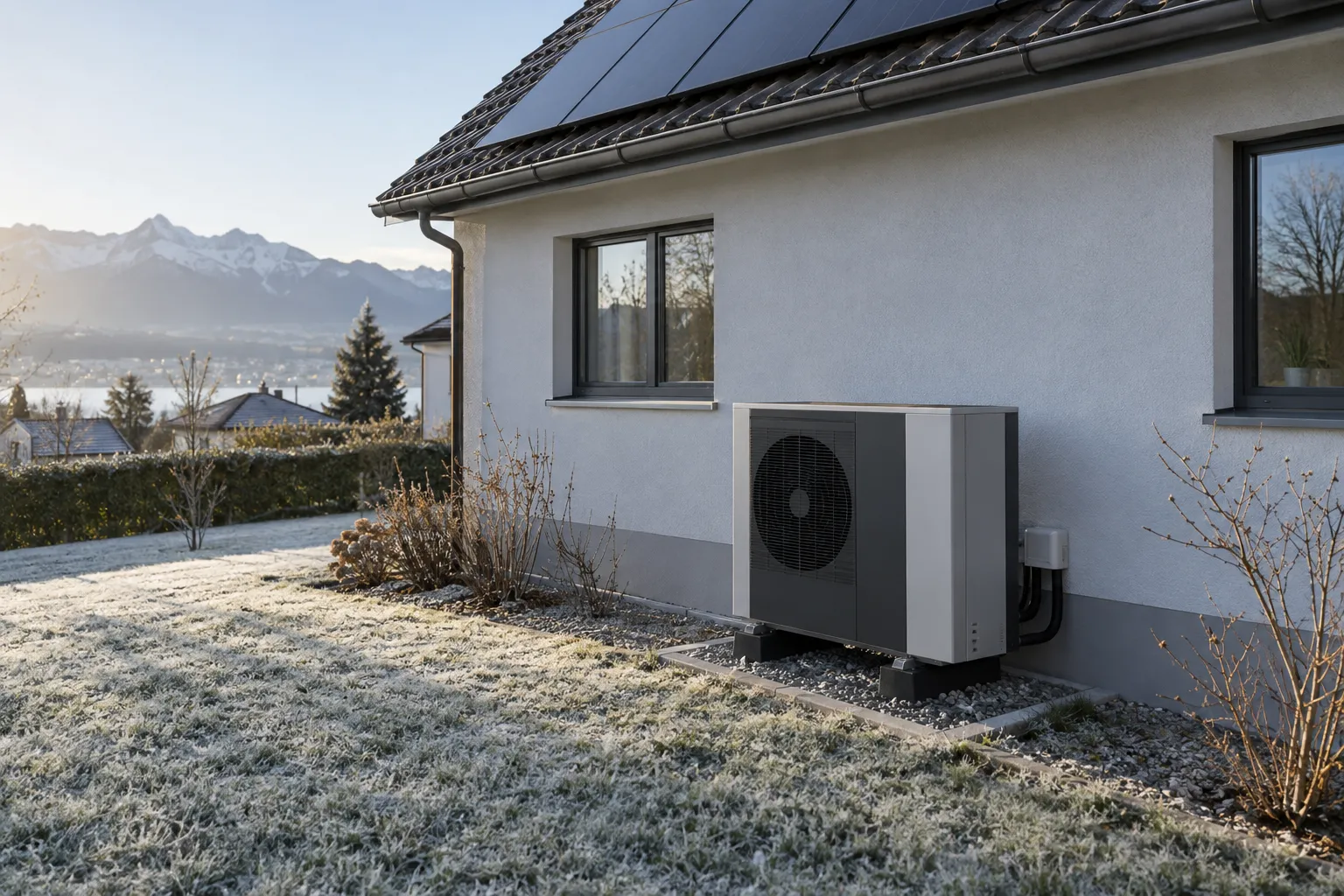
The first step
We come to you. Free of charge.
We check your roof, electrical system and consumption. Afterwards you know what is possible on your roof, what it costs and which subsidies you receive. The binding quote follows within 72 hours.
- Free and with no obligation
- Quote within 72 hours
- Subsidies pre-financed on request
