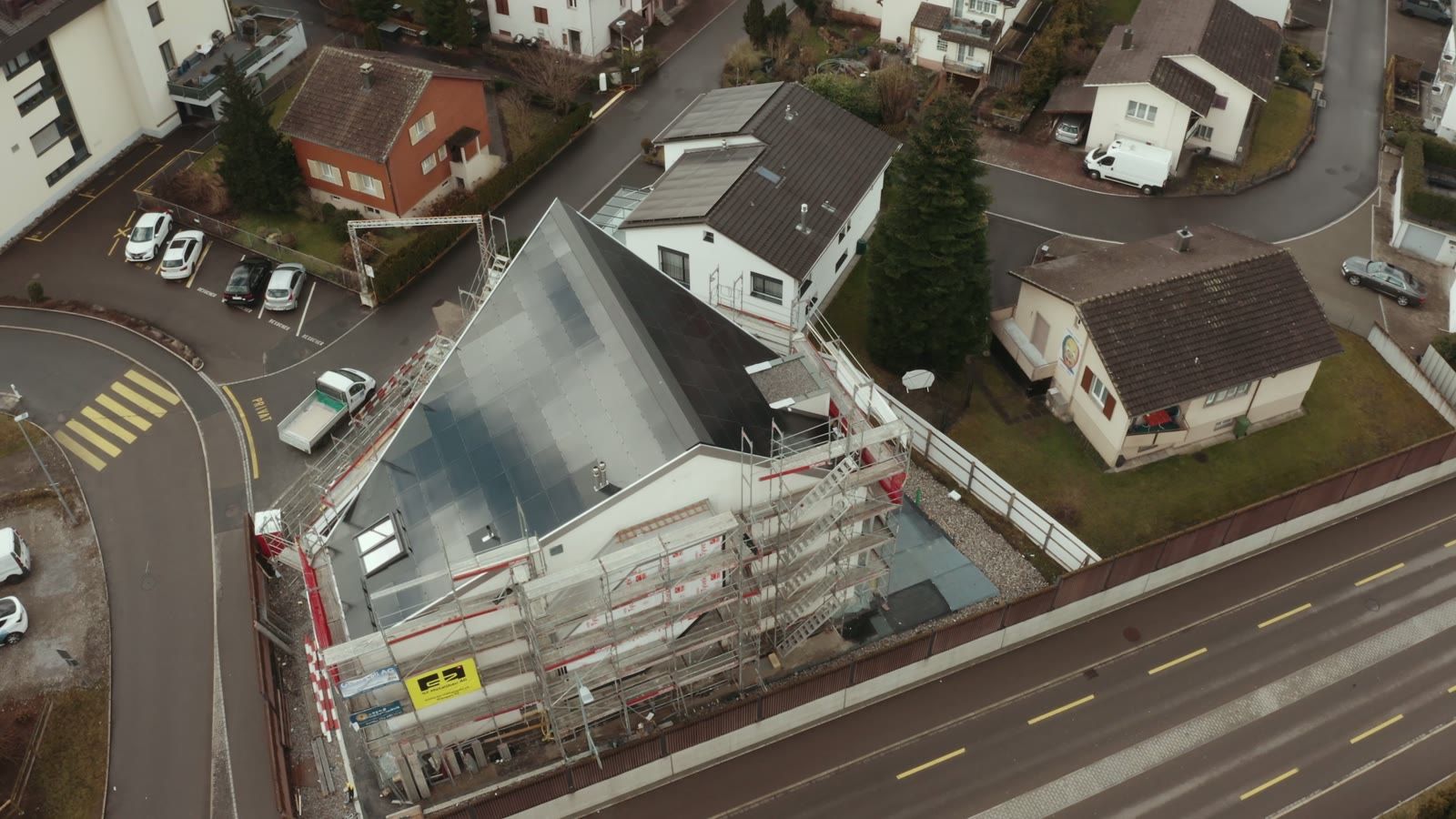
In-roof photovoltaics for German-speaking Switzerland
Solar roof and in-roof solar systemThe roof that makes power.
The modules replace the tiles and form the roof skin themselves. We check your roof on site and calculate the costs with your figures. You receive the binding quote within 72 hours.
- Site visit: free and with no obligation
- Binding quote within 72 hours
- Subsidies pre-financed on request
Prefer to talk?044 980 08 80
Request a free site visit
Takes 1 minute. No obligation.
- Building
- Location
- Contact
Thank you. We have your request.
We will call you within one working day to arrange the appointment.
Add details Optional
Prefer to talk now? 044 980 08 80
- documented reference systems
- 29
- output of these systems
- 718.1kWp
- to a binding quote
- 72h
- is what the site visit costs
- 0CHF
- Member of
 smart-me
Partner 2025
In-roof solar
What an in-roof solar system is and when it pays off
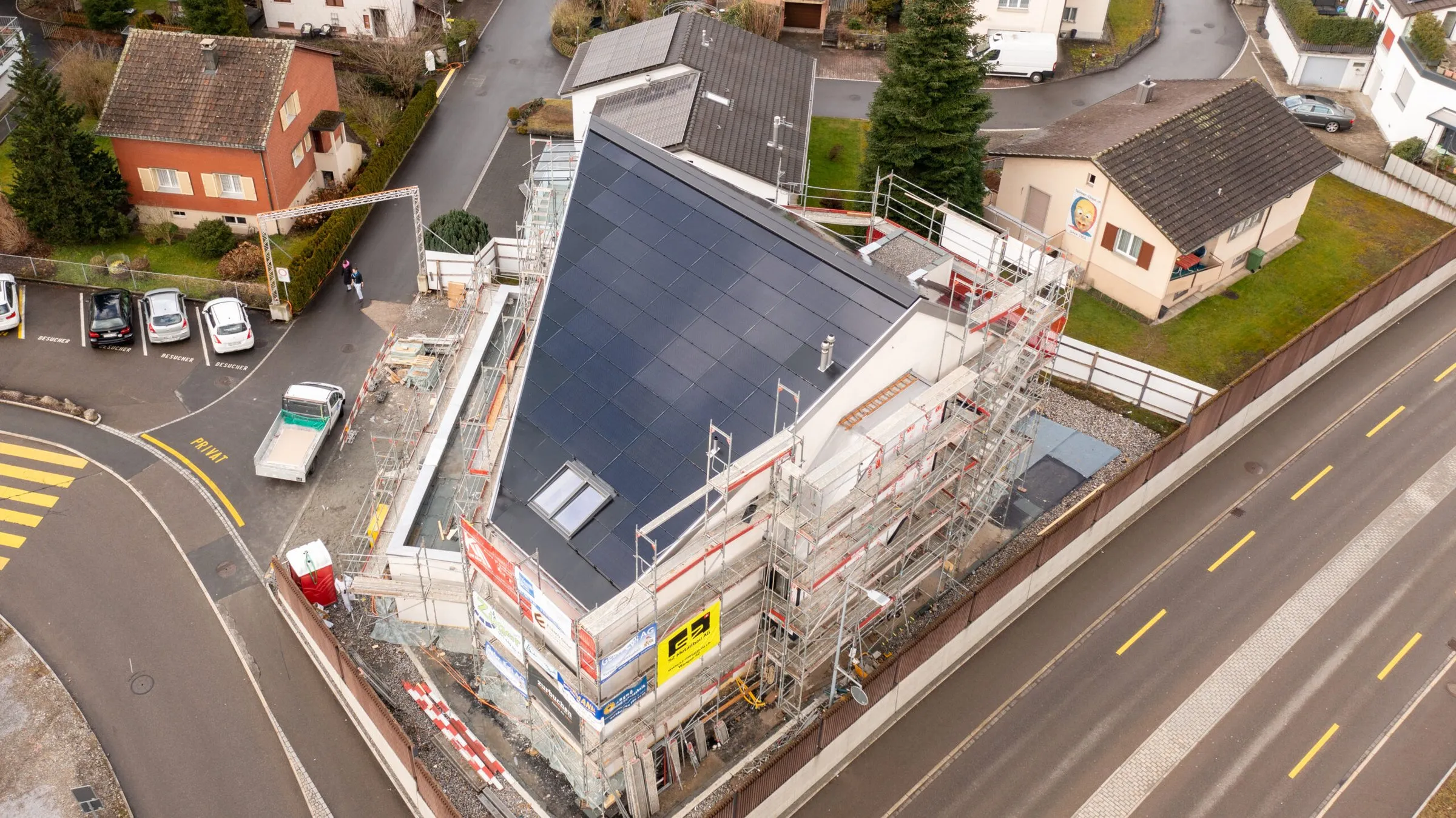
A solar roof replaces the tiles with solar modules. The modules are not placed on top of the roof, but set into the roof surface. They protect the house from rain and generate power at the same time. Specialists speak of an in-roof solar system or in-roof photovoltaics.
This makes the most sense for new builds and roof renovations. You need a new roof skin anyway. The modules take over this task, and you save the tiles.
What is the difference between in-roof and on-roof?
With an on-roof system, the modules lie on a mounting structure above the existing tiles. This is the most common solution. It is quick to install and suits almost any pitched roof in good condition.
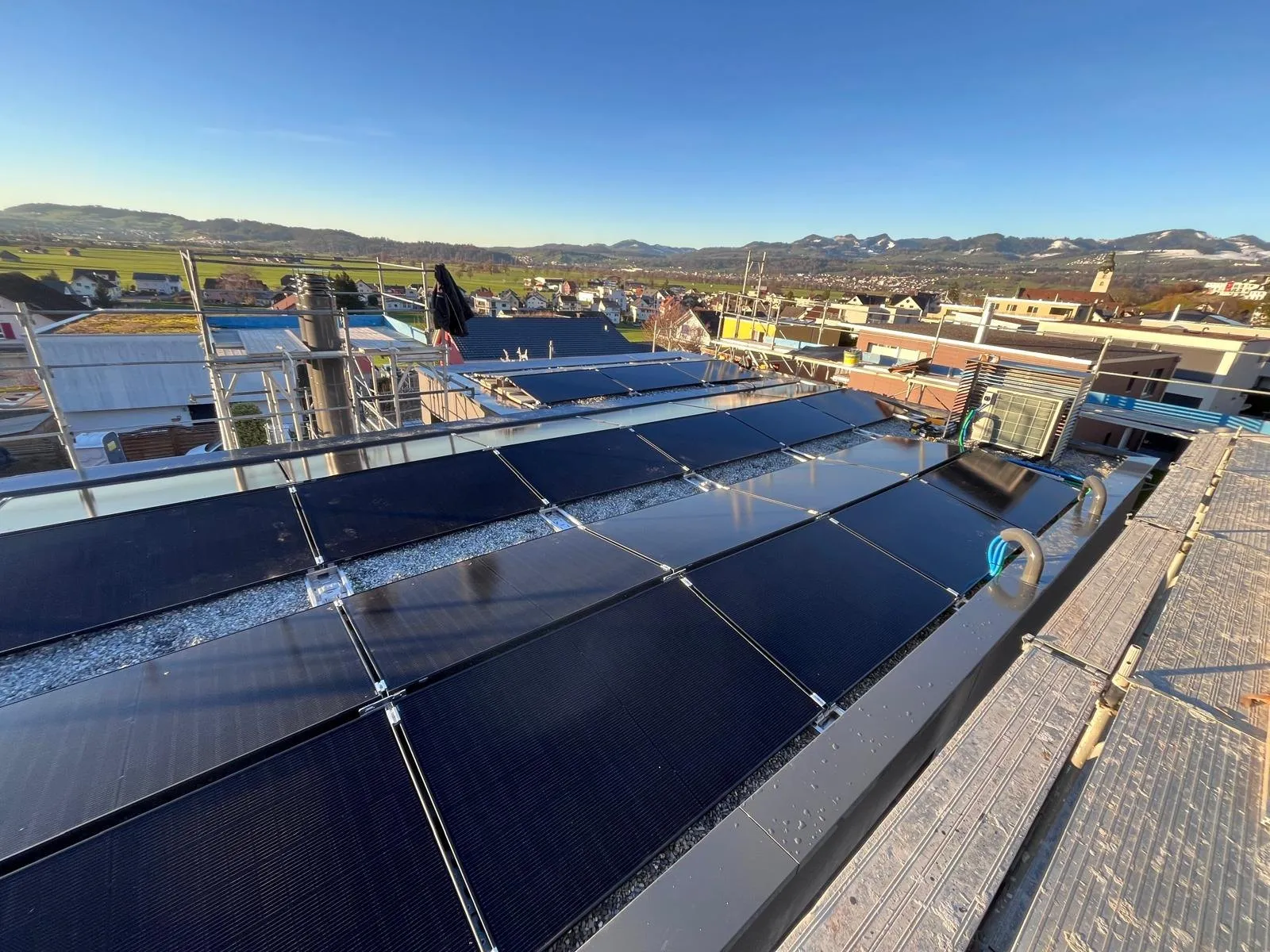
With an in-roof system, the modules lie in the plane of the roof surface. Together with flashings and seals, they form the water-bearing layer.
| On-roof | In-roof | |
|---|---|---|
| Tiles | stay in place | omitted under the modules |
| Look | modules stand slightly above the roof | flush, calm surface |
| Suitability | existing roof in good condition | new build, roof renovation |
| Cost per kWp | lower | higher, but tile costs are saved |
| Ventilation behind modules | good | poorer, slightly lower yield |
| Historic core zone and protected townscape | sometimes difficult | often more likely to be approved |
Both systems produce power from the same sunlight. The choice depends on your roof, your budget and the look.
Is a solar roof worthwhile for a new build?
For a new build, the timing is good. The roof is not yet covered, and we can coordinate modules, roof structure and electrical planning from the start. This saves interfaces and scaffolding costs.
It is important that the architect, roofer, sheet-metal worker and we sit down together early. Then the roof structure, connections and schedule fit. Later changes are more complex with in-roof systems than with on-roof.
And for a roof renovation?
If your roof has to be re-covered anyway, the comparison is worthwhile. With an in-roof system, you only pay for new tiles where there are no modules. You can renew the insulation and underlay membrane at the same time.
If your roof is still good, it is better not to renovate just for the solar system. Then on-roof is the cheaper solution. We tell you that during the site visit as it is.
Solar roof in a historic core zone and protected townscape
In historic core zones and for protected buildings, stricter rules apply. On-roof systems with a visible mounting structure are more likely to meet resistance there. A flush-set, uniformly black in-roof system blends in better. Sometimes solar tiles are also an option, which look closer to a tiled roof.
Approval is decided case by case. The commune and, where applicable, the heritage protection authority decide. We clarify what is possible for your address, prepare the documents and submit them.
Which roofs are suitable?
In-roof systems are made for pitched roofs. What matters are the pitch, the roof shape and the construction:
- Pitch: Every system has an approved minimum pitch. Very flat roofs are not suitable. For flat roofs, a system on stands is the better solution.
- Roof shape: Simple gable and monopitch roofs without many openings are ideal. Dormers, roof windows and chimneys are possible, but need more connection work.
- Orientation: South, east and west produce power. Where the modules go is determined by the roof surface. Unlike with on-roof, modules cannot be moved freely.
- Substructure: Rafters, battens and insulation have to suit the system. We check this with the roofer.
You continue to cover unused roof areas with tiles. So that the surface looks uniform, modules and tiles are matched in colour.
How watertight is an in-roof system?
This is the most common question, and it is a fair one. An in-roof system is watertight if three things are right:
- The system is tested and approved for the roof pitch. Very flat roofs are not suitable.
- The connections are properly executed: eaves, ridge, side edges, chimneys and roof windows need suitable flashings and seals.
- An underlay membrane lies underneath, which drains water if anything ever gets through.
This is craftsmanship that is not done on the side. We plan the system with the roofer and the sheet-metal worker so that system and roof form a whole.
And fire protection and ventilation?
Two points that are often asked about with in-roof systems:
- Ventilation: Modules become slightly less efficient in heat. On-roof modules have air underneath, in-roof modules less. Good systems therefore provide an air channel under the modules. The yield loss then stays small.
- Fire protection: The roof skin must meet the requirements of the cantonal fire protection regulations. We only choose systems that are tested for this, and clarify open points in advance with you and the commune.
What does an in-roof solar system cost?
The price depends on size, roof shape, system and effort. As a rule of thumb: per kWp, in-roof costs more than on-roof. On the other hand, the tiles and part of the roofer’s effort are omitted. If you are renovating or building new anyway, it is better to compare the additional cost compared with a tiled roof than the full price of the system.
A flat figure would not be serious, because prices vary widely depending on system and roof. You receive your exact price after the site visit in the binding quote within 72 hours. On request, we calculate on-roof and in-roof side by side, with yield, subsidies and payback.
How much power does a solar roof produce?
The principle is the same as for any system: orientation, tilt and location determine the yield. A south-facing roof produces the most, east and west a little less, but the power is spread across the day. Compared with an on-roof system, the yield of in-roof is usually slightly lower, see above. In the quote, we show you the yield forecast for your roof so that you can compare.
The more of the power you use yourself, the better the solar roof pays off. With a heat pump or an EV charger, self-consumption rises.
Subsidies
The federal Pronovo one-off payment (Einmalvergütung, EIV) is available for on-roof and in-roof systems. How much it is in your case, you see in the quote. Many cantons and communes pay additional amounts. On request, we pre-finance the subsidy.
How your project works
- Enquiry: Online in a minute or by phone.
- Site visit: We check the roof, roof structure, electrical installation and consumption. Free of charge.
- Quote in 72 hours: binding, on request with on-roof and in-roof compared.
- Permit and grid operator: We clarify the notification or building application and register the system.
- Installation: Our own installers, coordinated with the roofer and sheet-metal worker.
- Commissioning and handover: We show you the system and the app.
Planning through to commissioning comes from one provider. You can find more about the system as a whole under solar system and photovoltaics. How the modules themselves are built is described under PV modules. With battery storage and an EV charger, you use more of your own rooftop power.
Solar roofs in your region
Our locations are in Zumikon ZH and Lachen SZ. We build in-roof systems throughout German-speaking Switzerland. Enter your postcode in the appointment card, and we will arrange the free site visit.
The free site visit
One appointment at your home. Then you know everything.
A project manager from our team visits you and checks three things. No sales show, no obligation. Afterwards you receive a binding quote with yield, subsidies and payback.
 01
01Roof
Area, orientation, pitch, condition of the roof covering and shading.
 02
02Electrical system
Grid connection, distribution board and space for inverter and battery.
 03
03Your consumption
Electricity bill, car, heating, plans. From this we calculate yield and subsidies.
How your project runs
Request
Tell us briefly about your building and your goal. Online or by phone.
Site visit
We check your roof, electrical system and consumption at your home. Free of charge.
Quote in 72 hours
Binding and transparent, with yield, subsidies and payback.
Permit and subsidies
We handle the notification procedure, the grid operator and Pronovo.
Installation and commissioning
Our own installers, a fixed date, final inspection with you on the roof.
Step 1 takes one minute. We take care of the rest.
Google reviews
What our customers say about us.
5.0
Unabridged and unedited, straight from our Google profile. The reviews are in German.
All reviews on GoogleWir sind sehr zufrieden mit unserer Wallbox für unser E-Auto.
Cemil B. · October 2026
Wir können Solarinnovation.ch und insbesondere Jordan für seine kompetente Beratung und perfekte Umsetzung als zuverlässigen Partner für nachhaltige Energielösungen aus einer Hand von Herzen weiterempfehlen. Er hat uns mit seinem umfangreichen Fachwissen von der ersten Beratung bis und mit der Umsetzung kompetent begleitet. Er hat alle Fragen immer verständlich erklärt. Wir sind mit der Indach-Solaranlage, kombiniert mit einem Speicher sehr zufrieden.
Daniel · August 2026
Die SolarInnovation GmbH hat mich durch ihre sehr flexible und kompetente Beratung und Arbeitsausführung sehr überzeugt!
Frederic L. · September 2025
Eine sehr seriöses Firma. Danke Aulson, Danke Jorden.
Alex I. · August 2025
Top Service und super Beratung! Unsere Solaranlage am linken Zürichseeufer läuft perfekt, produziert mehr Strom als erwartet und sieht auch noch toll aus. Absolut empfehlenswert!
Marc W. · August 2025
Built near you.
29 projects, 718.1 kWp in total. From Zumikon and Lachen we work all over German-speaking Switzerland, most often in the cantons of Zurich, St. Gallen, Schwyz and Aargau.
Canton of Zurich
- Rüti41.1 kWp
- Zürich26.6 kWp
- Zürich6.8 kWp
- Zürich10.9 kWp
- Gossau ZH7.7 kWp
- Zollikerberg17.7 kWp
- Ebmatingen16.9 kWp
- Ebmatingen17 kWp
- Zürich7.5 kWp
- Maur6.9 kWp
- Herrliberg14.8 kWp
- Herrliberg12 kWp
- Meilen17.2 kWp
- Bachs10.2 kWp
Canton of St. Gallen
Canton of Schwyz
Canton of Aargau
- Staffelbach16 kWp
- Reinach AG20.7 kWp
- Berikon19.8 kWp
- Oberkulm20.7 kWp
Canton of Lucerne
Canton of Zug
Frequently asked questions
Before you get in touch.
Is the site visit really free?
Yes. The visit and the quote cost you nothing and commit you to nothing. You only decide once you hold the binding quote in your hands.
Is an in-roof system watertight?
Yes, if it is properly planned and installed. Together with flashings and seals, the modules form the water-bearing layer. Underneath, an underlay membrane remains as a second safeguard. Connections at the chimney, ridge and eaves are the critical points. We work with particular care there.
Can I convert my existing roof to in-roof?
Yes, but it only makes sense as part of a roof renovation. The tiles have to come off anyway then. If your roof is still in good condition, an on-roof system is usually the more economical solution. We tell you honestly during the site visit what is worthwhile.
Will an in-roof system be approved in a historic core zone?
Often more readily than an on-roof system, because it looks calmer. For protected buildings and in historic core zones, a permit is required, and the commune decides case by case. We clarify the situation for your address and submit the documents.
How much more expensive is in-roof than on-roof?
Per kWp, in-roof is usually more expensive, because the systems are more complex. On the other hand, the tiles and part of the roofer's work are no longer needed. For a renovation that is planned anyway, the difference is therefore often much smaller. We calculate the comparison for you in the quote.
Does an in-roof system produce less?
As a rule, a little less. The modules lie directly on the roof and have less ventilation behind them. They therefore get warmer and produce slightly less power. With good planning, the difference is small.
What are solar tiles?
Solar tiles are small solar elements in the shape of a roof tile. They look more like a classic tile, but usually cost significantly more per watt than large-format in-roof modules. They are mainly considered for protected buildings. We clarify on site whether they suit your building.
How long does the roof conversion with an in-roof system take?
That depends on roof shape, size and weather. The system is planned together with the roofer and the sheet-metal worker. We agree the process and schedule with you in advance.
Which regions do you cover?
All of German-speaking Switzerland. We build most often in the cantons of Zurich, St. Gallen, Schwyz and Aargau. Our locations are in Zumikon ZH and Lachen SZ.
From one company
Goes well with

The first step
We come to you. Free of charge.
We check your roof, electrical system and consumption. Afterwards you know what is possible on your roof, what it costs and which subsidies you receive. The binding quote follows within 72 hours.
- Free and with no obligation
- Quote within 72 hours
- Subsidies pre-financed on request
