Guide to heat pumps
Air-to-water or ground-source: which heat pump fits?Compared for your house.
The ground-source heat pump is more efficient and quieter, the air-to-water heat pump cheaper and easier to permit. Here you see what decides it for which house.
- Site visit: free and with no obligation
- Binding quote within 72 hours
- Subsidies pre-financed on request
Prefer to talk?044 980 08 80
Request a free site visit
Takes 1 minute. No obligation.
- Building
- Location
- Contact
Thank you. We have your request.
We will call you within one working day to arrange the appointment.
Add details Optional
Prefer to talk now? 044 980 08 80
Guide · Updated October 2026
Air-to-water and ground-source compared
The air-to-water heat pump is the most common choice in Switzerland because it is cheaper and easier to permit. The ground-source heat pump is more efficient in winter, quieter and costs more. Which one fits better is decided by plot, heating system, heat demand and budget. Here is the comparison in seven points.
The two systems in brief
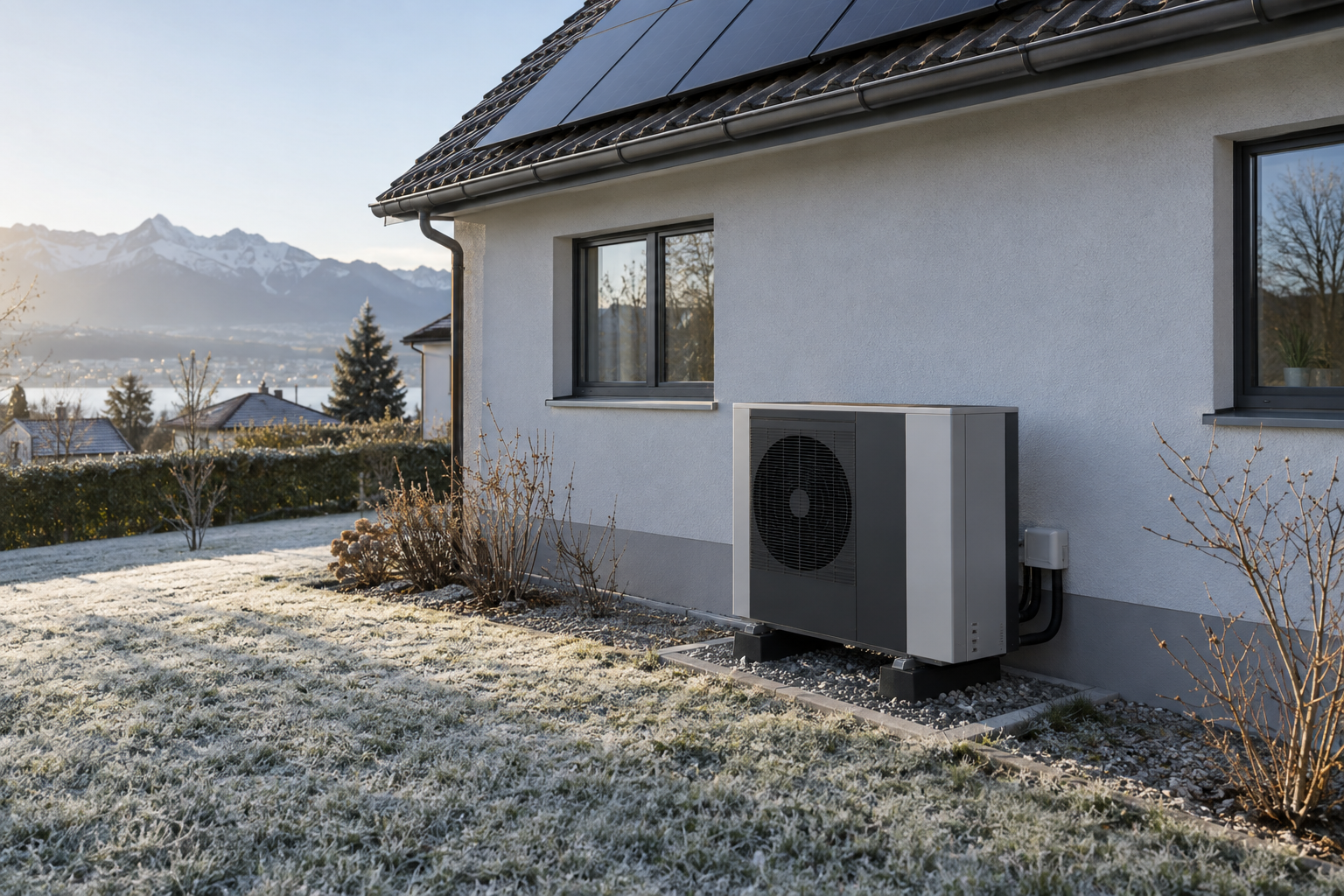
The air-to-water heat pump draws heat from the outside air. It needs no drilling, but it needs a place for the unit or the evaporator.
The ground-source heat pump takes heat from the ground. A closed pipe loop reaches into the soil. There the temperature stays almost constant all year, even when it freezes outside.
Comparison at a glance
| Air-to-water | Ground-source | |
|---|---|---|
| Total cost in a single-family home (before subsidies) | about CHF 30,000 to 50,000 | about CHF 45,000 to 70,000 |
| Seasonal performance factor in operation | about 3 to 3.5 | about 4 to 5 |
| Efficiency in winter | falls with the cold | consistently high |
| Outdoor unit and noise | yes, location and sound matter | none |
| Permit | often notification procedure, differs by canton | always required, not possible everywhere |
| Space needed | standing area for the unit | access for the drilling rig |
| Installation | usually a few days | drilling plus installation, permit beforehand |
The amounts are ranges, not prices. Your quote is binding.
Cost: where the difference comes from
The extra cost of the ground-source system comes almost entirely from drilling. Depending on depth and ground, it often costs CHF 10,000 to 25,000. Hard rock is drilled more slowly than loose ground, and narrow access makes the work more expensive. With the air-to-water heat pump, costs arise instead for the foundation, pipes and, where needed, sound insulation.
Whichever system you choose, replacing your heating also brings removal of the boiler and oil tank, electrical work, a hot water tank and possibly some radiators. What is included is explained in the guide Heat pump cost.
Efficiency and running costs
The seasonal performance factor (SPF, JAZ) tells you how much heat the unit delivers per kWh of electricity. With air-to-water it is usually 3 to 3.5 in operation, with ground-source 4 to 5. Electricity demand is the heat demand divided by the SPF.
Worked example (assumptions, not a quote): A house needs 20,000 kWh of heat per year.
- Air-to-water with SPF 3.5: 20,000 / 3.5 = about 5,700 kWh of electricity.
- Ground-source with SPF 4.5: 20,000 / 4.5 = about 4,400 kWh of electricity.
- Difference: about 1,300 kWh per year.
- At 27.7 ct. per kWh excluding VAT (household median 2026, ElCom, the Federal Electricity Commission) that is about CHF 360 per year.
In this example the ground-source system saves about CHF 360 of electricity per year. The extra cost of several CHF 10,000 is therefore earned back through electricity costs alone only over a very long time, if at all. The calculation tips in favour of the ground-source system when heat demand is high, for example in a large older house or an apartment building, or when the higher subsidy narrows the gap.
Permits and water protection
Boreholes need a permit. Drilling reaches into the ground and can endanger groundwater. In groundwater protection zones, boreholes are usually prohibited or subject to conditions, and the cantons keep maps that show this. In the Canton of Zurich, the heat use atlas (Wärmenutzungsatlas) shows the permitted areas, and the application goes through the commune to the AWEL (cantonal office for waste, water, energy and air) (source: zh.ch, ground-source probes). Depending on the canton, the permit takes weeks to months.
For air-to-water units, a notification to the commune is often enough. In the Canton of Zurich this applies to units inside the building and to outdoor units up to 2 cubic metres. In historic core zones and in areas with protected townscape or heritage protection, a permit is required (source: zh.ch, notification procedure). What applies in your canton is on our canton pages, for example for Zurich or Schwyz.
Noise and space
With the air-to-water heat pump, fan and compressor produce sound. At the neighbour’s boundary, the limits of the Noise Abatement Ordinance apply. We choose a quiet model and a location away from bedroom windows, and we prepare the noise assessment if the commune requires it. On narrow plots this can cause difficulties.
The ground-source heat pump has no outdoor unit, and the unit stands in the boiler room. The building site needs room, though: the drilling rig needs access and a standing area, and the ground cannot be used for a few days. A borehole is usually drilled in one to two days.
Subsidies
Both systems are subsidised, as a rule through the cantonal buildings programme (Gebäudeprogramm), and in many cantons the application must be submitted before building starts. In some cantons the ground-source system receives more. In the Canton of Zurich in 2026 it is CHF 6,800 up to 15 kW of thermal output for ground-source and CHF 2,900 for air-to-water (source: 2026 energy funding programme, Canton of Zurich). Other cantons do it differently. You find all the basics in the guide Heat pump subsidies.
Which system when?
Air-to-water usually fits when:
- You want a lower investment.
- There is a place for the unit with enough distance to the neighbour.
- The permit for drilling is uncertain or ruled out.
- The flow temperature is not too high.
Ground-source is more worthwhile when:
- Heat demand is high, for example in a large house or apartment building.
- The older house needs a higher flow temperature.
- There is no space outside for a unit or noise is an issue.
- You plan for the long term: the borehole lasts many decades, and the heat pump can be replaced later without drilling again.
For many houses, air-to-water is the more economical solution. We tell you this openly, even if the ground-source system would mean the larger order.
The flow temperature has a say
Both systems work better when the flow temperature of the heating is low. This is the temperature at which the heating water flows into the radiators. Underfloor heating manages with about 30 to 35 degrees, older radiators often need more. With the air-to-water heat pump, a high flow temperature has a stronger effect on cold days, because the air then gives little heat and the unit needs more electricity. The ground-source system is less sensitive, because the source stays equally warm.
During the site visit we measure which flow temperature your radiators need at which outside temperature. It can often be lowered with a few larger radiators. Then the air-to-water heat pump is a good solution in an older house too. If your house permanently needs high temperatures, that points more towards the ground-source system.
Combination with a solar system
Both systems can be run with a solar system. The ground-source system needs less electricity in winter, which the roof does not supply anyway. The air-to-water heat pump needs more, but the system is cheaper. How much heating electricity your roof covers is shown in the guide Heat pump with solar system.
We calculate it for your house
Which system makes sense for you, we do not decide at a desk. We come for a free site visit, check heating, radiators, plot and electrical installation, clarify water protection in advance for ground-source systems and calculate both options. You receive a binding quote within 72 hours with subsidies and running costs, planned from start to commissioning from a single source.
The free site visit
One appointment at your home. Then you know everything.
A project manager from our team visits you and checks three things. No sales show, no obligation. Afterwards you receive a binding quote with yield, subsidies and payback.
 01
01Roof
Area, orientation, pitch, condition of the roof covering and shading.
 02
02Electrical system
Grid connection, distribution board and space for inverter and battery.
 03
03Your consumption
Electricity bill, car, heating, plans. From this we calculate yield and subsidies.
How your project runs
Request
Tell us briefly about your building and your goal. Online or by phone.
Site visit
We check your roof, electrical system and consumption at your home. Free of charge.
Quote in 72 hours
Binding and transparent, with yield, subsidies and payback.
Permit and subsidies
We handle the notification procedure, the grid operator and Pronovo.
Installation and commissioning
Our own installers, a fixed date, final inspection with you on the roof.
Step 1 takes one minute. We take care of the rest.
Frequently asked questions
Before you get in touch.
Is the site visit really free?
Yes. The visit and the quote cost you nothing and commit you to nothing. You only decide once you hold the binding quote in your hands.
Which is better: air-to-water or ground-source heat pump?
It depends on the house. The ground-source heat pump is more efficient and needs no outdoor unit, but costs more and needs a permit. The air-to-water heat pump is cheaper and installed faster. We calculate both options for your house.
How much more does a ground-source heat pump cost?
As a guide in a single-family home CHF 45,000 to 70,000 against CHF 30,000 to 50,000 for air-to-water, both before subsidies. Drilling often accounts for CHF 10,000 to 25,000. Our quote is binding.
What seasonal performance factor do the two systems reach?
In operation, air-to-water units usually reach 3 to 3.5, ground-source units 4 to 5. The lower the flow temperature of your heating, the higher the value.
Is a borehole permitted on my property?
The canton decides, based on water protection rules. In groundwater protection zones, drilling is usually prohibited or subject to conditions. We check your plot before the quote.
Which of the two heat pumps is quieter?
Yes. There is no outdoor unit with a fan, and the unit stands in the boiler room. With air-to-water units the noise depends on model, location and distance to the neighbour. We calculate the level in advance.
Is the ground-source heat pump subsidised more?
In many cantons yes. In the Canton of Zurich in 2026 it is CHF 6,800 up to 15 kW of thermal output, against CHF 2,900 for air-to-water. Other cantons do it differently, and the amounts are on the canton pages.
Which regions do you cover?
All of German-speaking Switzerland. We build most often in the cantons of Zurich, St. Gallen, Schwyz and Aargau. Our locations are in Zumikon ZH and Lachen SZ.
On to the service
Air-to-water heat pump and what goes with it

The first step
We come to you. Free of charge.
We check your roof, electrical system and consumption. Afterwards you know what is possible on your roof, what it costs and which subsidies you receive. The binding quote follows within 72 hours.
- Free and with no obligation
- Quote within 72 hours
- Subsidies pre-financed on request
