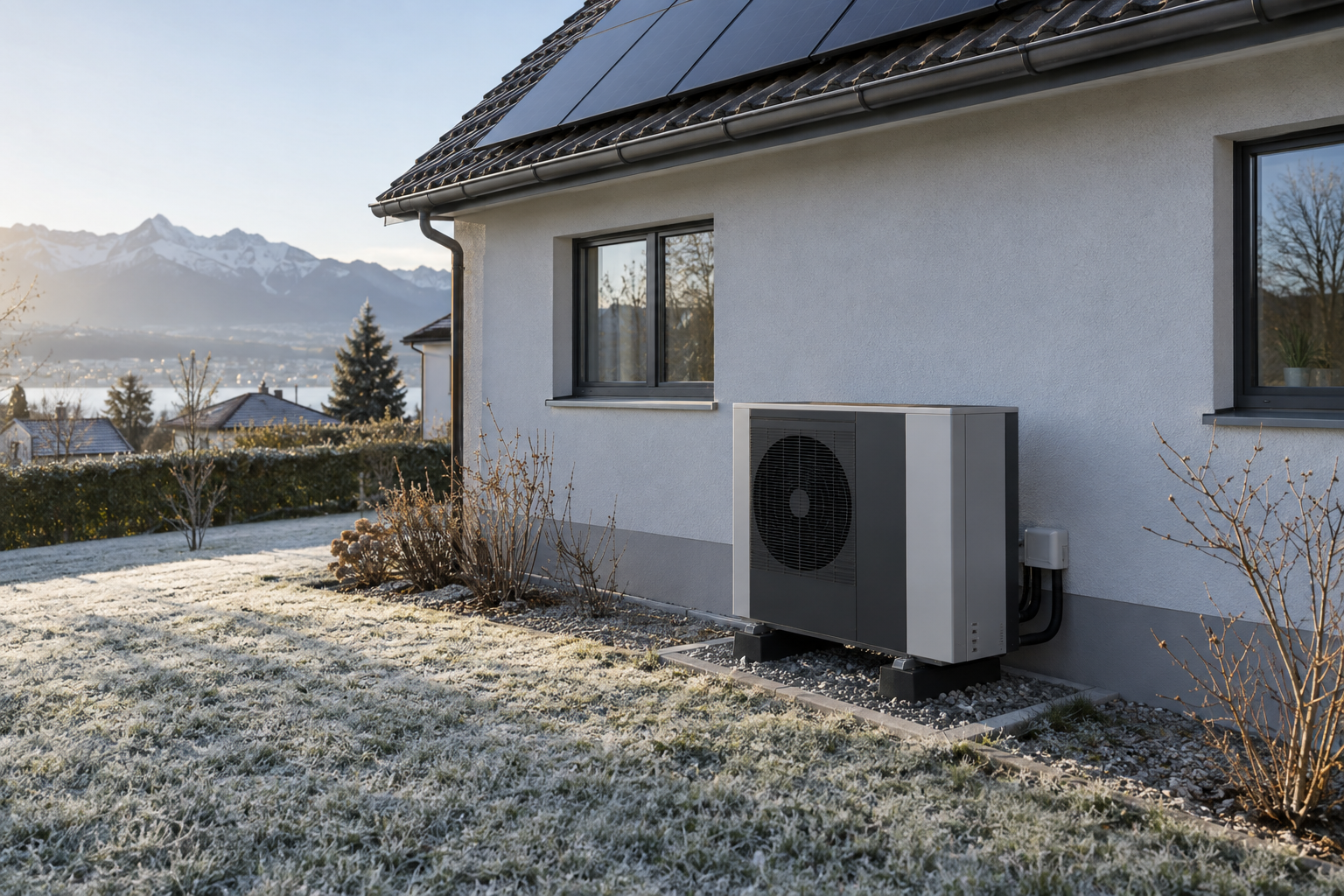
Guide to heat pumps
What does a heat pump cost?Purchase and running costs.
The purchase costs more than a new oil heating system, running it costs much less. Here you see how the bill adds up over 20 years.
- Site visit: free and with no obligation
- Binding quote within 72 hours
- Subsidies pre-financed on request
Prefer to talk?044 980 08 80
Request a free site visit
Takes 1 minute. No obligation.
- Building
- Location
- Contact
Thank you. We have your request.
We will call you within one working day to arrange the appointment.
Add details Optional
Prefer to talk now? 044 980 08 80
Guide · Updated October 2026
Heat pump: price, electricity use and subsidies
An air-to-water heat pump in a single-family home costs around CHF 30,000 to 50,000 including installation, and a ground-source heat pump around CHF 45,000 to 70,000. That is before subsidies. The electricity to run it costs about CHF 1,000 to 2,000 a year in a typical house.
These are ranges, not prices. What your heating system costs depends on the house, the heating system and the plot. That is why we calculate with your figures at the free site visit.
Purchase: air-to-water or ground-source
The air-to-water heat pump is the most common in Switzerland. It needs no drilling. Instead, the location and noise matter.
The ground-source heat pump costs more because the drilling is added. Depending on depth and ground, the extra cost is often in the range of CHF 10,000 to 25,000. In return, it works more efficiently in winter and needs no outdoor unit.
| System | Guide to total cost (single-family home) | Seasonal performance factor |
|---|---|---|
| Air-to-water | around CHF 30,000 to 50,000 | about 3 to 3.5 |
| Ground-source | around CHF 45,000 to 70,000 | about 4 to 5 |
These amounts include the unit, hot water cylinder, hydraulics and installation. What comes on top, you see in the next section.
Extra costs that are often forgotten
A quote for the unit alone says little. When replacing a heating system, further items come in:
- Removal: taking out the boiler, emptying, cleaning and decommissioning the oil tank. The room can often be used differently afterwards.
- Electrical installation: the heat pump needs its own supply cable and fusing. With older meter cabinets, a rebuild is needed.
- Hydraulics and cylinder: connection to the heating system, hot water cylinder, pumps and controls.
- Radiators: if some are too small for low flow temperatures, they are replaced.
- Permits: applications, noise protection certificate and, for ground-source systems, the drilling permit.
In our quotes, each of these items is listed separately. That way you compare offers on the same basis.
Subsidies: regulated by canton
Replacing an oil, gas or electric heating system is subsidised. The canton usually pays the contributions through its building programme. Each canton sets the amount and conditions itself. Some communes and energy suppliers add something on top.
Two points are important:
- In many cantons, the application has to be submitted before work starts. If you build first, you lose the entitlement.
- In most cantons, you can deduct the investment from your taxable income.
Which contribution applies to your address, we check at the site visit. We submit the subsidy application for you. On request, we pre-finance the contribution.
Electricity use and running costs
A heat pump delivers several times as much heat as the electricity it uses. This ratio is called the seasonal performance factor (SPF, JAZ). With an SPF of 3.5, 1 kWh of electricity produces 3.5 kWh of heat. Electricity use is therefore the heat demand divided by the SPF.
Worked example (assumptions, not an offer): a single-family home needs 20,000 kWh of heat a year for heating and hot water. That corresponds to about 2,000 litres of heating oil.
- Air-to-water with SPF 3.5: 20,000 / 3.5 = around 5,700 kWh of electricity.
- Ground-source with SPF 4.5: 20,000 / 4.5 = around 4,400 kWh of electricity.
- Electricity price: according to ElCom (Federal Electricity Commission), the 2026 median for household basic supply is 27.7 ct. per kWh excluding VAT. Your tariff may differ.
- Electricity cost, air-to-water: 5,700 kWh x 0.277 = around CHF 1,580 a year.
- Electricity cost, ground-source: 4,400 kWh x 0.277 = around CHF 1,220 a year.
These figures depend heavily on the house. A well-insulated house needs less, a large older building more. The flow temperature also has a strong effect on the SPF.
Comparison with oil heating over 20 years
Take the same house. The oil heating system uses around 2,000 litres a year. With an assumed price of CHF 1.10 per litre, that is CHF 2,200. On top come servicing and the chimney sweep, assumed here at CHF 400 a year.
| Item over 20 years (example) | Oil heating | Air-to-water heat pump |
|---|---|---|
| Energy | CHF 44,000 | CHF 31,600 |
| Servicing, chimney sweep | CHF 8,000 | CHF 3,000 |
| Total running costs | CHF 52,000 | CHF 34,600 |
The difference of around CHF 17,000 offsets part of the higher purchase price. With subsidies and tax deduction, the extra cost shrinks further. Price swings in oil and electricity are not included. The CO2 levy on heating oil can also change.
Besides money, two things speak for the heat pump: you no longer depend on the oil price, and the system can be run on your own solar power.
With a solar system, running costs fall
You do not have to buy every kilowatt-hour from your own roof at the grid tariff. In the example above: if a solar system covers 30 percent of the heat pump’s electricity, that is around 1,700 kWh. At 27.7 ct., you save about CHF 470 a year. The figure is an example. It rises with a battery and good controls.
Most of the electricity is needed in winter, when the roof delivers less. The solar system therefore does not replace grid electricity entirely, it reduces it. Especially in spring and autumn, the heat pump runs on solar power during the day, and hot water can be moved to the sunniest hours.
If you plan both together, you also save effort: meter cabinet, supply cable and controls are built once. We then size the solar system for the future heating electricity right away.
What pushes the price up or down
Two houses with the same living area can be CHF 15,000 apart on the heat pump. The main reasons:
- Heating capacity: a large house with high heat demand needs a more powerful unit and more metres of drilling.
- Condition of the house: insulated houses need less power. With older buildings, we calculate the heating load exactly instead of estimating it.
- Siting: an outdoor unit next to the house is cheaper than an installation with long pipes or sound insulation.
- Access: narrow access and difficult building sites make removal and drilling more expensive.
- Timing: if you plan before a breakdown, you can compare quotes and meet the deadlines for subsidies.
When comparing quotes, count all items, not just the unit. A low figure without removal, electrical work and cylinder is misleading.
Heat pump with an existing solar system
If you already have a solar system, self-consumption counts. We check whether the inverter, meter and yield suit the heat pump and whether an extension of the solar system is worthwhile. If the system is only sized for household electricity, it usually covers the heating electricity only in part.
Is a heat pump worthwhile?
Usually yes, if the old heating system has to be replaced anyway. Then it is not heat pump against doing nothing, but heat pump against a new oil heating system. The heat pump has the lower running costs and benefits from the subsidies.
It is less clear if the heating system will keep running for many years, or the house needs very high flow temperatures. Then we check whether adjustments are worthwhile or whether a later date suits better. We will tell you openly. If your heating system fails right now, you decide under time pressure. So plan early, ideally before it fails.
We calculate it for your house
The figures above are guides and examples. We only know your price after the site visit. We come free of charge to your home, check the heating, radiators, space and electrical installation, and you receive a binding quote within 72 hours. With subsidies, running costs and the comparison with your current heating.
The free site visit
One appointment at your home. Then you know everything.
A project manager from our team visits you and checks three things. No sales show, no obligation. Afterwards you receive a binding quote with yield, subsidies and payback.
 01
01Roof
Area, orientation, pitch, condition of the roof covering and shading.
 02
02Electrical system
Grid connection, distribution board and space for inverter and battery.
 03
03Your consumption
Electricity bill, car, heating, plans. From this we calculate yield and subsidies.
How your project runs
Request
Tell us briefly about your building and your goal. Online or by phone.
Site visit
We check your roof, electrical system and consumption at your home. Free of charge.
Quote in 72 hours
Binding and transparent, with yield, subsidies and payback.
Permit and subsidies
We handle the notification procedure, the grid operator and Pronovo.
Installation and commissioning
Our own installers, a fixed date, final inspection with you on the roof.
Step 1 takes one minute. We take care of the rest.
Frequently asked questions
Before you get in touch.
Is the site visit really free?
Yes. The visit and the quote cost you nothing and commit you to nothing. You only decide once you hold the binding quote in your hands.
How much electricity does a heat pump use per year?
For a single-family home with a heat demand of around 20,000 kWh, it is about 4,000 to 7,000 kWh of electricity a year. The figure depends on the seasonal performance factor (SPF, JAZ) and on the heat demand. We calculate it for your house.
What is a good seasonal performance factor?
In operation, air-to-water units usually reach 3 to 3.5 and ground-source units 4 to 5. The lower the flow temperature of your heating, the higher the figure.
Is a heat pump more expensive than a new oil heating system?
To buy, yes. In return, fuel, the chimney sweep and part of the servicing fall away. How this plays out over 20 years, we show you in the quote using your current oil consumption.
Can I deduct the cost from my income?
In most cantons yes. Replacing a fossil-fuel heating system in an existing building counts as value-preserving or energy-saving. The rules differ by canton, so ask your tax office too.
What extra costs arise during installation?
Typical items are removal of the boiler and oil tank, changes to the electrical installation, hydraulics and a hot water cylinder. With ground-source systems, the drilling is added. Everything is listed separately in the quote.
Is a heat pump worthwhile without a solar system?
Yes, even on grid power the heat pump saves running costs compared with oil. With your own solar power they fall further. The roof can be added later if the supply cable is prepared for it.
Which regions do you cover?
All of German-speaking Switzerland. We build most often in the cantons of Zurich, St. Gallen, Schwyz and Aargau. Our locations are in Zumikon ZH and Lachen SZ.
On to the service
Heat pump and what goes with it

The first step
We come to you. Free of charge.
We check your roof, electrical system and consumption. Afterwards you know what is possible on your roof, what it costs and which subsidies you receive. The binding quote follows within 72 hours.
- Free and with no obligation
- Quote within 72 hours
- Subsidies pre-financed on request
