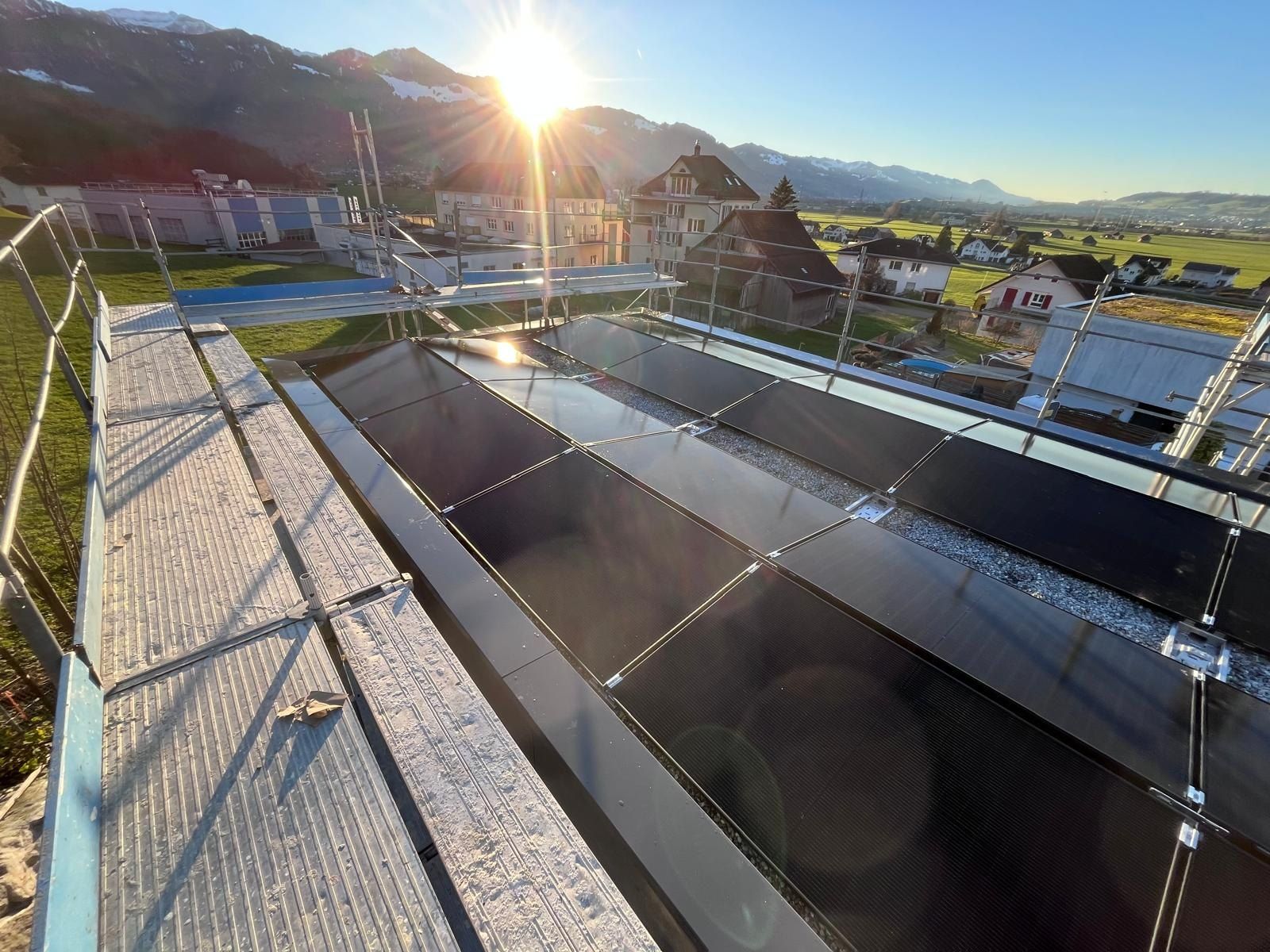
Guide to solar systems
How long does a solar system last?Maintenance and lifespan.
A solar system runs for 25 to 30 years and needs little care. Here you see what comes up in that time: inverter, inspection, monitoring, cleaning and insurance.
- Site visit: free and with no obligation
- Binding quote within 72 hours
- Subsidies pre-financed on request
Prefer to talk?044 980 08 80
Request a free site visit
Takes 1 minute. No obligation.
- Building
- Location
- Contact
Thank you. We have your request.
We will call you within one working day to arrange the appointment.
Add details Optional
Prefer to talk now? 044 980 08 80
Guide · Updated October 2026
Solar system maintenance at a glance
A solar system usually runs for 25 to 30 years. In that time it needs little care. One part of the system has a shorter life, though: the inverter. This guide shows what to expect, so that your solar system delivers power over its whole life.
How long do modules and inverter last?
The modules have no moving parts. They age mainly through heat, light and weather, and their output falls slowly. Manufacturers state a product warranty and a performance warranty on their data sheets. The terms differ from one manufacturer to another and are given in the quote and the data sheet. With PV modules it is therefore worth looking closely at the warranty conditions.
The inverter works all the time. It converts the direct current from the modules into grid power and heats up as it does so. It usually lasts 12 to 15 years. Swissolar assumes that it has to be replaced once during the operating life of a system. Allow for this replacement when you work out the economics. The cost of the inverter and its installation depends on output and becomes concrete with a quote.
Reading the warranties properly
There are two warranties to tell apart. The product warranty covers defects in materials and workmanship. The performance warranty promises that after a certain time the modules still deliver a certain share of their rated output. The inverter has its own warranty. How long it lasts differs by manufacturer and device, and for some devices it can be extended. Ask for the terms in the quote and keep the documents safe. In a warranty case you need the invoice, serial numbers and data sheets.
When our own installers do the work, the system stays with one contact. That makes warranty cases easier, because nobody has to work out who built which part.
What does maintenance mean for a solar system?
Maintenance keeps the system in working and safe condition and slows wear. Solar systems are considered low-maintenance. There is no legal duty to maintain them. Even so, an inspection by specialists at longer intervals is worthwhile. We check:
- modules for cracks, discolouration and hot spots
- connectors and wiring
- fixings and mounting structure
- inverter and stored error messages
- yield figures compared with the forecast
An inspection makes most sense when someone is on the roof anyway, for example for cleaning or after a storm. It finds faults before they cost yield or become a safety risk. We also inspect systems that we did not build.
What is monitoring for?
Monitoring keeps watch over the yield of your system. Swissolar recommends it for all systems, because nobody looks at the inverter display every day for 20 to 25 years. Monitoring shows failures of the inverter or of a string and displays the yield by year, month and hour.
Most inverters today have remote monitoring built in that can be used at no extra cost. Alternatively an external data logger can monitor different inverters. If the yield falls compared with the previous year for no obvious reason, or the system reports a fault, a check is worthwhile. With us you receive an app after commissioning that shows yield and consumption.
How to spot a problem early
Most problems show up in the yield. These signs are a reason for a check:
- a yield clearly below the previous year
- error messages in the app or on the inverter
- one string that stands out from the others
- a module that looks discoloured, hot or damaged
- visible dirt, leaves or bird droppings on the modules
It is best to compare yield over a whole year, because weather and season vary a lot. If the comparison shows a gap you cannot explain, contact us. We look at the readings and on the roof to find the cause.
Do I have to clean the modules?
Usually not. On pitched roofs the rain washes the dust off. Cleaning is worthwhile with shallow modules, near farmland, trees or birds, and with a visible film of dirt. We check on site whether it pays off for your system, and tell you if it does not.
When cleaning is done, it uses demineralised water and a soft brush, with no chemicals and no pressure washer, and with fall protection. We advise against cleaning the modules yourself on the roof. You find the details on the page cleaning solar systems. It is best to combine cleaning with the inspection.
Is the system insured?
Who insures the system against damage depends on the canton. In most cantons a cantonal building insurer insures the buildings. Solar systems fixed to the building are generally covered there. The Lucerne building insurer, for example, covers fixed systems against fire and natural hazards, but not loss of yield. The GVZ (Zurich cantonal building insurance) counts solar energy systems among the installations insured with a building.
In cantons without a cantonal building insurer, the cover is set out in your policy with a private insurer. In German-speaking Switzerland this applies, for example, to Schwyz, Uri, Obwalden, Appenzell Innerrhoden and Upper Valais (Oberwallis). There, check whether natural hazards are included and whether the system is part of the sum insured.
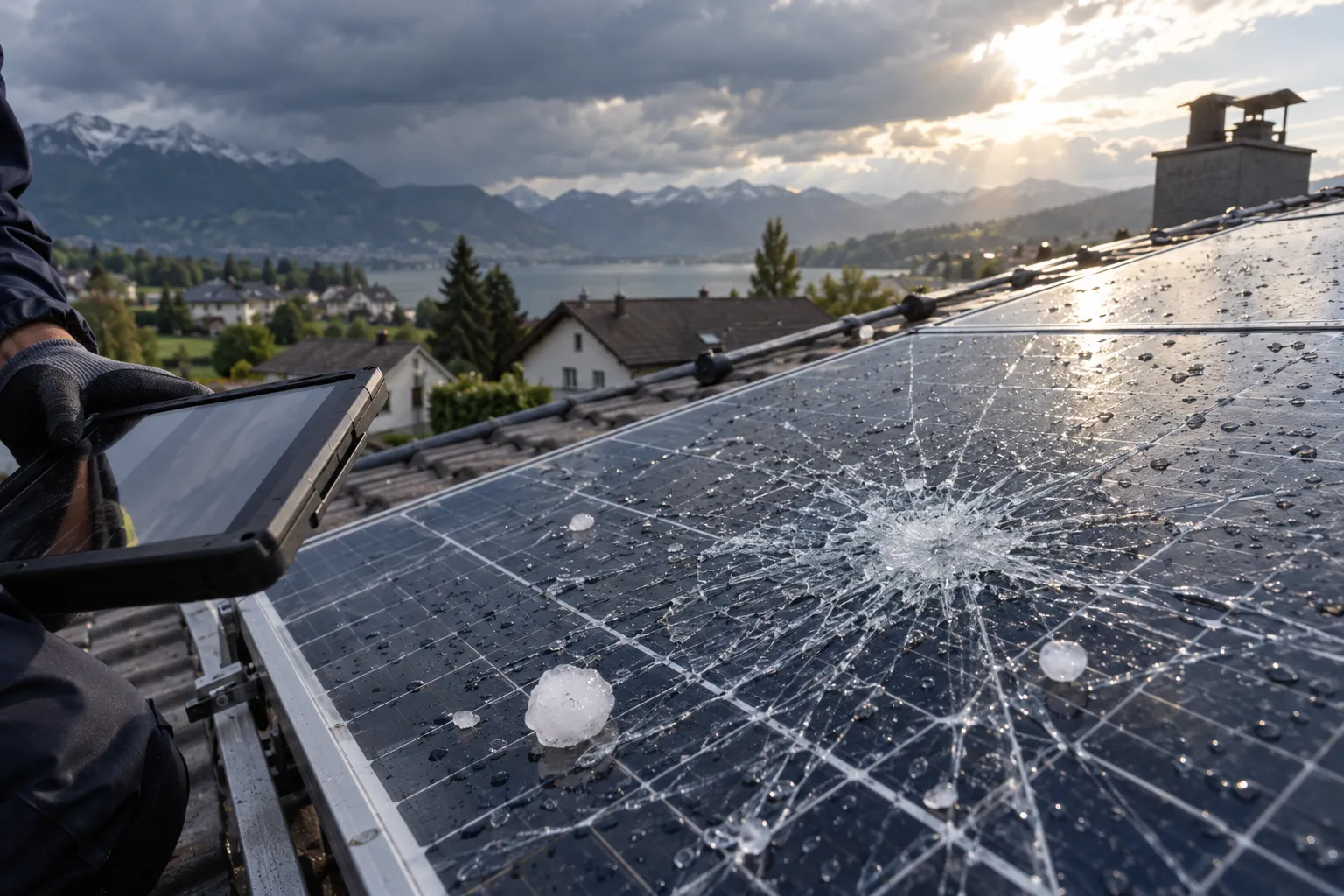
Report a new system to your insurer after commissioning and compare the sum insured with the building costs. The same applies after an extension. What to do after a hailstorm is explained in the guide hail damage: what to do.
When is it worth looking at the whole system?
After ten to fifteen years, when the inverter is due, things in the house often change too. Perhaps you drive an electric car, have installed a heat pump or use more power during the day. A home battery as a retrofit may then make sense. If your roof still has room, the system can be extended. We discuss both at the inspection, with no obligation.
We calculate it for your system
Whether inspection, inverter, cleaning or extension, we look at your system on site. The site visit is free and without obligation. Within 72 hours afterwards you receive a binding quote for what your system really needs. If you are planning a new system, you find the costs under solar system cost and payback.
The free site visit
One appointment at your home. Then you know everything.
A project manager from our team visits you and checks three things. No sales show, no obligation. Afterwards you receive a binding quote with yield, subsidies and payback.
 01
01Roof
Area, orientation, pitch, condition of the roof covering and shading.
 02
02Electrical system
Grid connection, distribution board and space for inverter and battery.
 03
03Your consumption
Electricity bill, car, heating, plans. From this we calculate yield and subsidies.
How your project runs
Request
Tell us briefly about your building and your goal. Online or by phone.
Site visit
We check your roof, electrical system and consumption at your home. Free of charge.
Quote in 72 hours
Binding and transparent, with yield, subsidies and payback.
Permit and subsidies
We handle the notification procedure, the grid operator and Pronovo.
Installation and commissioning
Our own installers, a fixed date, final inspection with you on the roof.
Step 1 takes one minute. We take care of the rest.
Frequently asked questions
Before you get in touch.
Is the site visit really free?
Yes. The visit and the quote cost you nothing and commit you to nothing. You only decide once you hold the binding quote in your hands.
How long does a solar system last?
A system runs for 25 to 30 years, and the modules often longer. Output falls slowly over the years. The inverter usually lasts 12 to 15 years and is replaced once in that time.
Does my solar system need servicing?
There is no legal duty to maintain it. Solar systems are considered low-maintenance. An inspection of modules, wiring and inverter by specialists at longer intervals helps to find faults early.
What does a replacement inverter cost?
That depends on output and type. We give a figure only after seeing your system. When planning, assume that the inverter is replaced after 12 to 15 years.
Do I need monitoring?
Swissolar recommends it for all systems. Most inverters today have remote monitoring built in. This way a failure is noticed even if nobody looks at the display.
Is my solar system insured?
That depends on the canton and your policy. Fixed systems are often covered by the cantonal building insurance. In cantons with private insurers, the cover is set out in your policy. Ask your insurer.
Do I have to clean the modules regularly?
Usually not. On pitched roofs the rain washes the dust off. Cleaning can be worthwhile with a shallow pitch, farmland nearby, trees or birds. We check this on site.
Which regions do you cover?
All of German-speaking Switzerland. We build most often in the cantons of Zurich, St. Gallen, Schwyz and Aargau. Our locations are in Zumikon ZH and Lachen SZ.
On to the service
Cleaning and maintenance and what goes with it

The first step
We come to you. Free of charge.
We check your roof, electrical system and consumption. Afterwards you know what is possible on your roof, what it costs and which subsidies you receive. The binding quote follows within 72 hours.
- Free and with no obligation
- Quote within 72 hours
- Subsidies pre-financed on request
