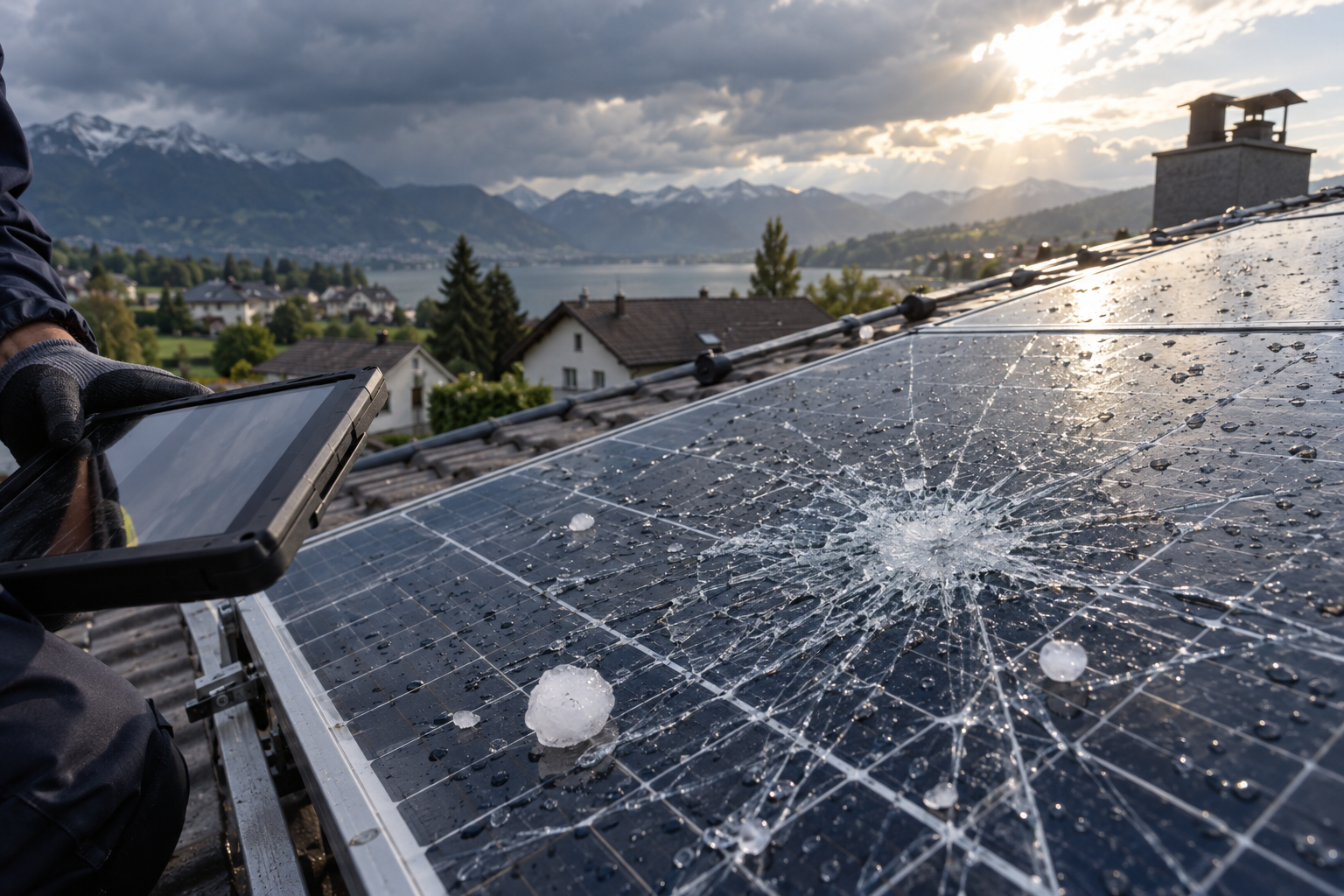
Guide to hail damage
Hail damage to a solar system: what to do?Steps and insurance.
After hail the order matters: keep your distance, report the damage, have the system checked. Here you see how to proceed and who pays for the damage in your canton.
- Site visit: free and with no obligation
- Binding quote within 72 hours
- Subsidies pre-financed on request
Prefer to talk?044 980 08 80
Request a free site visit
Takes 1 minute. No obligation.
- Building
- Location
- Contact
Thank you. We have your request.
We will call you within one working day to arrange the appointment.
Add details Optional
Prefer to talk now? 044 980 08 80
Guide · Updated October 2026
Hail damage to a solar system
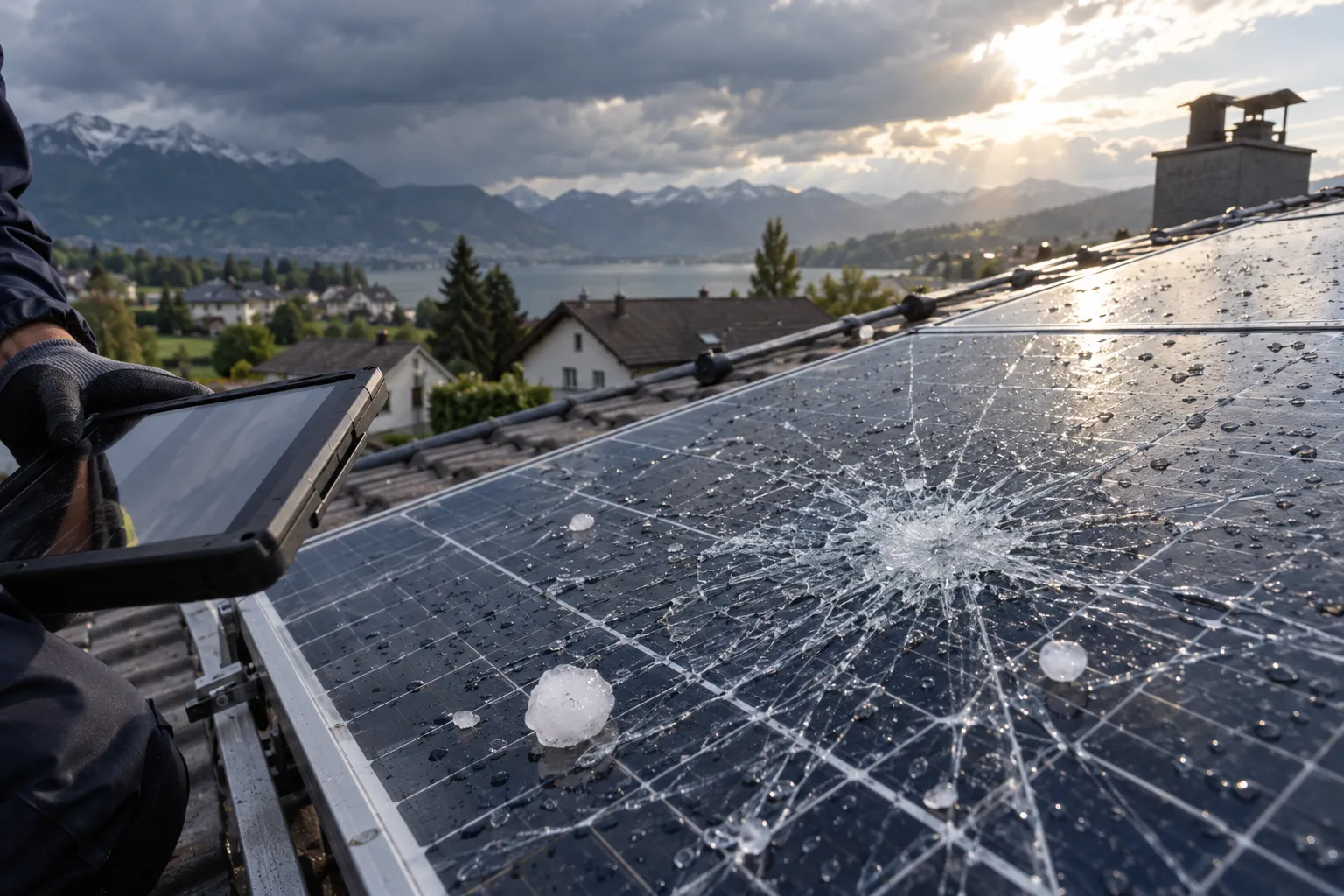
Hail can damage solar modules. Most of the time they withstand the impact, but not always. If your system was hit, the rule is: keep your distance, report the damage, have the system checked. Our page on hail damage to solar systems describes our service. Here you can read how to proceed step by step and how insurance is arranged in German-speaking Switzerland.
The first steps after hail
- Do not climb on the roof. Wet roofs are slippery, and damaged modules may be live.
- Look from the ground. Watch for broken glass, cracks, loose modules and hanging cables. Touch nothing.
- Switch the system off if you can reach the switch at the inverter safely. If in doubt, leave it.
- Take photos of what you can see from the ground.
- Report the damage. Tell your insurer before you have anything repaired.
- Contact us. We arrange a check on site.
Broken modules can carry voltage. The risk is invisible, so work on the roof is left to specialists with fall protection.
Why a check is worthwhile even with intact modules
Broken glass and cracks are visible. Fine cell cracks inside the module cannot be seen with the naked eye. They can reduce output or lead to hot spots later. We therefore check systematically: visual inspection of the modules, check of wiring and connectors, electrical measurement of the strings, check of inverter and mounting structure. You receive a written report with pictures. It shows which modules are defective and what can be replaced.
Who pays for hail damage: canton or private insurer?
In Switzerland buildings are not insured in the same way everywhere. Most cantons have a cantonal building insurer that covers fire and natural hazards. Hail is one of the natural hazards. Solar systems fixed to the building are generally insured with it.
- Canton of Zurich: The GVZ (Zurich cantonal building insurance) expressly counts solar energy systems among the installations insured with a building. You report the damage to it through the form on its website.
- Canton of Lucerne: The GVL (Lucerne cantonal building insurance) insures fixed solar systems against fire and natural hazards. It asks for the system to be reported before building starts and again after commissioning. It does not cover loss of yield.
A number of cantons have no cantonal building insurer. They are known by their abbreviation, the GUSTAVO cantons. In German-speaking Switzerland these include Schwyz, Uri, Obwalden, Appenzell Innerrhoden and Valais, for us Upper Valais (Oberwallis). There private companies insure the buildings, and the policy sets out whether and how hail damage to the solar system is covered. In the Canton of Obwalden, owners must insure their building privately against fire and natural hazards. Valais and Appenzell Innerrhoden (outside the district of Oberegg) have no insurance obligation.
You find the situation in your canton on the relevant cantonal page, for example hail damage in the Canton of Zurich. With private insurers: check whether natural hazards are included, whether the system counts as part of the building and whether the sum insured matches the building costs. Get the answer in writing.
How to document the damage
Good documentation makes the claim easier to settle. It includes:
- photos of the system and the visible damage, with the date
- date and time of the hail, and if possible a photo of hailstones next to a ruler
- module type, number, year of construction and the invoice for the system
- the technical report from the check
- a cost estimate for replacing the modules
We put the report, photos and quote together as a file for your insurer. The claim itself and the decision on payment are up to the insurer. Many policies set a reporting deadline. Read the policy conditions first after the event, and report before the repair, so that the insurer can examine the damage.
What applies to condominiums, apartment buildings and businesses
If the system belongs to an owners’ association or a business, the report usually goes through the property management or the management board. We agree the report and the file with the responsible body. With larger systems many modules are often affected. We then plan the replacement in stages so that operations continue. You find more on large systems under solar systems for businesses.
What you should better leave alone after hail
Some reactions are understandable but risky:
- Climbing on the roof to check the modules yourself. The risk of a fall is high, and broken modules can carry voltage.
- Touching damaged modules or cables.
- Having repairs or module replacements done before reporting. The insurer must be able to examine the damage first.
- Letting the system keep running after glass breakage. Switch it off if you can reach the switch safely.
- Trusting modules that look intact. Cell cracks cannot be seen.
Keep all receipts until the insurer has closed the case. That makes follow-up questions easier.
Replacing modules and repairs
If the insurer accepts the damage, or you want the replacement done directly, we replace the defective modules. Our own installers do this, usually in one day. If the old model is no longer available, we look for a module that fits the system electrically and in size. In some cases it makes more sense to renew a whole string. We discuss this with you beforehand. We also check systems that we did not build.
Not every defect comes from hail
Modules, wiring or inverters can also fail without a storm. Signs are a yield clearly below the previous year, error messages in the app or on the inverter, and a module that is discoloured or hot. We check the system, find the cause and fix it. Whether such a defect is insured is set out in your policy.
Hail register and hail resistance classes
For the hail protection of building components, Switzerland has the hail register with hail resistance classes (HW). The class states which hailstone size a product withstands in the test. Class 3 stands for hailstones 3 cm in diameter.
The cantonal building insurers give recommendations. The GVZ recommends at least class 3. The GVL writes that hailstones of at least 3 cm must be expected across the whole Canton of Lucerne, and recommends at least HW3 for solar systems, a higher class if possible, ideally HW4 and above. With a new solar system we therefore look for tested modules with a good class, especially in areas with a lot of hail. The class is given on the data sheet of the PV modules.
After the damage: add to the system with foresight
If the system is open anyway, it is worth looking ahead. Perhaps you would like to extend it or retrofit a home battery. This can often be combined with the repair. For the ongoing care of your system, read solar system maintenance and lifespan.
We calculate it for your system
After the check on site you receive a binding quote within 72 hours that you can pass straight to your insurer. The site visit is free and without obligation. If glass is broken, it is best to call us directly. We then arrange a date quickly.
The free site visit
One appointment at your home. Then you know everything.
A project manager from our team visits you and checks three things. No sales show, no obligation. Afterwards you receive a binding quote with yield, subsidies and payback.
 01
01Roof
Area, orientation, pitch, condition of the roof covering and shading.
 02
02Electrical system
Grid connection, distribution board and space for inverter and battery.
 03
03Your consumption
Electricity bill, car, heating, plans. From this we calculate yield and subsidies.
How your project runs
Request
Tell us briefly about your building and your goal. Online or by phone.
Site visit
We check your roof, electrical system and consumption at your home. Free of charge.
Quote in 72 hours
Binding and transparent, with yield, subsidies and payback.
Permit and subsidies
We handle the notification procedure, the grid operator and Pronovo.
Installation and commissioning
Our own installers, a fixed date, final inspection with you on the roof.
Step 1 takes one minute. We take care of the rest.
Frequently asked questions
Before you get in touch.
Is the site visit really free?
Yes. The visit and the quote cost you nothing and commit you to nothing. You only decide once you hold the binding quote in your hands.
What should I do first after hail hits my solar system?
Do not climb on the roof. Look from the ground, photograph the damage and report it to your insurer. Switch the system off only if you can reach the switch safely. After that we check the system.
Does insurance pay for hail damage to a solar system?
Usually yes, if the system is fixed to the building. In cantons with cantonal building insurance it is generally covered. In the other cantons your policy decides. Ask your insurer.
How quickly must I report hail damage?
As soon as possible and before the repair. Many policies set a reporting deadline. You find it in your policy conditions.
Are cell cracks visible from outside after hail?
Often not. Broken glass and cracks are visible. Fine cell cracks inside show up only with a measurement. A check is therefore worthwhile even if the modules look intact.
What does the hail resistance class HW mean?
It states which hailstone size a component withstands in the test. Class 3 corresponds to a hailstone 3 cm in diameter. Tested products are listed in the Swiss hail register and on the module data sheet.
Does insurance also cover loss of yield?
Not automatically. The Lucerne building insurer, for example, pays for the physical damage but not for loss of yield. Whether your policy includes it is set out in the policy conditions.
Which regions do you cover?
All of German-speaking Switzerland. We build most often in the cantons of Zurich, St. Gallen, Schwyz and Aargau. Our locations are in Zumikon ZH and Lachen SZ.
On to the service
Hail damage and what goes with it

The first step
We come to you. Free of charge.
We check your roof, electrical system and consumption. Afterwards you know what is possible on your roof, what it costs and which subsidies you receive. The binding quote follows within 72 hours.
- Free and with no obligation
- Quote within 72 hours
- Subsidies pre-financed on request
