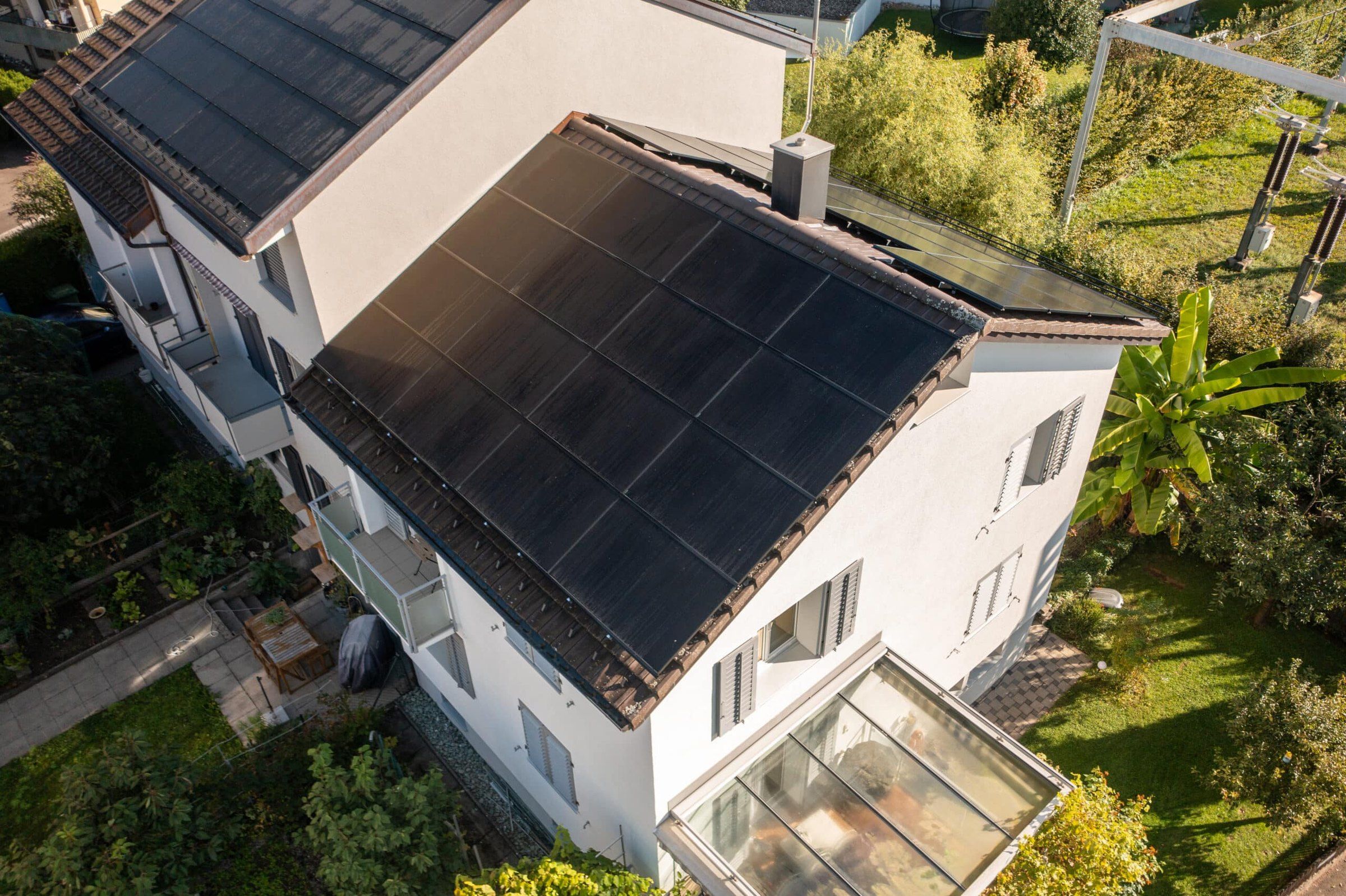
Guide to solar systems
What does a solar system cost?Prices and payback.
A system for a single-family home usually costs CHF 24,000 to 30,000 in 2026. Here you see what the price is made of and when the investment pays for itself.
- Site visit: free and with no obligation
- Binding quote within 72 hours
- Subsidies pre-financed on request
Prefer to talk?044 980 08 80
Request a free site visit
Takes 1 minute. No obligation.
- Building
- Location
- Contact
Thank you. We have your request.
We will call you within one working day to arrange the appointment.
Add details Optional
Prefer to talk now? 044 980 08 80
Guide · Updated October 2026
Solar system costs at a glance
A solar system for a single-family home in Switzerland usually costs CHF 24,000 to 30,000 in 2026, turnkey and installed, at a size of about 10 kWp. That is around CHF 2,400 to 3,000 per kWp. The federal one-off payment (for 10 kWp, around CHF 3,700 to 4,100) and the tax deduction come off that. After deducting the one-off payment, about CHF 20,000 to 26,000 remain. With normal self-consumption, this pays for itself in about 12 to 17 years, and the system runs for 25 to 30 years.
These figures are guides. What your system really costs, we see at the site visit. That is why every solar system with us starts with a visit on site.
What does each size cost?
The price per kWp falls as the system gets bigger. Scaffolding, travel, inverter and connection are needed even for a small system. The more modules share these fixed costs, the cheaper each kWp becomes.
| System | Module area | Guide price installed | per kWp |
|---|---|---|---|
| 5 kWp | about 25 m² | CHF 14,000 to 19,000 | CHF 2,800 to 3,800 |
| 10 kWp | about 50 m² | CHF 24,000 to 30,000 | CHF 2,400 to 3,000 |
| 15 kWp | about 75 m² | CHF 33,000 to 42,000 | CHF 2,200 to 2,800 |
These are guide figures for on-roof systems on pitched roofs, before subsidies. In-roof systems and complex flat roofs cost more. More on the in-roof solar system page.
What the price is made of
- Modules: the largest single item, about a third to a half of the price. Quality and warranty differ, so it pays to look closely at PV modules.
- Inverter: it converts the direct current from the modules into grid power. Several roof surfaces or shade need more technology, such as power optimisers.
- Mounting structure and installation: rails, hooks and the work of our installers. A steep or complex roof costs more than a simple gable roof.
- Scaffolding: work cannot go ahead without fall protection. If scaffolding is already up for a roof refurbishment, you save here.
- Electrical installation: cabling, meter, possibly a new meter cabinet. If the house wiring is old, this can cost more. We see it at the site visit.
- Notification and registration: notification to the commune (municipality), connection application to the grid operator, registration for the one-off payment. Included in our price.
A good quote lists all of these items. If scaffolding or electrical work is missing, it comes later as a surcharge.
What to look for when comparing
Two quotes for “10 kWp” are rarely the same. Check:
- Is scaffolding included in the price?
- Are the notification to the commune and the registration with the grid operator included?
- Which modules and which inverter are quoted, with what warranty?
- Is the price binding, or are surcharges possible?
- Has the one-off payment already been deducted or not?
A low price per kWp is not a mark of quality. Anyone who quotes without a site visit often overlooks the condition of the roof, the meter cabinet or the space for the inverter. That costs you later.
Extra cost for a battery
A battery storage system costs, as a guide, CHF 1,000 to 1,500 per kWh of capacity. A 10 kWh battery is therefore CHF 10,000 to 15,000. The federal government does not subsidise batteries directly, but some cantons and communes do.
A battery raises self-consumption, but the system does not necessarily pay for itself faster. That depends on the feed-in tariff: the lower it is, the more a battery is worthwhile. That is why we calculate both options side by side.
Subsidies: one-off payment and taxes
One-off payment (Einmalvergütung, EIV): for systems under 30 kWp, Pronovo pays a one-off CHF 360 per kWp for on-roof systems and CHF 400 per kWp for in-roof systems. There has been no base contribution since April 2025. For a 10 kWp on-roof system, that is CHF 3,600 (Energy Funding Ordinance, 2026 position). The rates change regularly, and we check the exact amount for your system when preparing the quote. We register the system. On request, we pre-finance the payment.
Canton and commune: some pay additional contributions, often for batteries or together with a heat pump. We find out which apply for your address.
Taxes: in most cantons you can deduct the investment in an existing building from your taxable income, after deducting the one-off payment. How much you save depends on your tax rate and your canton.
When does the system pay for itself?
The payback depends on three things:
- Self-consumption: how much of the solar power do you use yourself?
- Electricity price: in 2026, grid electricity costs 27.7 ct. per kWh excluding VAT in the median for basic supply (ElCom, household with 4,500 kWh consumption). Every kWh you use yourself saves this amount.
- Feed-in tariff: what your grid operator pays for the electricity you feed in. The range is wide, often between 6 and 15 ct. per kWh.
Electricity you use yourself is therefore worth more than twice as much as electricity you feed in. That is why self-consumption counts for more than the size of the system.
Worked example
The following example is a simplified calculation, not a quote. Assumptions: 10 kWp, yield 10,000 kWh a year, system price CHF 26,000, one-off payment CHF 3,600, electricity price 27.7 ct. excluding VAT, feed-in tariff 8 ct. No tax deduction, no changes in electricity prices.
| Single-family home, no extras | With heat pump and electric car | |
|---|---|---|
| Self-consumption | 30% (3,000 kWh) | 60% (6,000 kWh) |
| Saving on grid electricity | CHF 831 | CHF 1,662 |
| Income from feed-in | CHF 560 | CHF 320 |
| Benefit per year | CHF 1,391 | CHF 1,982 |
| Net investment | CHF 22,400 | CHF 22,400 |
| Payback | about 16 years | about 11 years |
The difference comes from self-consumption alone. If you run a heat pump or charge an electric car, you use more of your own power. The table shows only the electricity effects, not the cost of the heat pump and the car themselves. With the tax deduction, the time shortens again.
And if prices keep falling?
Some people wait for lower prices. Module prices have fallen in recent years, but installation and electrical work hardly at all. Waiting therefore rarely saves much. At the same time, every year you go without power from your own roof, which in the example above is around CHF 1,400 to 2,000. The subsidy rates and the feed-in tariff also keep changing. It is better to calculate with today’s figures than with future ones.
Is a solar system worthwhile?
For most single-family homes with a suitable roof: yes. The system lasts 25 to 30 years, and the inverter has to be replaced after 12 to 15 years. After that, the system produces electricity for years at very low cost. If you plan to sell in a few years, or have a roof in poor condition, you should calculate more carefully. We will tell you openly if a system makes no sense for you.
For how your own generation compares with a utility tariff, read the guide solar power from your own roof. If you also want to charge your car: What does an EV charger cost?
We calculate it for your roof
Online calculators and guide prices give a first orientation. It only becomes exact with your roof, your electrical installation and your consumption. We come by and check everything on site, and the site visit is free. Afterwards you receive a binding quote within 72 hours with price, yield forecast, subsidies and payback.
The free site visit
One appointment at your home. Then you know everything.
A project manager from our team visits you and checks three things. No sales show, no obligation. Afterwards you receive a binding quote with yield, subsidies and payback.
 01
01Roof
Area, orientation, pitch, condition of the roof covering and shading.
 02
02Electrical system
Grid connection, distribution board and space for inverter and battery.
 03
03Your consumption
Electricity bill, car, heating, plans. From this we calculate yield and subsidies.
How your project runs
Request
Tell us briefly about your building and your goal. Online or by phone.
Site visit
We check your roof, electrical system and consumption at your home. Free of charge.
Quote in 72 hours
Binding and transparent, with yield, subsidies and payback.
Permit and subsidies
We handle the notification procedure, the grid operator and Pronovo.
Installation and commissioning
Our own installers, a fixed date, final inspection with you on the roof.
Step 1 takes one minute. We take care of the rest.
Frequently asked questions
Before you get in touch.
Is the site visit really free?
Yes. The visit and the quote cost you nothing and commit you to nothing. You only decide once you hold the binding quote in your hands.
What does a 10 kWp system cost including installation?
Expect around CHF 24,000 to 30,000, turnkey, installed and connected, before subsidies. Where you fall in that range depends on roof shape, scaffolding and electrical work.
Why is my neighbour's quote cheaper?
Prices can only be compared if size, roof shape, modules and scope of work are the same. The cheaper quote often leaves out scaffolding, notification or electrical work. Check whether everything is included.
Can I deduct the cost from my taxes?
In most cantons yes, if the system goes on an existing building. How much and in which year is set by each canton. Ask your tax office or tax adviser before ordering.
When do I get the one-off payment?
Pronovo pays it once the system is in operation and registered. On request, we pre-finance the subsidy until Pronovo pays out. We take care of the registration.
How do I calculate the payback myself?
Divide the net investment by the annual benefit. The benefit is the electricity you use yourself times your electricity price, plus the electricity fed in times the feed-in tariff. An online calculator gives a rough idea, and it becomes more accurate with your consumption.
Have solar system prices fallen in recent years?
Module prices have fallen sharply, but installation and electrical costs hardly at all. That is why the total price falls more slowly than the module price.
What does a battery cost on top?
As a guide, around CHF 1,000 to 1,500 per kWh of storage capacity, installed. Whether it pays off, we calculate in the quote with and without a battery side by side.
Which regions do you cover?
All of German-speaking Switzerland. We build most often in the cantons of Zurich, St. Gallen, Schwyz and Aargau. Our locations are in Zumikon ZH and Lachen SZ.
On to the service
Solar installation and what goes with it

The first step
We come to you. Free of charge.
We check your roof, electrical system and consumption. Afterwards you know what is possible on your roof, what it costs and which subsidies you receive. The binding quote follows within 72 hours.
- Free and with no obligation
- Quote within 72 hours
- Subsidies pre-financed on request
