Guide: solar systems
A solar system on a flat roofEast-west, ballast, tilt.
On a flat roof you choose the orientation yourself. Here you can see when east-west pays off better than south, what matters for ballast and structure, and what applies to permits.
- Site visit: free and with no obligation
- Binding quote within 72 hours
- Subsidies pre-financed on request
Prefer to talk?044 980 08 80
Request a free site visit
Takes 1 minute. No obligation.
- Building
- Location
- Contact
Thank you. We have your request.
We will call you within one working day to arrange the appointment.
Add details Optional
Prefer to talk now? 044 980 08 80
Guide · Updated October 2026
Flat roof solar system: planning at a glance
On a flat roof you have more freedom than on a pitched roof. You set the orientation and tilt of the modules yourself. The price is that you have more to decide: south or east-west, ballast or fixings, with or without a green roof. For a single-family home with about 10 kWp, expect CHF 24,000 to 30,000 before subsidies. Complex flat roofs cost more. This page shows what matters. What applies to your roof, we clarify during the site visit.
The general costs and payback of a solar system are explained in the guide What does a solar system cost?.
East-west or south: what suits a flat roof?
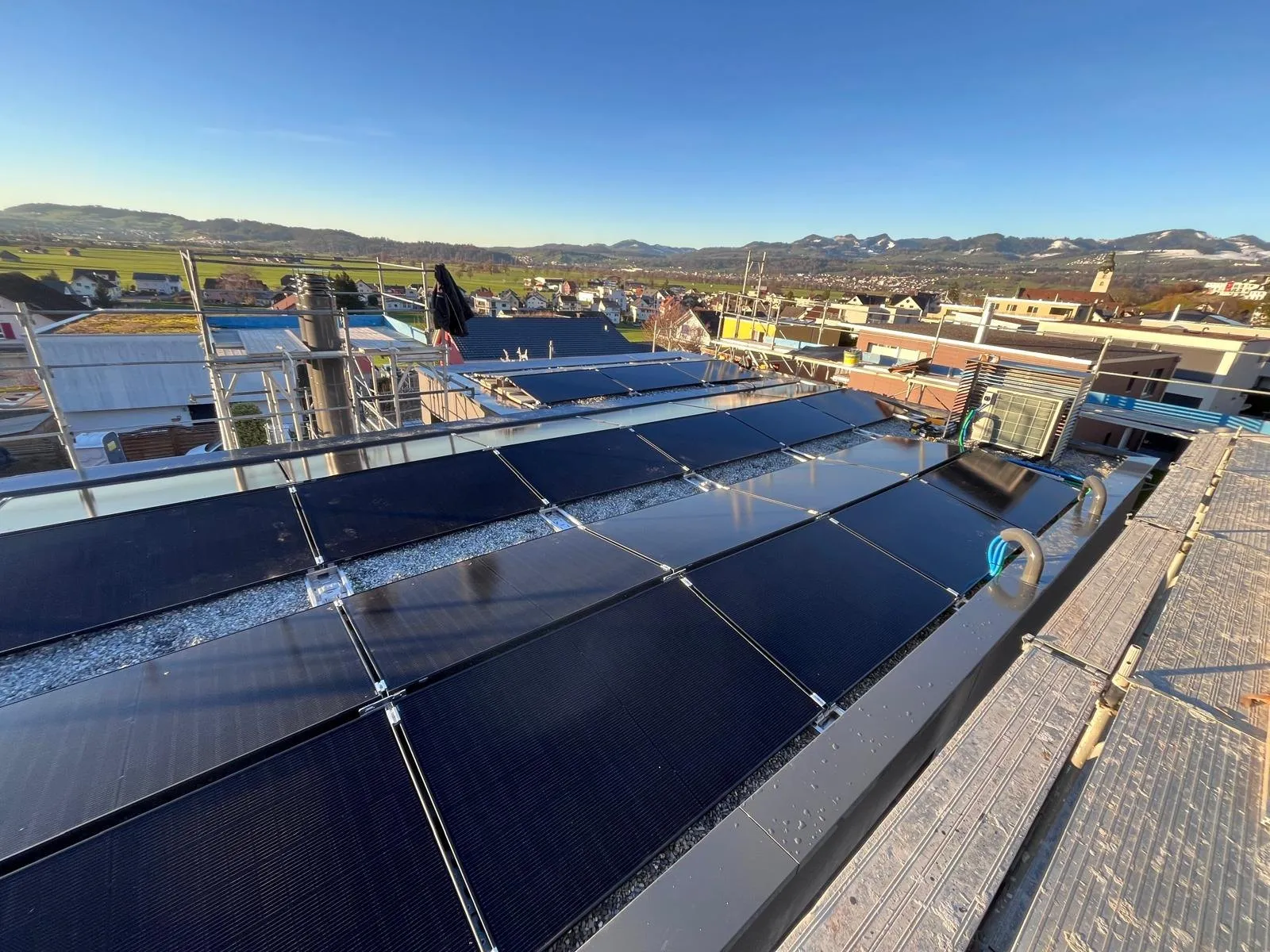
On a flat roof you can face the modules south, or set them up back to back facing east and west. Both options have advantages and drawbacks.
| South | East-west | |
|---|---|---|
| Yield per kWp | higher | somewhat lower |
| Modules per area | fewer, because rows need more space | more, because rows stand close together |
| Tilt | usually steeper | usually flat |
| Daily curve | peak at midday | stronger in the morning and evening, flatter midday peak |
| Wind load | higher | usually lower, because flatter |
If you have little space, east-west often gives you more electricity per roof, even though each module delivers a little less. If you need a lot of electricity in the morning and evening, for example with a heat pump and an EV charger, the broader daily curve helps. If you mainly feed into the grid, yield per kWp matters more.
There is no blanket answer. For your roof we calculate both set-ups side by side, with yield, self-consumption and price.
Which tilt makes sense?
On flat roofs, tilts of about 10 to 15 degrees are usual, much flatter than the 30 to 35 degrees that are ideal on a pitched roof. There are two reasons. The rows cast less shade on each other and can stand closer together. The wind also has less to push against, which saves ballast.
A steeper angle gives more yield in winter, but needs more space between the rows and more weight. The system is also more visible from outside. Where the system should deliver a lot in winter, it can pay off. It depends on your consumption. With high winter consumption a steeper angle is more likely to pay off than with mainly summer consumption.
Ballast or fixings: how is the system secured?
There are two ways to secure a system on a flat roof.
- With ballast: Weights, usually concrete slabs or gravel, hold the system in place. The roof skin stays intact. In return, the roof has to carry the extra load. The weight depends on location, building height, wind and set-up.
- With fixings: The system is bolted to the load-bearing structure. This saves weight, but the points where fixings pass through the roof skin must be carefully sealed.
The roof build-up decides which solution fits. Different systems are usual on gravel, bitumen or plastic membranes. What matters is that wind loads and load reserve are calculated for the location. Wind loads follow the SIA standards (Swiss Society of Engineers and Architects). A provider who quotes without looking at the roof easily overlooks this.
Check the structure and the roof condition
Before we plan, we look at three things.
- Load reserve: Can the structure take extra weight? For older buildings, documents are often missing. Then a structural check by a civil engineer may be needed.
- Waterproofing: Is it watertight, and how old is it? If you have to renew the waterproofing within a few years, do that before the solar system. Otherwise the system has to be taken down for it.
- Roof edge and fall protection: For installation and maintenance, our installers need safe access. If protection is missing, there are extra costs.
These are cost items that an online quote leaves out. With us, they are part of the site visit.
Flat roof with a green roof
Many flat roofs are planted, and some cantons and communes require it. A solar system and a green roof can be combined. The plants cool the modules slightly, and the planting can serve as ballast. The modules must, however, stand high enough above the vegetation not to be shaded. The roof must also stay accessible for maintenance.
Swissolar has published an information sheet on green roofs and solar systems. We find out for your address whether your commune prescribes a green roof.
Permits and fire protection
Since 1 January 2026, solar systems on flat roofs count as suitably adapted and need no building permit if they rise no more than one metre above the roof edge and are set back so that they cannot be seen from below at an angle of 45 degrees (Swissolar, building law). They must be notified to the commune. For cultural monuments, a building permit is still required. Procedures differ from canton to canton. We take care of the notification.
For fire protection, the cantonal rules and the VKF fire protection information sheet on solar systems apply (VKF: Association of Cantonal Fire Insurers). On flat roofs this mainly concerns distances, access and cable routing. We plan accordingly.
What does the system give you?
On the flat roof of a commercial building or an apartment building, the area is often big enough for 15 kWp and more. With larger systems the price per kWp falls. A 15 kWp system costs, as a guide, CHF 33,000 to 42,000 before subsidies. For systems under 30 kWp, the federal government pays a one-off payment (Einmalvergütung) of CHF 360 per kWp for attached systems, which includes a raised system on a flat roof (EnFV Annex 2.1). For 10 kWp that is CHF 3,600. There has been no base amount since April 2025.
For a single-family home with 10 kWp, 1,000 kWh per kWp and 30% self-consumption, about 3,000 kWh stay in the house. With a battery storage unit, self-consumption reaches 60 to 70%. In an apartment building, a ZEV (self-consumption community) helps share the electricity among tenants. When several parties use the system, self-consumption usually rises considerably.
An in-roof solar system is meant for pitched roofs. On a flat roof, a raised system is the usual solution. The comparison between the two systems is in the guide In-roof or on-roof.
We calculate it for your flat roof
East-west or south, ballast or fixings, with or without a green roof: this can only be answered with your roof. We visit, check the build-up, condition and space, the site visit is free. You then receive a binding quote within 72 hours with both set-ups, yield, subsidies and payback. We take care of the notification, the registration with the grid operator and the application for the one-off payment. Our own team does the installation.
The free site visit
One appointment at your home. Then you know everything.
A project manager from our team visits you and checks three things. No sales show, no obligation. Afterwards you receive a binding quote with yield, subsidies and payback.
 01
01Roof
Area, orientation, pitch, condition of the roof covering and shading.
 02
02Electrical system
Grid connection, distribution board and space for inverter and battery.
 03
03Your consumption
Electricity bill, car, heating, plans. From this we calculate yield and subsidies.
How your project runs
Request
Tell us briefly about your building and your goal. Online or by phone.
Site visit
We check your roof, electrical system and consumption at your home. Free of charge.
Quote in 72 hours
Binding and transparent, with yield, subsidies and payback.
Permit and subsidies
We handle the notification procedure, the grid operator and Pronovo.
Installation and commissioning
Our own installers, a fixed date, final inspection with you on the roof.
Step 1 takes one minute. We take care of the rest.
Frequently asked questions
Before you get in touch.
Is the site visit really free?
Yes. The visit and the quote cost you nothing and commit you to nothing. You only decide once you hold the binding quote in your hands.
East-west or south on a flat roof, which is better?
It depends on your consumption and the available area. South gives more electricity per kWp. East-west fits more modules on the same area and spreads the yield over the day. We calculate both options for your roof.
Does a flat roof system need a building permit?
Since 1 January 2026, suitably adapted systems on flat roofs need no permit if they rise no more than one metre above the roof edge and are set back from it. They must still be notified. Protected buildings still need a permit.
Can my flat roof carry the weight of the system?
This has to be checked beforehand. What counts is the load reserve of the structure, the roof build-up and wind loads. With ballast, weight is the issue. With fixings through the roof skin, it is the waterproofing. We check this during the site visit.
Can I combine a solar system with a green roof?
Yes. The planting can even serve as ballast, and the plants cool the modules. The modules need enough clearance above the vegetation so they are not shaded. Plan both together.
When is a flat roof too old for a solar system?
If the waterproofing will need replacing soon, do that first. Taking a system down and putting it up again costs money. We will tell you the condition of your roof during the site visit.
What does a solar system on a flat roof cost?
As a guide, CHF 24,000 to 30,000 for 10 kWp before subsidies. Complex flat roofs that need a crane, a lot of ballast or fall protection cost more. Only the quote is binding.
Which regions do you cover?
All of German-speaking Switzerland. We build most often in the cantons of Zurich, St. Gallen, Schwyz and Aargau. Our locations are in Zumikon ZH and Lachen SZ.
On to the service
Solar installation and what goes with it

The first step
We come to you. Free of charge.
We check your roof, electrical system and consumption. Afterwards you know what is possible on your roof, what it costs and which subsidies you receive. The binding quote follows within 72 hours.
- Free and with no obligation
- Quote within 72 hours
- Subsidies pre-financed on request
