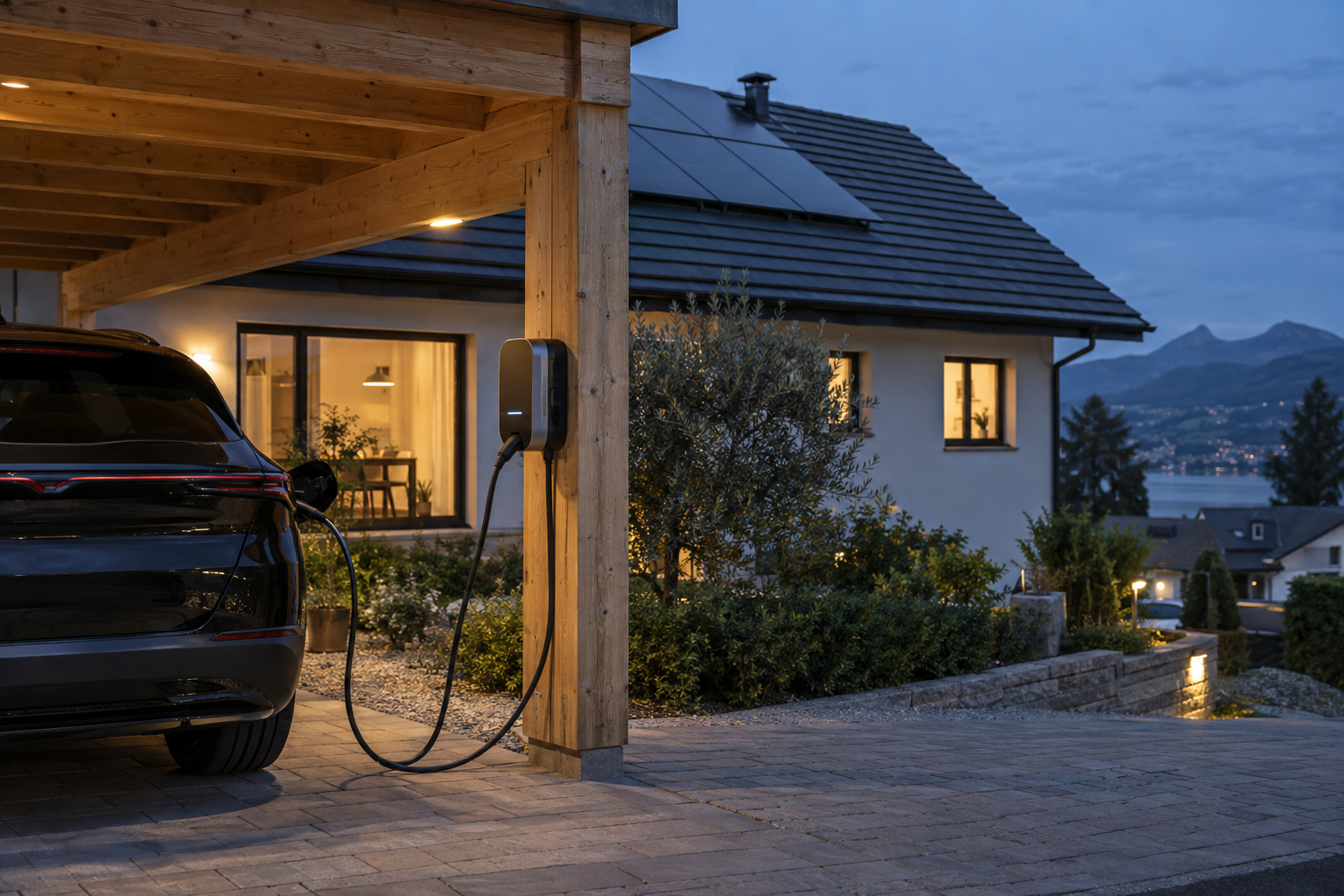
Guide to EV chargers
EV charger with a solar system: charging with your own roof powerUse the surplus well.
The car is often at home when the sun is not shining. Here is how much solar power realistically ends up in the car and what it takes.
- Site visit: free and with no obligation
- Binding quote within 72 hours
- Subsidies pre-financed on request
Prefer to talk?044 980 08 80
Request a free site visit
Takes 1 minute. No obligation.
- Building
- Location
- Contact
Thank you. We have your request.
We will call you within one working day to arrange the appointment.
Add details Optional
Prefer to talk now? 044 980 08 80
Guide · Updated October 2026
Charging an electric car with solar power: technology, yield, costs
An electric car is cheapest to charge with a solar system. Power from your own roof costs you only the feed-in payment you give up, while grid power costs a median of 27.7 ct. per kWh excluding VAT (ElCom, Federal Electricity Commission, household category H4, 2026). How much of the roof’s power reaches the car depends on when the car is at home and how the wallbox is controlled.
This page shows the options and a calculation with realistic assumptions. We plan the matching EV charger together with your solar system, with our own installers and registration from a single source.
How much electricity the car needs
Depending on model and driving style, an electric car uses about 15 to 20 kWh per 100 kilometres. We calculate with 18 kWh. At 15,000 kilometres a year that is 2,700 kWh. A 10 kWp solar system produces about 10,000 kWh a year at a yield of 1,000 kWh per kWp. The car’s demand is therefore a little over a quarter of annual production. In volume, the roof covers the driving electricity easily. The open question is timing.
The timing problem: sun by day, car in the evening
The system delivers most at midday, a lot in summer and little in winter. If you commute, you are not at home during the day. The car is plugged in in the evening, when hardly any solar power is flowing. There are three ways to deal with this:
- Surplus charging: The wallbox charges when the roof delivers more than the house needs.
- Charging with a battery: A home battery gives solar power from the day to the car in the evening.
- Charging by day: If you work from home, part-time or are retired, you charge straight from the roof.
A mix is usually sensible. If you are at home at weekends, you charge with surplus then. On working days the car charges at night with grid power or from the battery.
Surplus charging: how it works
A meter at the house connection continuously measures whether the system is feeding power into the grid. The wallbox reads this value and adjusts its charging power. If the system delivers 5 kW more than the house uses, the car charges at those 5 kW. When a cloud passes, the power drops.
The limits are set by technology:
- Single-phase, charging starts from about 1.4 kW of surplus, three-phase from about 4.1 kW. This is the minimum power the car accepts when charging.
- Below this value the wallbox pauses or draws grid power, depending on the setting.
- Many wallboxes can switch between single-phase and three-phase when needed. Charging then starts earlier and the yield rises.
For this to work, wallbox, inverter and energy management must fit together. When buying a wallbox, look for an open interface. We coordinate this during planning so that you do not have to retrofit anything later. How much power the wallbox needs in the first place is covered in the guide EV charger 11 kW or 22 kW.
Worked example: 10 kWp and an electric car
Assumptions, not a quote: 10 kWp, 1,000 kWh per kWp, the house’s self-consumption without the car 30%, car 15,000 km a year at 18 kWh per 100 km, grid power 27.7 ct., assumed feed-in tariff 8 ct.
- Solar yield: 10,000 kWh. The house uses 30% of it itself, so 3,000 kWh. The rest, 7,000 kWh, goes into the grid.
- The car’s demand: 2,700 kWh.
- Suppose 40% of that is charged with surplus, which is 1,080 kWh. Self-consumption rises to 4,080 kWh, or a little over 40%.
- Benefit per kWh: you save the grid purchase at 27.7 ct. and give up feeding in at 8 ct., so 19.7 ct.
- Saving: 1,080 kWh times 0.197 = about CHF 210 a year.
If you charged the whole 2,700 kWh with grid power, it would cost about CHF 750. With a 40% solar share, the electricity cost for the car falls to about CHF 540.
The solar share is the decisive figure. A house with home working reaches clearly more than 40%, a commuter household without a battery often less. The feed-in tariff differs greatly between grid operators. That is why we calculate with your tariff and your driving profile in the quote.
More solar power in the car with a battery
A home battery stores the midday solar power and releases it in the evening, including to the car. Self-consumption then rises from a typical 30 to 35% to 60 to 70%. A battery of 8 to 12 kWh costs about CHF 8,000 to 15,000.
Whether that pays off for the car alone depends on the driving profile. A battery benefits the whole household, not only the car. If you want to charge at 11 kW in the evening, you will empty the battery quickly, because the car draws more in a few hours than the battery holds. It usually makes sense to limit the evening charging power or to release the battery for household use only. More in the guide What does a home battery cost?.
What to clarify before planning
- When is the car at home? On weekdays, only at night, or during the day as well.
- How large is the system? A system with more power delivers surplus more often, even under cloud.
- What other consumers are there? A heat pump competes with the car for the surplus. Both can be coordinated through the energy management, more under heat pump with a solar system.
- What is the electrical installation like? The distribution board and house connection must be sized for wallbox and system.
- Is the system already built? Then we check whether the inverter can control the wallbox or whether an additional meter is needed.
In an apartment building, several parties charge with power from the shared roof. This works with a ZEV (self-consumption community), more in the guide on the LEG (local electricity community).
Subsidies and registration
The solar system receives the one-off payment (Einmalvergütung, EIV) from Pronovo: since 1 April 2025 there is no base contribution, and attached systems under 30 kWp receive CHF 360 per kWp, integrated ones CHF 400 (Annex 2.1 EnFV). The federal government does not subsidise the wallbox itself. Some cantons, communes (municipalities) and energy suppliers pay contributions, which change often. We check what applies to your address and submit the subsidy applications.
Every EV charger and every solar system must be registered with the grid operator. We handle both.
We calculate it for your house
At the free site visit we check the roof, distribution board, parking space and your driving profile. Within 72 hours you receive a binding quote in which solar system, wallbox and, if applicable, battery are matched to each other. Planning through to commissioning from a single source, with our own installers, from Zumikon and Lachen for the whole of German-speaking Switzerland.
The free site visit
One appointment at your home. Then you know everything.
A project manager from our team visits you and checks three things. No sales show, no obligation. Afterwards you receive a binding quote with yield, subsidies and payback.
 01
01Roof
Area, orientation, pitch, condition of the roof covering and shading.
 02
02Electrical system
Grid connection, distribution board and space for inverter and battery.
 03
03Your consumption
Electricity bill, car, heating, plans. From this we calculate yield and subsidies.
How your project runs
Request
Tell us briefly about your building and your goal. Online or by phone.
Site visit
We check your roof, electrical system and consumption at your home. Free of charge.
Quote in 72 hours
Binding and transparent, with yield, subsidies and payback.
Permit and subsidies
We handle the notification procedure, the grid operator and Pronovo.
Installation and commissioning
Our own installers, a fixed date, final inspection with you on the roof.
Step 1 takes one minute. We take care of the rest.
Frequently asked questions
Before you get in touch.
Is the site visit really free?
Yes. The visit and the quote cost you nothing and commit you to nothing. You only decide once you hold the binding quote in your hands.
Can I charge my electric car with solar power only?
In summer you often can for a large part, in winter the roof delivers much less. Charging with solar power only all year round is not realistic without a very large battery. The car takes the rest from the grid.
What is surplus charging?
The wallbox measures how much power the solar system delivers beyond what the house needs and charges the car with exactly that surplus. The charging power adjusts continuously. If the surplus is too small, the wallbox pauses or continues with grid power, depending on the setting.
Do I need a special wallbox for this?
Yes, the wallbox needs an interface to the solar system or to the energy management, for example through a meter at the house connection. A simple wallbox without control always charges at full power. We choose the unit to suit your system.
Is a home battery worth it for the car?
A battery stores the day's solar power for the evening, when the car is plugged in. It raises the solar share in the car, but costs CHF 8,000 to 15,000. We calculate whether it pays off with your driving profile.
Can I charge with solar power in winter too?
On sunny winter days the roof gives some surplus, on dull days hardly any. The car then charges with grid power, ideally at the cheaper night tariff if your grid operator offers one.
What do I get for the solar power I do not put into the car?
Your grid operator pays for the power fed into the grid at the feed-in tariff. It differs greatly between grid operators. Since 2026, where there is no agreement, a minimum rate based on the market price applies.
Which regions do you cover?
All of German-speaking Switzerland. We build most often in the cantons of Zurich, St. Gallen, Schwyz and Aargau. Our locations are in Zumikon ZH and Lachen SZ.
On to the service
EV charger and what goes with it


The first step
We come to you. Free of charge.
We check your roof, electrical system and consumption. Afterwards you know what is possible on your roof, what it costs and which subsidies you receive. The binding quote follows within 72 hours.
- Free and with no obligation
- Quote within 72 hours
- Subsidies pre-financed on request
