Guide to battery storage
Is a home battery worth it?Cost and benefit.
A battery for a single-family home usually costs CHF 8,000 to 15,000. Here you see what it delivers and when it is more likely to pay off.
- Site visit: free and with no obligation
- Binding quote within 72 hours
- Subsidies pre-financed on request
Prefer to talk?044 980 08 80
Request a free site visit
Takes 1 minute. No obligation.
- Building
- Location
- Contact
Thank you. We have your request.
We will call you within one working day to arrange the appointment.
Add details Optional
Prefer to talk now? 044 980 08 80
Guide · Updated October 2026
Home battery cost and benefit
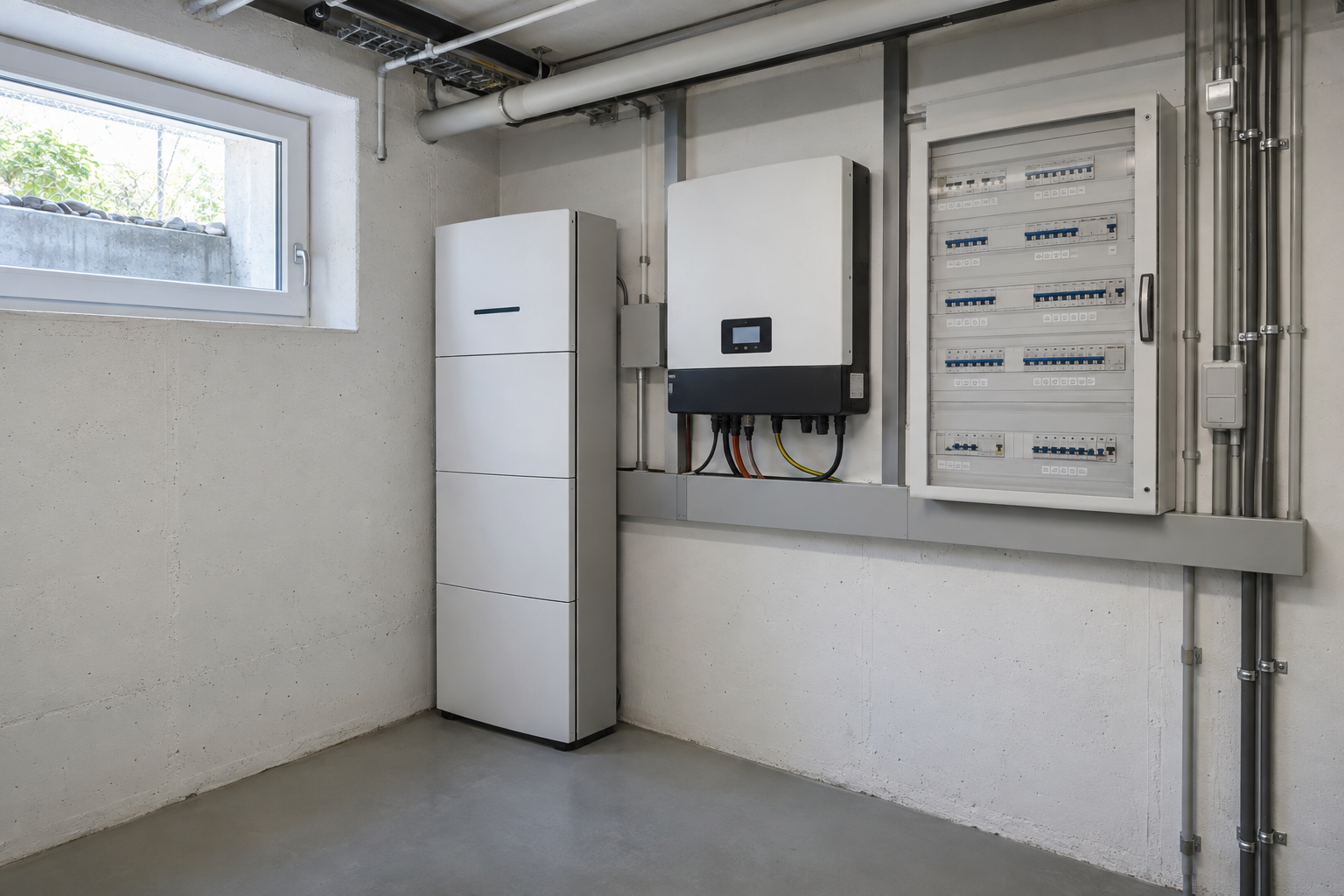
A home battery for a single-family home in Switzerland usually costs CHF 8,000 to 15,000 in 2026, installed, for a capacity of 8 to 12 kWh. That is CHF 1,000 to 1,500 per kWh. Whether the investment pays off depends on three things: the gap between your electricity price and the feed-in tariff, your consumption in the evening, and the size of the battery.
This page shows what a battery delivers and works through an example. The figures are guide values. We give the price for your home in a binding quote after the site visit.
What does a home battery cost?
The price rises with capacity, but not in the same proportion. The inverter, installation and electrical work are needed even for a small battery.
| Capacity | Guide price installed |
|---|---|
| 8 kWh | about CHF 8,000 to 12,000 |
| 10 kWh | about CHF 10,000 to 15,000 |
| 12 kWh | about CHF 12,000 to 15,000 |
Across all sizes the guide values are CHF 1,000 to 1,500 per kWh. Where you end up in that range depends on these points:
- Coupling: A DC-coupled battery on a hybrid inverter is usually cheaper on a new system than a retrofitted AC battery with its own inverter.
- Backup power: The backup function needs a suitable inverter and an adapted distribution board. That raises the price.
- Output: A high output, for example for a heat pump and wallbox, costs more than a small one.
- Location: Long cable runs and a tight utility room increase the effort.
More on technology and sizing on the page battery storage. If you already have a system, read adding a battery.
What does a battery deliver?
A solar system produces most at midday, when residents are often not at home. Without a battery, a household uses about 30 to 35% of its solar power itself. With a suitable battery the share often rises to 60 to 70%.
Each additional self-used kWh replaces power you would otherwise buy at the full tariff. The household median in 2026 is 27.7 ct. per kWh excluding VAT, and ElCom (Federal Electricity Commission) has published 26.6 ct. for 2027. Fed-in power, by contrast, only earns the feed-in tariff. For systems up to 30 kW, a statutory minimum payment of 6 ct. per kWh has applied since 1 January 2026 (Energy Act Art. 15, according to Swissolar). Many grid operators pay more.
So the battery shifts power from midday to the evening and night. It does not replace power the system does not produce. In winter it is often only partly charged.
Worked example: 10 kWp with a 10 kWh battery
Assumptions: a 10 kWp system, yield 1,000 kWh per kWp, so 10,000 kWh a year. Self-consumption 30% without a battery, 65% with one. Electricity price 27.7 ct. per kWh, feed-in tariff 8 ct. per kWh. The battery costs CHF 12,500 (CHF 1,250 per kWh).
| Item | without battery | with battery |
|---|---|---|
| Self-consumption | 3,000 kWh | 6,500 kWh |
| Feed-in | 7,000 kWh | 3,500 kWh |
| Additionally self-used | 3,500 kWh |
Each of these 3,500 kWh brings 27.7 minus 8, that is 19.7 ct. more than feeding in. That comes to around CHF 690 a year. The CHF 12,500 battery then pays for itself after about 18 years. With the 2027 electricity price of 26.6 ct. it is around CHF 650 a year and just over 19 years.
At a feed-in tariff of 6 ct. the benefit rises to around CHF 760 a year. At a high tariff it falls accordingly. Compare the result with the lifetime and warranty of the battery you choose. The example does not include the tax deduction or possible grants.
How big should the battery be?
A battery that is too small brings little. One that is too big stays empty in winter and costs more than needed. As a rule of thumb, allow about 1 kWh of capacity per kWp of solar output. For single-family homes that is usually 8 to 15 kWh. What matters is your consumption in the evening and at night. We read it from your electricity bills and, if available, from your smart meter data. We take the heat pump, electric car and home office into account before comparing several sizes.
When does a battery pay off more easily?
A battery is more likely to suit you if several of these points apply:
- Your grid operator’s feed-in tariff is low.
- You use a lot of power in the evening and at night.
- You have an electric car or a heat pump, and the system is large enough for them.
- You want part of the house to keep running during a grid outage.
- You want to be as independent as possible from the electricity price.
A battery makes less sense if you use a lot of power during the day anyway, for example when working from home, or if the feed-in tariff is high. Self-consumption is then good even without a battery. If you run an electric car and heating on solar power, read the guide Solar power from your own roof.
Subsidies and taxes for the battery
The federal government pays no one-off payment for the battery. The funding under the Energy Funding Ordinance applies to the solar system. Some cantons and communes have their own programmes, which often have an annual budget and change. We check which apply to your address when we prepare the quote.
For tax purposes the battery can be among the deductible investments in energy saving and environmental protection. In the Canton of Zurich the home battery counts. Rules differ by canton. Ask your tax office or tax adviser before ordering. More in the guide Solar system subsidies.
New since 2026: if a battery draws power from the grid and later feeds it back, operators can, according to Swissolar, apply for a refund of the grid charges, provided metering records both quantities. How this works with your grid operator is best asked of your utility.
Battery, EV charger and heat pump together
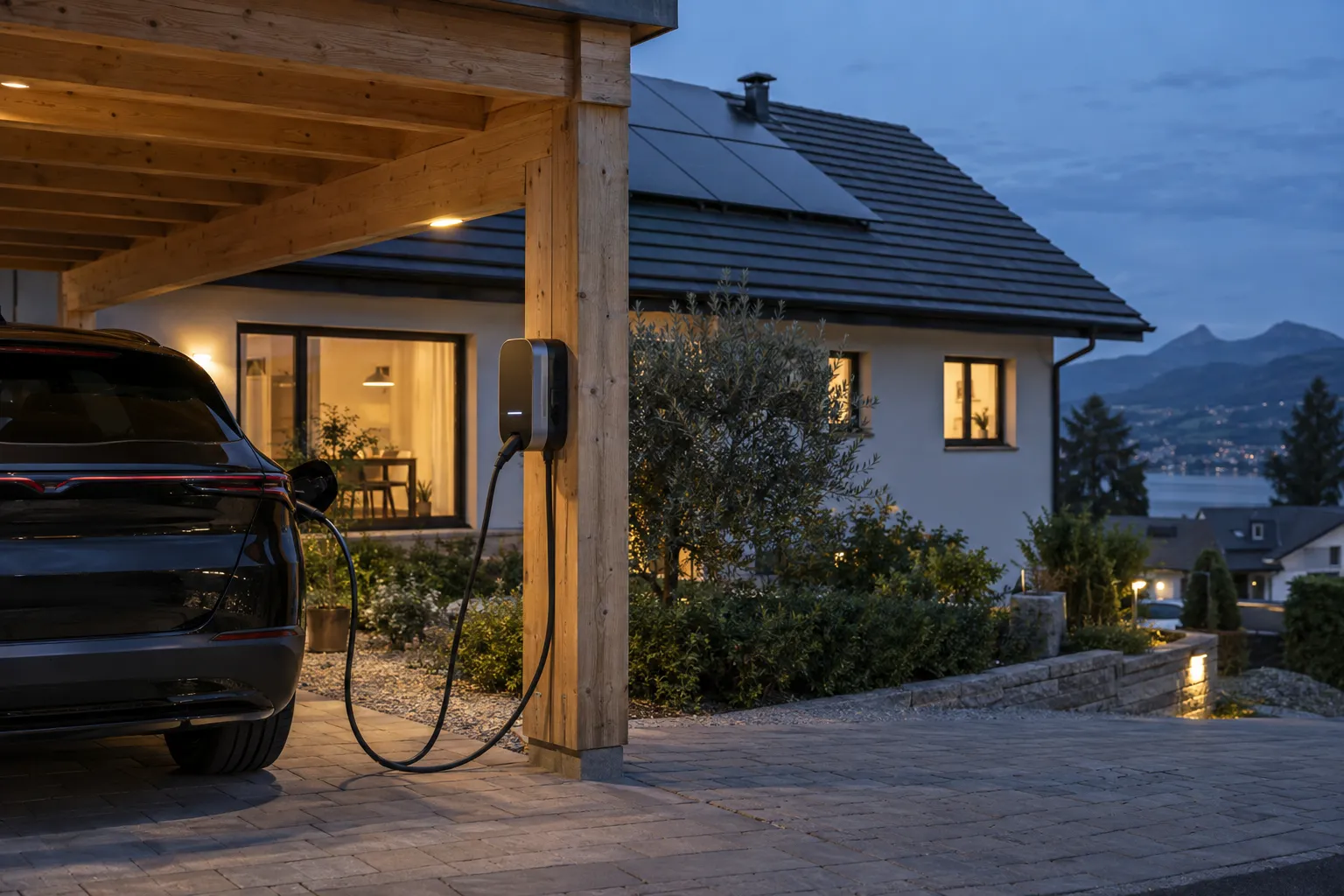
A battery can work together with an EV charger and a heat pump. An energy management system charges the car first with surplus from the roof and runs the heat pump when the sun shines. The battery then covers part of the evening. On the page solar installation you can see how we plan the parts together. The cost of the system itself is in the guide Solar system cost and payback.
We calculate it for your home
Whether a battery pays off for you depends on consumption, system and tariff. At the free site visit we read your consumption from your electricity bills and calculate several battery sizes. Within 72 hours you receive a binding quote with and without a battery side by side. Planning, installation and registration are with us, with our own installers, at our locations in Zumikon and Lachen.
The free site visit
One appointment at your home. Then you know everything.
A project manager from our team visits you and checks three things. No sales show, no obligation. Afterwards you receive a binding quote with yield, subsidies and payback.
 01
01Roof
Area, orientation, pitch, condition of the roof covering and shading.
 02
02Electrical system
Grid connection, distribution board and space for inverter and battery.
 03
03Your consumption
Electricity bill, car, heating, plans. From this we calculate yield and subsidies.
How your project runs
Request
Tell us briefly about your building and your goal. Online or by phone.
Site visit
We check your roof, electrical system and consumption at your home. Free of charge.
Quote in 72 hours
Binding and transparent, with yield, subsidies and payback.
Permit and subsidies
We handle the notification procedure, the grid operator and Pronovo.
Installation and commissioning
Our own installers, a fixed date, final inspection with you on the roof.
Step 1 takes one minute. We take care of the rest.
Frequently asked questions
Before you get in touch.
Is the site visit really free?
Yes. The visit and the quote cost you nothing and commit you to nothing. You only decide once you hold the binding quote in your hands.
What does a home battery cost for a single-family home?
As a guide, CHF 1,000 to 1,500 per kWh, installed. A battery of 8 to 12 kWh therefore costs around CHF 8,000 to 15,000. The binding quote gives the exact price.
Is a battery worth it with the 2026 feed-in tariff?
That depends on your grid operator's tariff. The bigger the gap between the electricity price and the feed-in tariff, the more each self-used kWh brings. We calculate the system with and without a battery side by side.
How much self-consumption does a battery add?
Without a battery households use about 30 to 35% of their solar power themselves, with a suitably sized battery often 60 to 70%. These are guide values. Your daily routine and the battery size determine the result.
Does the federal government pay anything towards the battery?
No. The federal one-off payment (Einmalvergütung) applies to the solar system, not to the battery. Some cantons and communes have their own programmes. For tax purposes, the battery can be deducted like the system in the Canton of Zurich.
Can I add a battery later?
Yes, if the inverter is suitable. We plan for this on new systems. For existing systems, see the options under adding a battery.
Do I need a battery for backup power?
For backup power you need a battery with backup function, a suitable inverter and an adapted electrical distribution. A battery without this function switches off during a grid outage. We plan backup power in from the start.
Which regions do you cover?
All of German-speaking Switzerland. We build most often in the cantons of Zurich, St. Gallen, Schwyz and Aargau. Our locations are in Zumikon ZH and Lachen SZ.
On to the service
Battery storage and what goes with it

The first step
We come to you. Free of charge.
We check your roof, electrical system and consumption. Afterwards you know what is possible on your roof, what it costs and which subsidies you receive. The binding quote follows within 72 hours.
- Free and with no obligation
- Quote within 72 hours
- Subsidies pre-financed on request
