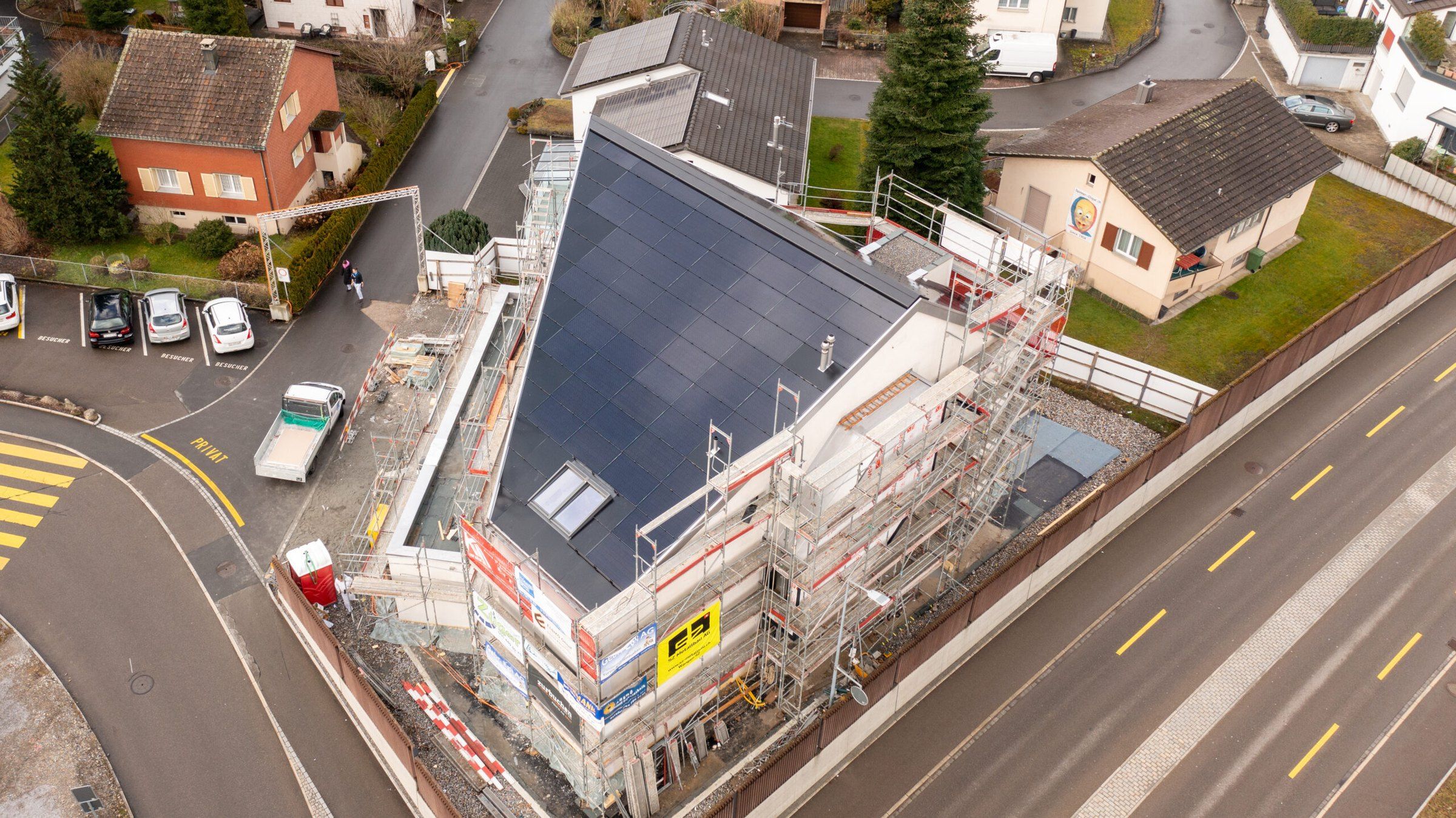
Guide to ZEV and LEG
What is a local electricity community (LEG)?How it differs from ZEV.
Since 1 January 2026, neighbours can share solar power over the public grid. Here you read what applies and how the LEG differs from ZEV and vZEV.
- Site visit: free and with no obligation
- Binding quote within 72 hours
- Subsidies pre-financed on request
Prefer to talk?044 980 08 80
Request a free site visit
Takes 1 minute. No obligation.
- Building
- Location
- Contact
Thank you. We have your request.
We will call you within one working day to arrange the appointment.
Add details Optional
Prefer to talk now? 044 980 08 80
Guide · Updated October 2026
The LEG at a glance
A local electricity community, or LEG, has made it possible since 1 January 2026 to share solar power with neighbours, even though each keeps their own grid connection. The power flows over the public grid. In return, participants pay a reduced grid fee on power exchanged within the community.
The model is new. Many details are set by grid operators and industry recommendations. This page shows what federal law says (status October 2026) and explains the difference from ZEV and vZEV. Where we cannot verify something with certainty, we say so. For an apartment building, you find the classic solution on the page ZEV, vZEV and LEG.
What does federal law say?
The basis is the Electricity Supply Act (StromVG). It was amended by the Federal Act on a Secure Electricity Supply with Renewable Energy (known as the Mantelerlass). The LEG is covered by Articles 17d and 17e StromVG, and Articles 19e to 19h of the Electricity Supply Ordinance (StromVV) implement it. Both have applied since 1 January 2026.
According to ElCom (Federal Electricity Commission), a LEG must meet these requirements:
- Same grid area: All participants are connected in the grid area of the same grid operator.
- Same grid level: Participants are connected at the same grid level. Grid levels above 36 kV are excluded. For households this is grid level 7, the usual low voltage, or grid level 5.
- Same commune: The community may cover the area of one commune at most. The location of the house connection counts.
- Intelligent metering system: All participants have a smart meter.
- Minimum generation: Together, the community’s plants have at least 5% of the connection capacity of all participating consumers. Batteries do not count towards this.
Participation is voluntary. Consumers can take part in only one LEG per consumption site. Plants and batteries can also be used in only one LEG.
The reduced grid fee
The advantage of the LEG is in the price for using the grid. Power exchanged within the community puts less load on the grid than power from a power station. That is why there is a discount on the grid fee:
| Case | Discount |
|---|---|
| The power flows without being stepped up to a higher grid level | 40% |
| The power needs a higher grid level (transformation) | 20% |
Swissolar and several grid operators, such as BKW and ewb, give these percentages for the federal rules. Three limits matter:
- The discount applies only to the grid fee. According to ElCom there is no discount on the metering fee.
- The grid surcharge, levies and payments to public bodies are charged without a discount (Art. 19h StromVV).
- If the plants’ output falls below 5% of the connection capacity, the right to the discount lapses.
How much you save in francs depends on your grid operator’s grid tariff. Grid use is only one part of the electricity price, which in 2026 has a median of 27.7 ct. per kWh excluding VAT (ElCom). The rest is energy, levies and surcharges. We deliberately do not give a figure in ct. per kWh here, because it differs from utility to utility.
How does a LEG work day to day?
A participant’s solar system feeds power into the public grid. The grid operator measures each participant’s feed-in and consumption with the smart meter and calculates what quantity was exchanged within the community. The reduced grid tariff applies to these quantities.
What the community cannot cover, each participant buys from their supplier as before. This is called residual power. For households on basic supply this is the local grid operator. A household on basic supply may also be supplied only by the grid operator or by a LEG participant with self-generated power.
Participants set the price for power within the community among themselves. Disputes about this price go to the civil courts, not to ElCom. Batteries may take part too. Per billing period they may not release more power into the community than they draw from it. Systematically charging from the grid and reselling within the LEG is ruled out.
LEG, ZEV and vZEV compared
All three models share solar power, but they work differently. The key difference is the public grid.
| ZEV | vZEV | LEG | |
|---|---|---|---|
| Legal basis | Energy Act (self-consumption) | Energy Act (self-consumption) | Electricity Supply Act Art. 17d and 17e |
| Power flows | at the place of production, without the public grid | at the place of production, allocation is virtual | over the public grid |
| Counts as self-consumption | yes | yes | no |
| Towards the grid | one end consumer | one end consumer | each participant individually |
| Spatial scope | the plot and further plots without using the grid | as for ZEV | same commune, same grid area, same grid level |
| Grid fee | does not apply to internal power | does not apply to internal power | 40% or 20% discount |
The ZEV (Zusammenschluss zum Eigenverbrauch, self-consumption community) may use self-generated power at the place of production without using the public grid. The place of production covers the plot of the system and further plots where the power can be used without the distribution grid. Towards the outside, all participants count as one single end consumer.
The vZEV is a virtual ZEV. The parties keep their meters, and the solar power is allocated by calculation. For power drawn from the grid, like a ZEV, it counts as one end consumer.
The LEG is not self-consumption. Because the power uses the public grid, participants pay a grid fee, but with a discount. In return, the model reaches beyond buildings and plots, for example to a neighbourhood of several houses.
Rule of thumb: if all apartments are in the same building or on the same plot, a ZEV or vZEV is usually the better choice, because no grid fee arises. The LEG comes into play when houses are connected to the grid separately. We describe how a ZEV works on the page ZEV, vZEV and LEG.
What to clarify before a LEG
The LEG is young, and not every detail is implemented the same way everywhere. Clarify these points with your grid operator:
- Connection: Are all participants in the same grid area, on the same grid level and in the same commune?
- Metering: Do all participants have smart meters, and what does metering cost?
- Billing: Who represents the community towards the grid operator, and who does the internal billing?
- Tariff: How high is the discount in francs, and what fees arise for the LEG?
- Generation: Are the plants enough for 5% of the connection capacity?
If a plant has received the high one-off payment for full feed-in, ElCom says this does not stand in the way of joining a LEG, because power in a LEG does not count as self-consumption.
We do not carry out a legal review of the contracts. Your lawyer is responsible for that.
What this means for your project
If you build or renovate an apartment building, you usually choose between ZEV and vZEV, because internal power avoids the grid fee. The LEG is interesting for groups that want to link houses on separate plots. Both start with a suitable solar installation. A home battery raises the share of solar power that stays in the community, and an EV charger uses the surplus during the day.
We calculate it for your building
Which model fits depends on the building, the connection and the grid operator. We check this at the free site visit and tell you what is possible with your grid operator today. Within 72 hours you receive a binding quote for the solar system and metering. Planning through to commissioning is with us, with our own installers, at our locations in Zumikon and Lachen.
The free site visit
One appointment at your home. Then you know everything.
A project manager from our team visits you and checks three things. No sales show, no obligation. Afterwards you receive a binding quote with yield, subsidies and payback.
 01
01Roof
Area, orientation, pitch, condition of the roof covering and shading.
 02
02Electrical system
Grid connection, distribution board and space for inverter and battery.
 03
03Your consumption
Electricity bill, car, heating, plans. From this we calculate yield and subsidies.
How your project runs
Request
Tell us briefly about your building and your goal. Online or by phone.
Site visit
We check your roof, electrical system and consumption at your home. Free of charge.
Quote in 72 hours
Binding and transparent, with yield, subsidies and payback.
Permit and subsidies
We handle the notification procedure, the grid operator and Pronovo.
Installation and commissioning
Our own installers, a fixed date, final inspection with you on the roof.
Step 1 takes one minute. We take care of the rest.
Frequently asked questions
Before you get in touch.
Is the site visit really free?
Yes. The visit and the quote cost you nothing and commit you to nothing. You only decide once you hold the binding quote in your hands.
What is a local electricity community (LEG)?
A LEG is a group of electricity consumers, producers and storage operators who sell self-generated power to each other over the public grid. It has been possible since 1 January 2026. A reduced grid fee applies to power exchanged within the community.
How big is the discount on the grid fee?
It is 40% if the power does not have to be stepped up to a higher grid level. If a higher grid level must be used, it is 20%. The discount applies only to the grid fee, not to levies, surcharges and the metering fee.
What is the difference between LEG and ZEV?
A ZEV uses the power at the place of production, without the public grid, and counts as one end consumer towards the grid. A LEG uses the public grid, and each participant keeps their own connection and grid contract. Legally, a LEG is not self-consumption.
Can neighbouring houses take part in a LEG?
Yes, if all of them are in the same grid area, on the same grid level and in the same commune. A LEG may not extend beyond the commune boundary. Your grid operator clarifies whether your connection qualifies.
Do I need a smart meter for a LEG?
Yes. All participants must have an intelligent metering system. The grid operator supplies the meter data and calculates how much power was exchanged within the community.
Is taking part in a LEG compulsory?
No, it is voluntary. For each consumption site, participation in only one LEG is possible. Generation plants and batteries may also be used in only one LEG.
Which regions do you cover?
All of German-speaking Switzerland. We build most often in the cantons of Zurich, St. Gallen, Schwyz and Aargau. Our locations are in Zumikon ZH and Lachen SZ.
On to the service
ZEV and vZEV and what goes with it

The first step
We come to you. Free of charge.
We check your roof, electrical system and consumption. Afterwards you know what is possible on your roof, what it costs and which subsidies you receive. The binding quote follows within 72 hours.
- Free and with no obligation
- Quote within 72 hours
- Subsidies pre-financed on request
