Guide to EV chargers
Bidirectional charging: what works in Switzerland?As of October 2026.
The car as storage for the house or the grid is technically possible, but not yet for every car and every house. Here is what is documented today.
- Site visit: free and with no obligation
- Binding quote within 72 hours
- Subsidies pre-financed on request
Prefer to talk?044 980 08 80
Request a free site visit
Takes 1 minute. No obligation.
- Building
- Location
- Contact
Thank you. We have your request.
We will call you within one working day to arrange the appointment.
Add details Optional
Prefer to talk now? 044 980 08 80
Guide · Updated October 2026
Bidirectional wallbox: legal position, vehicles, costs
Bidirectional charging means that the car not only takes in electricity but also gives it back. In the evening the car can then supply the house (vehicle-to-home, V2H) or feed power into the grid (vehicle-to-grid, V2G). The idea is good: a car battery is often larger than any home battery.
In practice, the situation in Switzerland in October 2026 is this: it is allowed and technically feasible, but only with few combinations of car and wallbox, and not yet economical everywhere. On this page we tell you what is documented today and what is still open. We make no promises.
Three terms
- V2H (vehicle-to-home): The car gives power to your own house. The day’s solar power is available in the evening.
- V2G (vehicle-to-grid): The car feeds power into the grid, for example to stabilise it.
- V2L (vehicle-to-load): The car supplies an appliance directly through a socket on the vehicle. No wallbox is needed. Whether your car can do this is in the owner’s manual.
What is allowed today
Bidirectional charging is not prohibited in Switzerland. A bidirectional EV charger counts as storage with end consumption and must be registered with the distribution grid operator through the technical connection request (Technisches Anschlussgesuch, TAG). A qualified electrical installer submits it. Since 1 January 2022 an updated request has been provided for this (source: Swiss eMobility, German). Devices above 3.6 kW must be reported.
Since 1 January 2026 there is also this: if you charge electricity from the grid into storage with end consumption and later feed it back, you can have the grid usage charge refunded by the grid operator for the quantity fed back. This requires metering that records draw and feed-back separately. At most the quantity previously drawn from the grid is refunded (sources: Swissolar, Energonia, both German). This applies to stationary home batteries as well as to bidirectional EV chargers.
What is not regulated here: the grid operator must take solar power, but there is no obligation to take power from a battery, unless it needs it to relieve the grid (source: Energeia, December 2025). What you get for car power fed back is therefore something you agree with the grid operator.
Which cars can do it
The vehicle question is the tightest point:
- CHAdeMO vehicles such as the Nissan Leaf and the Honda e have charged bidirectionally for years. In Japan the function has been standard since 2013.
- CCS vehicles, which means most new cars in Switzerland, are partly prepared technically. Whether the function is enabled is decided by the manufacturer, often only with a particular wallbox. With VW ID models, for example, it works only with approved charging stations.
- Alternating-current (AC) solutions, where the wallbox stays simple and cheap, are not approved or only rarely approved in Switzerland today.
Supplier overviews name, among others, the Hyundai Ioniq 5 and 6, Kia EV6 and EV9, Renault 5, Skoda Enyaq, Volvo EX90 and VW ID models as technically prepared. The lists differ, and not every function is released in Switzerland. For your car we check this by model and year of manufacture and obtain the manufacturer’s confirmation.
Standard and communication
For every car to talk to every wallbox, a common standard is needed. That is ISO 15118-20. It governs communication between vehicle and charging station, including feeding back. It is not mandatory, and manufacturers do not yet implement it uniformly. Nationwide implementation is expected for 2027 to 2028, for direct-current solutions at the earliest in 2028 (sources: Energeia, Mobility, Powernewz). Until then, car and wallbox must expressly match.
What the pilot projects showed
The largest trial in Switzerland was called V2X Suisse (2021 to 2024). The Mobility cooperative tested 50 bidirectional Honda e cars at around 40 locations in its car-sharing network, supported by the Federal Office of Energy. Partners included Honda, EVTEC, sun2wheel and tiko.
The results (sources: Mobility, electrive):
- The technology works. On average 5.5 kWh per day was converted bidirectionally per active vehicle.
- Together the vehicles formed a virtual storage unit that met Swissgrid’s requirements for balancing power.
- On paper, up to CHF 2,000 a year of flexibility revenue per vehicle was possible.
- A business model did not emerge at the time, mainly because of high equipment prices. Mobility did not continue the project.
Mobility named expensive charging stations, few vehicles, grid operators’ terms and the missing uniform standard as hurdles.
What it costs
Simple AC wallboxes prepared for bidirectional charging are in part available from about CHF 1,000. Full direct-current charging stations cost about CHF 3,300 to 8,000 with installation depending on the source, and older reports also mentioned about CHF 12,000 (sources: Powernewz, energie-experten.ch, both German). An ordinary EV charger costs about CHF 2,000 to 5,500 with installation. Prices change quickly, so we give binding figures only in the quote.
A simple calculation for V2H
The following calculation is an upper limit, not a promise. Assumptions: grid power 27.7 ct. per kWh, assumed feed-in tariff 8 ct., 3,000 kWh of solar power a year that the car gives to the house in the evening instead of feeding it in.
- Benefit per kWh: 27.7 minus 8 ct., so 19.7 ct.
- 3,000 kWh times 0.197 = about CHF 590 a year before deductions.
From this come losses in charging and discharging, the extra cost compared with an ordinary wallbox, and the additional wear on the car battery, which manufacturers assess differently. A stationary home battery reaches similar values in this calculation, but has no vehicle question. How home batteries pay off is in the guide What does a home battery cost?.
What you can provide for today with an EV charger
If you install a wallbox now, you do not have to give up bidirectional charging. It makes sense to have:
- A wallbox with an open interface that can later be linked to an energy management system.
- A cable with reserve, so that a later wallbox needs no new cable. Which power is enough today is explained in the guide EV charger 11 kW or 22 kW.
- A solar system that supplies the power. How charging with surplus works today is in the guide EV charger with a solar system.
- When buying a car, the manufacturer’s written confirmation that bidirectional charging is approved with warranty.
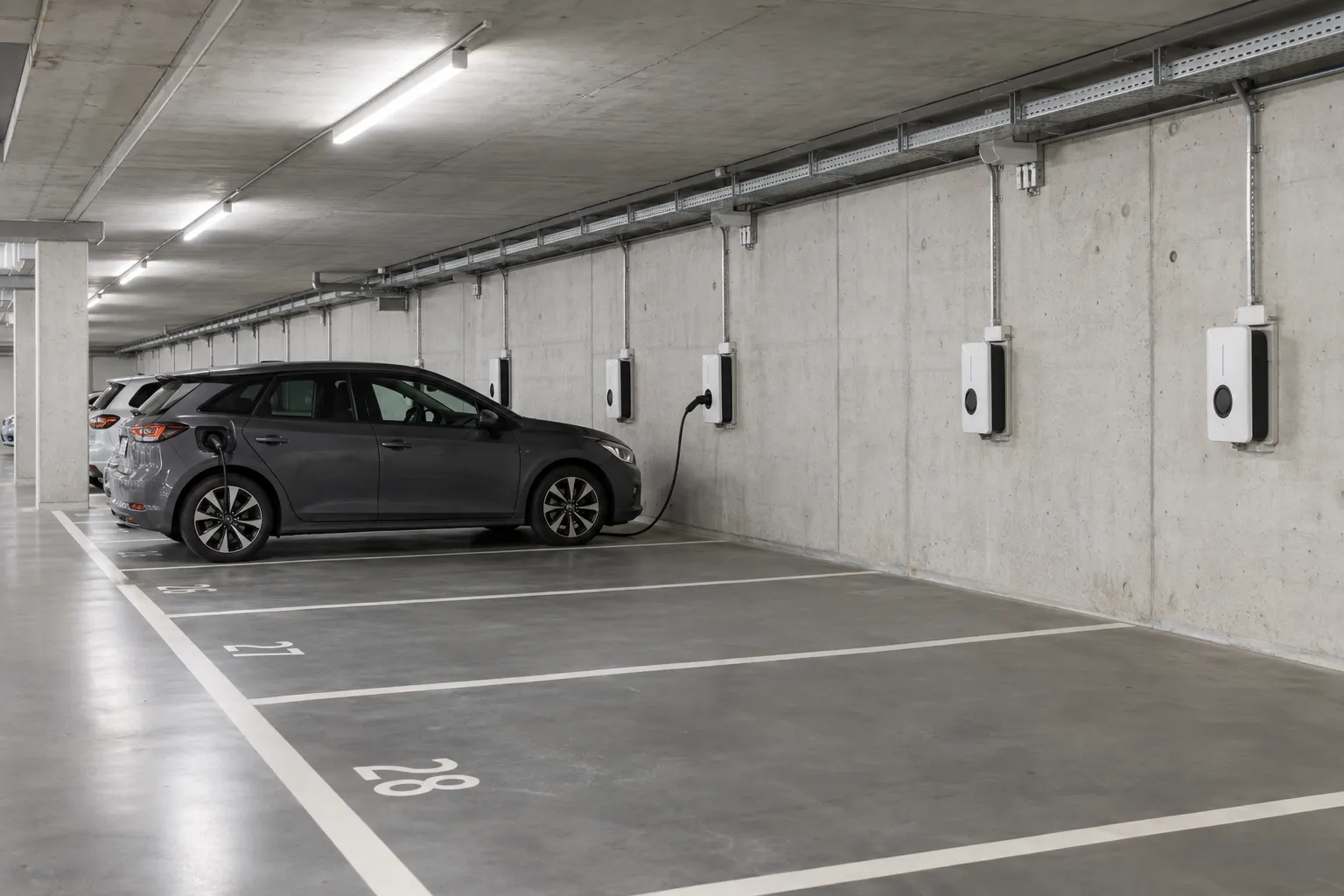
These points also apply in apartment buildings and underground car parks. There, coordination with property management comes in, see EV charging in underground car parks.
We calculate it for your house
At the free site visit we clarify which car you drive or want to buy, what your distribution board looks like and whether a bidirectional solution is an option for you today. If not, we prepare the installation so that the switch stays simple later. Within 72 hours you receive a binding quote. We handle registration with the grid operator and installation by our own installers from a single source. We plan the EV charger from Zumikon and Lachen for the whole of German-speaking Switzerland.
The free site visit
One appointment at your home. Then you know everything.
A project manager from our team visits you and checks three things. No sales show, no obligation. Afterwards you receive a binding quote with yield, subsidies and payback.
 01
01Roof
Area, orientation, pitch, condition of the roof covering and shading.
 02
02Electrical system
Grid connection, distribution board and space for inverter and battery.
 03
03Your consumption
Electricity bill, car, heating, plans. From this we calculate yield and subsidies.
How your project runs
Request
Tell us briefly about your building and your goal. Online or by phone.
Site visit
We check your roof, electrical system and consumption at your home. Free of charge.
Quote in 72 hours
Binding and transparent, with yield, subsidies and payback.
Permit and subsidies
We handle the notification procedure, the grid operator and Pronovo.
Installation and commissioning
Our own installers, a fixed date, final inspection with you on the roof.
Step 1 takes one minute. We take care of the rest.
Frequently asked questions
Before you get in touch.
Is the site visit really free?
Yes. The visit and the quote cost you nothing and commit you to nothing. You only decide once you hold the binding quote in your hands.
Is bidirectional charging allowed in Switzerland?
Yes. There is no ban. Every bidirectional installation must, however, be registered with the distribution grid operator by technical connection request, and it is installed by a qualified electrician.
Which electric cars can charge bidirectionally?
That depends on model, connector and software. It has worked longest with vehicles with a CHAdeMO connector such as the Nissan Leaf. For vehicles with a CCS connector, the manufacturer decides whether and with which wallbox it is approved. Ask in writing before you buy.
Will I lose the battery warranty?
The manufacturer decides. Some give a warranty only for approved combinations of car and wallbox. Get the commitment in writing before you invest.
Does a bidirectional wallbox pay off financially today?
The V2X Suisse pilot concluded that a business model did not add up at the equipment prices of the time. For your own house (V2H) the calculation can look better. It depends on unit, car and driving profile. We work it out with you.
Do I get paid for car power fed back into the grid?
Since 2026 the grid usage charge for the power fed back is refunded on request, if the metering is right. There is no automatic payment for the power itself. The grid operator does not necessarily have to take power from storage.
Should I buy a bidirectional wallbox today?
Only if your car or your next car can definitely do it. Otherwise we recommend a wallbox with an open interface and a cable with reserve. That keeps a later upgrade simple.
Which regions do you cover?
All of German-speaking Switzerland. We build most often in the cantons of Zurich, St. Gallen, Schwyz and Aargau. Our locations are in Zumikon ZH and Lachen SZ.
On to the service
EV charger and what goes with it

The first step
We come to you. Free of charge.
We check your roof, electrical system and consumption. Afterwards you know what is possible on your roof, what it costs and which subsidies you receive. The binding quote follows within 72 hours.
- Free and with no obligation
- Quote within 72 hours
- Subsidies pre-financed on request
