Guide to EV chargers
What does an EV charger cost?Unit, cable, electricity.
The unit is only part of the bill. Installation often costs more. Here you see what the price is made of and how solar power makes charging cheaper.
- Site visit: free and with no obligation
- Binding quote within 72 hours
- Subsidies pre-financed on request
Prefer to talk?044 980 08 80
Request a free site visit
Takes 1 minute. No obligation.
- Building
- Location
- Contact
Thank you. We have your request.
We will call you within one working day to arrange the appointment.
Add details Optional
Prefer to talk now? 044 980 08 80
Guide · Updated October 2026
Wallbox: costs for unit, installation and electricity
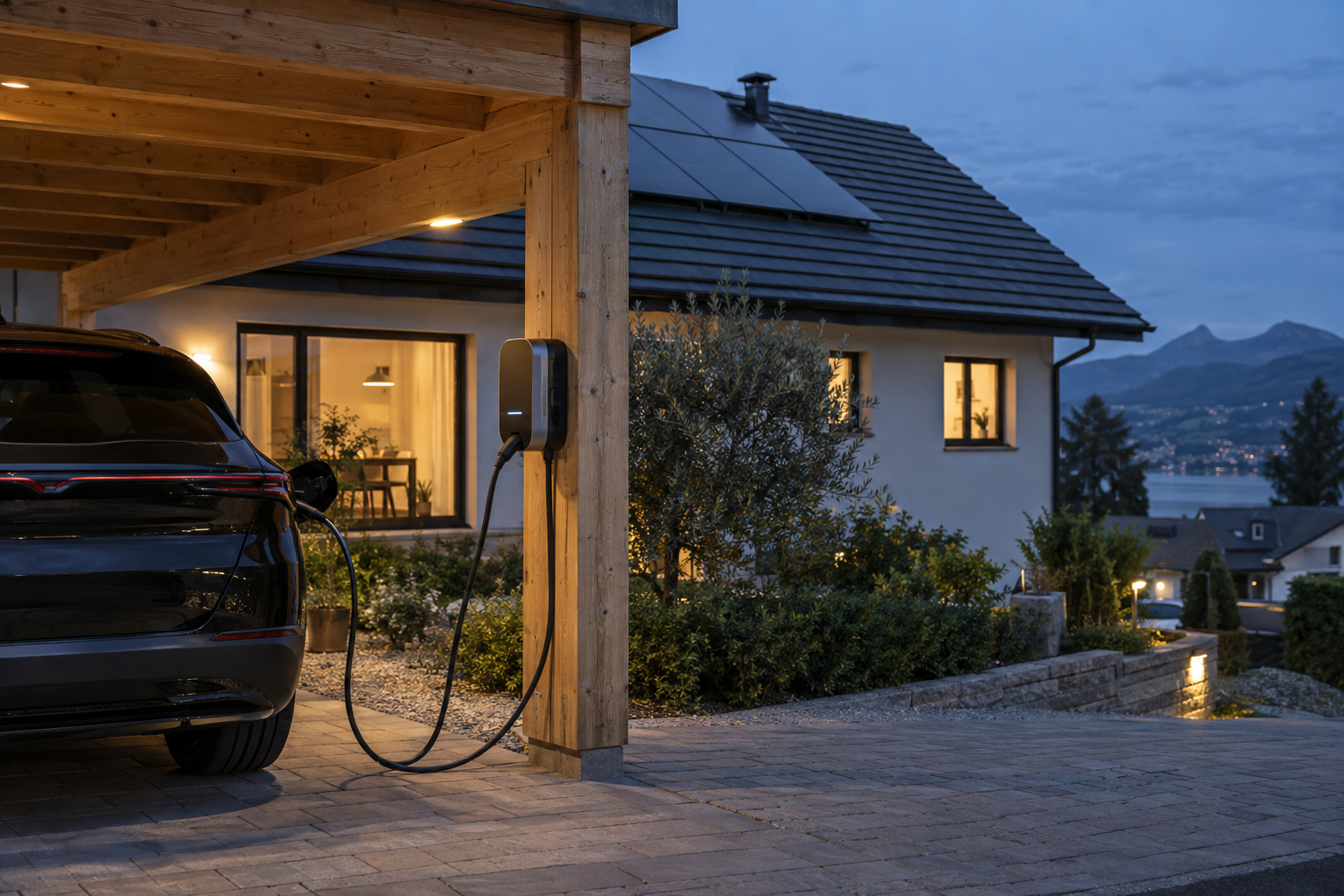
A wallbox with installation in a single-family home usually costs around CHF 2,000 to 5,500. The unit accounts for about CHF 800 to 2,500 of that, and installation for CHF 1,000 to 3,000. Electricity at home costs around CHF 5 per 100 kilometres, and much less with your own solar power.
These are guide figures, not prices. What your EV charger costs is only known after the site visit. The length of the cable route in particular decides.
The unit: 11 kW, 22 kW, smart
For most households, an 11 kW wallbox is enough. It charges on three phases and puts enough power into the car overnight for several hundred kilometres. Units start at around CHF 800.
A 22 kW wallbox is only worthwhile if your car can also charge at 22 kW. Many models take only 11 kW on AC. Then you pay for power that the car does not use. A 22 kW unit also needs a stronger supply cable, and the grid operator sets higher requirements.
The price rises with the features:
- Basic: charging, access protection by key or card.
- Smart: app, charging schedule, consumption display.
- Solar-ready: surplus charging and a link to the inverter or energy manager. This is mainly of interest to households with a solar system.
The right choice depends on your car and your system. For more on selection and the process, see EV chargers.
Installation: cable, fusing, distance
This is where the biggest price difference arises. The wallbox is permanently wired, and only a licensed electrician may do that. The effort includes:
- Supply cable: a dedicated cable from the distribution board to the wallbox. Every metre adds material and labour costs.
- Fusing: circuit protection and residual-current protection in the distribution board. With older installations, a new or larger distribution board is sometimes needed.
- Distance: if the garage is next to the distribution board, it is cheap. If the cable has to go through a wall, the cellar or the garden, it gets more expensive. Digging costs extra.
- Safety certificate: inspection and documentation are part of the job.
The price goes down if the cable was already prepared during a renovation, or if you combine the installation with a solar system or a battery. Then some work is only done once.
Registration with the grid operator
An EV charger is a heavy consumer. You therefore have to notify the grid operator, and depending on the grid operator, an approval is needed above a certain power. The requirements differ from one grid area to another.
At best, the procedure costs you only time. We submit the documents and clarify deadlines and conditions. That way there are no surprises at installation.
Apartment buildings and underground car parks
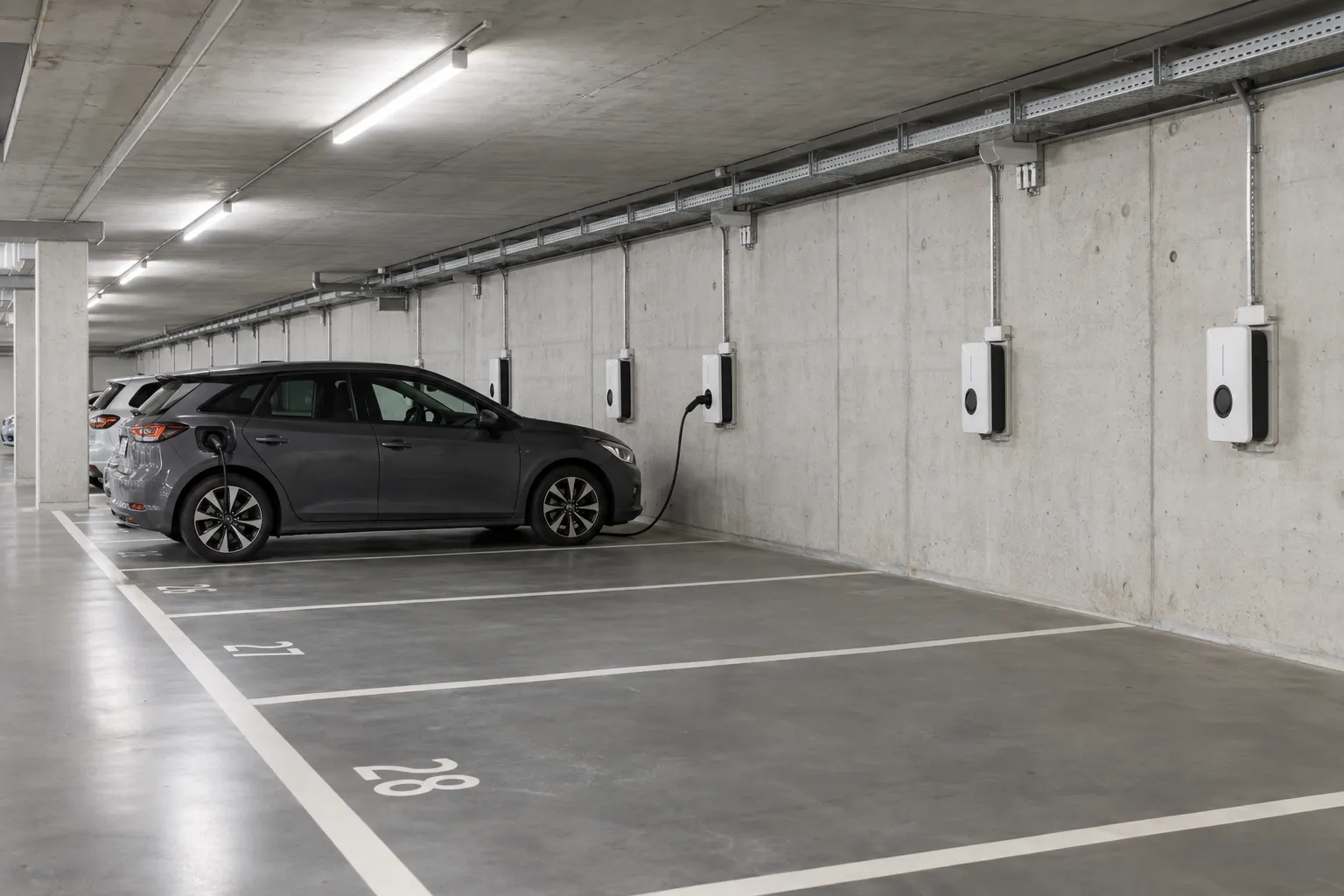
Several EV chargers on one building connection are a different task from a single wallbox. Load management shares the available power between all the cars so that the connection is not overloaded. This can avoid expensive upgrades of the building’s supply line.
Then there is billing per user and the decision of the owners or property management. You can read how this works under EV charging in underground car parks.
Subsidies and taxes
The federal government does not subsidise private EV chargers. Some cantons, communes (municipalities) and electricity utilities do pay a contribution, often for load management or in combination with solar power. The programmes change quickly, and the funds are sometimes used up fast.
In many cantons, you can deduct the cost of an EV charger in an existing building from your taxes. Ask your tax office about this. We check which subsidy currently applies for your address and tell you before the quote.
Charging with solar surplus lowers the cost
An electric car needs about 15 to 20 kWh per 100 kilometres. According to ElCom (Federal Electricity Commission), grid electricity in the 2026 median for basic supply costs about 27.7 ct. per kWh excluding VAT. Your tariff may differ.
Worked example (assumptions, not an offer): 15,000 kilometres a year, 18 kWh per 100 km.
- Electricity needed: 15,000 / 100 x 18 = 2,700 kWh a year.
- With grid power: 2,700 x 0.277 = around CHF 750 a year, so about CHF 5 per 100 km.
- With your own solar power: power from the roof only costs you the feed-in payment you give up. With an assumed feed-in tariff of 8 ct., that is 2,700 x 0.08 = around CHF 216 a year, so about CHF 1.50 per 100 km.
- If you charge half of the electricity with solar power, you save about CHF 270 a year compared with grid power alone.
The feed-in tariff differs widely between grid operators. That is why we calculate with your tariff in the quote.
For surplus charging to work, the wallbox has to regulate its power according to the roof yield. If you are not at home during the day, combine it with a battery storage system that collects the solar power for the evening.
What you can clarify before the quote
If you are prepared, you get a more accurate quote and save follow-up questions. Three things help:
- Photo of the distribution board: the meter cabinet and fuses show whether there is enough space and power.
- Parking space and route: where should the wallbox be mounted, and how does the route from the distribution board get there?
- Your car: model and maximum AC charging power. This helps you avoid an oversized wallbox.
If you rent, or live in condominium ownership, the consent of property management or the owners’ association is also needed. We prepare a quote that you can present there. If you expect a second electric car, plan the supply cable larger from the start. It costs little today and saves a second intervention later.
Running costs and maintenance
A wallbox needs hardly any maintenance. Service contracts are rarely necessary in a private household. You should expect the charging electricity, a possible fee model in the manufacturer’s app, and a check of the installation as part of the periodic electrical inspection. With units that have cloud functions, it is worth reading the small print: some functions become chargeable after a trial period.
Example: three typical situations
The following cases are examples to give you an idea, not quotes.
- Garage right next to the distribution board: short cable route, 11 kW unit with no special functions. This is the cheap option, close to the lower end of the range.
- Carport in the garden, 25 metres from the house: the cable has to be laid in the ground. Digging and cable push the installation cost up.
- House with solar system and battery: the wallbox needs an interface to the energy manager. The unit costs more, but it charges with solar surplus.
The second case in particular shows why a flat price over the phone is of little use. Only someone who has seen the route and the ground can calculate a binding price.
After installation
Commissioning includes a test of the installation, the safety certificate and an introduction to the app. Afterwards you can see how much electricity you charge and how much of it comes from the roof. That lets you check later whether the numbers add up, and adjust the charging times.
We calculate it for your home
Wallbox, cable, registration and subsidies: we look at the distribution board, parking space and cable route. The site visit is free, and you receive a binding quote within 72 hours. Unit, installation and possible contributions are listed separately, and on request together with a solar system and battery.
The free site visit
One appointment at your home. Then you know everything.
A project manager from our team visits you and checks three things. No sales show, no obligation. Afterwards you receive a binding quote with yield, subsidies and payback.
 01
01Roof
Area, orientation, pitch, condition of the roof covering and shading.
 02
02Electrical system
Grid connection, distribution board and space for inverter and battery.
 03
03Your consumption
Electricity bill, car, heating, plans. From this we calculate yield and subsidies.
How your project runs
Request
Tell us briefly about your building and your goal. Online or by phone.
Site visit
We check your roof, electrical system and consumption at your home. Free of charge.
Quote in 72 hours
Binding and transparent, with yield, subsidies and payback.
Permit and subsidies
We handle the notification procedure, the grid operator and Pronovo.
Installation and commissioning
Our own installers, a fixed date, final inspection with you on the roof.
Step 1 takes one minute. We take care of the rest.
Frequently asked questions
Before you get in touch.
Is the site visit really free?
Yes. The visit and the quote cost you nothing and commit you to nothing. You only decide once you hold the binding quote in your hands.
What does a wallbox cost without installation?
The unit alone costs about CHF 800 to 2,500 depending on features. Simple 11 kW units are at the lower end, models with solar control and load management above that.
Why is installation often more expensive than the wallbox?
The cable from the distribution board to the parking space makes up the effort: cable, fusing, wall openings and possibly digging. The longer the route, the higher the price.
Do I have to register the EV charger with the grid operator?
Yes, in most cases. Depending on the grid operator, there is a duty to notify or to obtain approval, especially above a certain power. We submit the documents for you.
Are there subsidies for a wallbox?
The federal government does not subsidise private EV chargers. Some cantons, communes (municipalities) and electricity utilities do pay contributions. The programmes change, so we check the current position for your address.
What does charging at home cost per 100 kilometres?
At 18 kWh per 100 km and a grid tariff of 27.7 ct., it is around CHF 5. With your own solar power the cost is lower. The worked example below shows the assumptions.
Do I really save money with a smart wallbox?
It pays off mainly with a solar system. A wallbox with surplus charging uses the roof power and reduces what you buy from the grid. Without your own generation, it helps you charge at the cheaper night tariff.
Which regions do you cover?
All of German-speaking Switzerland. We build most often in the cantons of Zurich, St. Gallen, Schwyz and Aargau. Our locations are in Zumikon ZH and Lachen SZ.
On to the service
EV charger and what goes with it

The first step
We come to you. Free of charge.
We check your roof, electrical system and consumption. Afterwards you know what is possible on your roof, what it costs and which subsidies you receive. The binding quote follows within 72 hours.
- Free and with no obligation
- Quote within 72 hours
- Subsidies pre-financed on request
