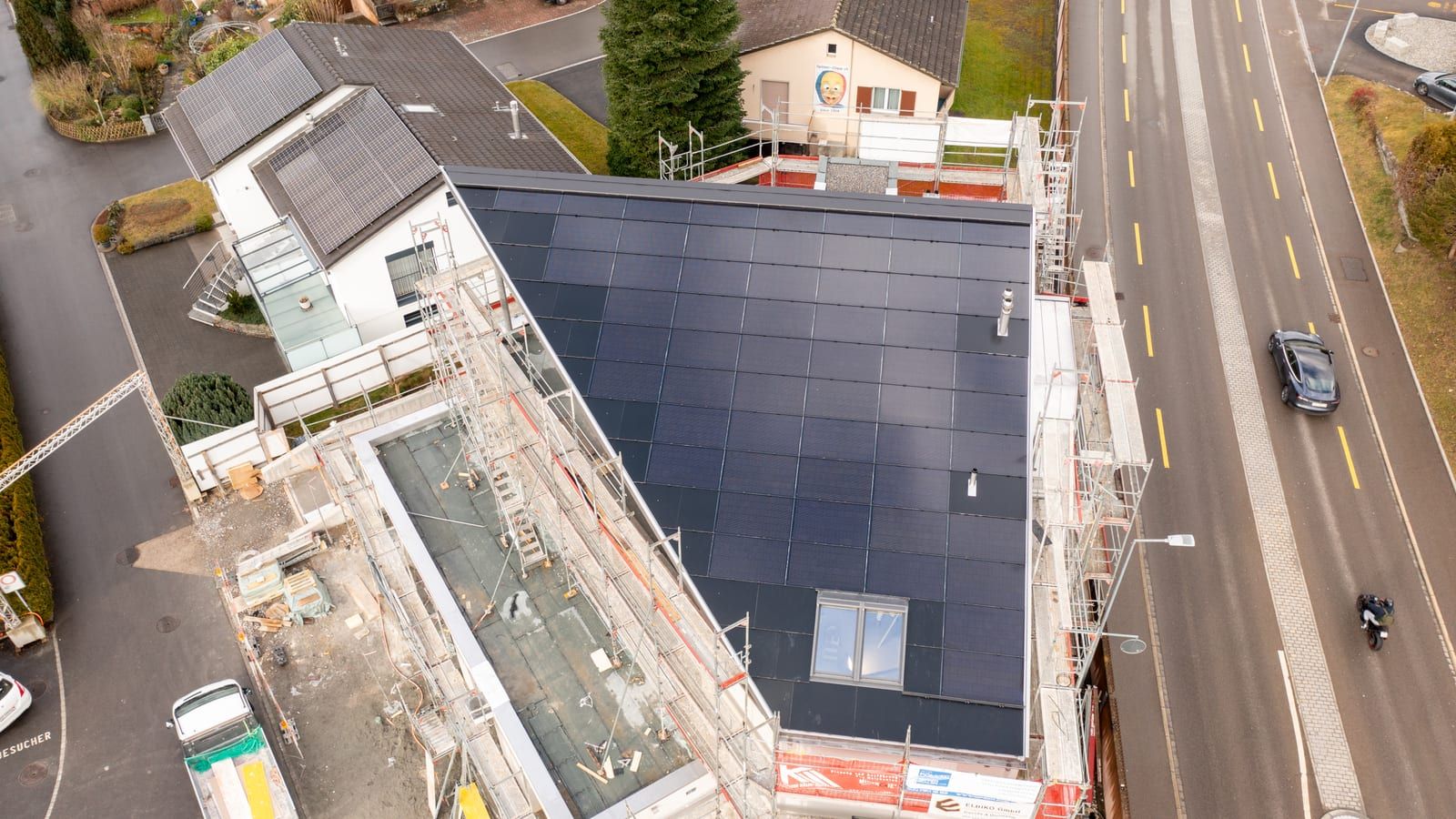
Guide for architects
Photovoltaics on the facadeWinter power and safety.
A solar facade delivers a higher share of its annual yield in winter than a roof. Here architects find what to clarify early: fire protection, subsidies, permits and planning.
- Site visit: free and with no obligation
- Binding quote within 72 hours
- Subsidies pre-financed on request
Prefer to talk?044 980 08 80
Request a free site visit
Takes 1 minute. No obligation.
- Building
- Location
- Contact
Thank you. We have your request.
We will call you within one working day to arrange the appointment.
Add details Optional
Prefer to talk now? 044 980 08 80
Guide · Updated October 2026
Solar facade: what architects should clarify early
A solar facade generates electricity where buildings have plenty of surface and the roof often does not suffice. Facades deliver less annual yield per square metre than a well-oriented roof, but a higher share of it in winter. According to Swissolar, about 45 per cent of a facade system’s annual yield falls in the winter half-year, compared with about 25 per cent for roof systems. For architects and planners this means the facade belongs in the design early. This page summarises what needs to be clarified.
Whether facade or roof, the basis is the same as for any solar system. What applies to pitched roofs is covered under in-roof solar system.
Why winter electricity on the facade matters
In winter a building uses the most electricity, above all with a heat pump. At the same time, roof systems deliver the least. A vertical surface makes better use of the low winter sun. Snow hardly stays on modules in a vertical position. East and west facades also deliver in the morning and evening, when consumption is high.
The Swiss Federal Office of Energy estimates the potential of suitable facade surfaces in Switzerland at about 17 TWh per year, of which a large part falls in the winter half-year (study Winterstrom Schweiz, BFE, German). Facade systems made up only 1.3 per cent of new installations in 2023 (Swissolar). The difference from the roof remains: the annual yield per kWp is lower. You should therefore calculate profitability with your own consumption profile.
Orientation, shading and grid
Three points are decisive for planning.
- Orientation: South facades deliver the most in winter. South-east and south-west deliver more evenly over the year. North facades are not suitable.
- Shading: Neighbouring buildings, trees, balconies and canopies shade parts of the surface. With modules wired in series, one shaded module slows the whole string. That is why the surfaces are surveyed before planning and the wiring concept is matched to them.
- Grid and colour: Module format, joint pattern and colour determine the look. Modern facade modules come in different colours and finishes. Coloured modules may deliver somewhat less electricity, and that belongs in the yield calculation.
Ventilated or integrated
A PV facade can be built as a rain-screen, ventilated facade. The modules then form the outer layer, with insulation and the load-bearing wall behind. The ventilation keeps the modules cool and carries moisture away. It is also a point for fire protection, see below.
Compared with a conventional ventilated facade, the building and electrical effort is higher. This includes the substructure, cable routing through the envelope, inverters and fall protection during installation. Against this stands the saving on the facade material that the modules replace. How the balance works out depends strongly on the project. We set it out openly in the quote.
Fire protection under VKF
For fire protection, two levels need to be distinguished.
The VKF fire protection regulations and the fire protection information sheet on solar systems from the Association of Cantonal Fire Insurers (VKF) apply to all PV systems. They set out protection goals, sources of danger and solution approaches, such as distances, cable routing and shut-off. The cantons implement them, and the fire protection authority checks the project.
For ventilated PV facades there is also a transitional document from Swissolar (October 2023). It describes an argument-based verification procedure for medium-rise buildings (11 to 30 metres) and high-rise buildings (30 to 100 metres). It sets requirements for modules, cable routing and structural fire protection measures. The document applies until the end of 2026 or until binding technical rules exist. For tall buildings with a ventilated facade, VKF requires a fire protection verification procedure (fire protection guideline 27-15).
In practice: clarify fire protection with the fire protection specialist and the cantonal authority during project design, before the construction stage. We supply the module and cable data and plan the execution accordingly.
One-off payment for facade systems
The federal government supports systems under 30 kWp with a one-off payment (Einmalvergütung) from Pronovo. There has been no base amount since 1 April 2025. The payment is CHF 360 per kWp for attached and CHF 400 per kWp for integrated systems (EnFV Annex 2.1).
A system counts as integrated if, besides generating electricity, it takes on a second function of the building envelope, such as weather protection, thermal insulation or fall protection. A facade system that replaces cladding can count. We clarify whether your system counts as integrated before registration. For steeply inclined systems, a tilt bonus is also possible. Pronovo gives CHF 400 per kW for integrated and CHF 200 per kW for attached systems. We check the exact conditions for each project.
For larger systems from 100 kW, other procedures apply: the application is made before construction. We register the system and submit the subsidy application. The subsidy can be pre-financed on request. More on subsidies is in the guide Subsidies for solar systems.
Permits: notification procedure since 2026
Since 1 January 2026, suitably adapted solar systems on facades in building and agricultural zones need no building permit, but they must be notified (Art. 18a RPG, Art. 32abis RPV). The ordinance sets criteria for when a facade system counts as suitably adapted, for example on the arrangement of the modules and the distance to the facade. For cultural monuments a building permit remains compulsory, and cantons may differ in the details.
For your project this means: check early whether the facade can go through the notification procedure, or whether a building application is needed because of protected townscape, historic core zone or heritage protection. For a new build, the facade system belongs in the building application anyway. How the procedures work day to day is shown in the guide Solar system permits.
Calculating profitability properly
A solar facade pays back differently from a roof system. The yield per kWp is lower, but winter electricity is worth more, because it replaces more expensive grid electricity and matches the demand of a heat pump. The household electricity price in 2026 is a median of 27.7 ct./kWh excluding VAT (ElCom, Federal Electricity Commission), and 26.6 ct. for 2027. Every kWh you use yourself saves this amount. Calculate with your winter self-consumption and with the extra cost compared with a facade that is planned anyway. Roof and facade systems often complement each other.
How we plan with architects
- Preliminary project: We calculate yield and shading for the planned surfaces and give guide values for cost and subsidies.
- Building project: We coordinate grid, module type, cable routing, inverter location and fire protection with you and the specialist planners.
- Permit: We prepare the documents and register the system with the commune and the grid operator.
- Execution: Our own installers work with the facade builder and the scaffolder.
- Operation: Commissioning, handover and registration for the one-off payment.
Planning to commissioning come from one source. If you plan facade and roof together, the electricity can be shared, for example in a ZEV (self-consumption community) in an apartment building.
We calculate it for your project
Only a calculation with your surfaces, your consumption and your building envelope shows whether a solar facade pays off. Send us plans or let us look at the building, the site visit is free. You then receive a binding quote within 72 hours with yield, subsidies and profitability.
The free site visit
One appointment at your home. Then you know everything.
A project manager from our team visits you and checks three things. No sales show, no obligation. Afterwards you receive a binding quote with yield, subsidies and payback.
 01
01Roof
Area, orientation, pitch, condition of the roof covering and shading.
 02
02Electrical system
Grid connection, distribution board and space for inverter and battery.
 03
03Your consumption
Electricity bill, car, heating, plans. From this we calculate yield and subsidies.
How your project runs
Request
Tell us briefly about your building and your goal. Online or by phone.
Site visit
We check your roof, electrical system and consumption at your home. Free of charge.
Quote in 72 hours
Binding and transparent, with yield, subsidies and payback.
Permit and subsidies
We handle the notification procedure, the grid operator and Pronovo.
Installation and commissioning
Our own installers, a fixed date, final inspection with you on the roof.
Step 1 takes one minute. We take care of the rest.
Frequently asked questions
Before you get in touch.
Is the site visit really free?
Yes. The visit and the quote cost you nothing and commit you to nothing. You only decide once you hold the binding quote in your hands.
How much electricity does a solar facade deliver in winter?
According to Swissolar, a facade delivers about 45 per cent of its annual yield in the winter half-year, a roof about 25 per cent. The annual yield per square metre is lower on a facade, though. We calculate the yield for your project with orientation and shading.
Does a solar facade need a building permit?
Since 1 January 2026, suitably adapted facade systems in building and agricultural zones can go through the notification procedure (Meldeverfahren). Cultural monuments need a building permit. The cantons regulate the details, and we clarify them for your project.
Is there a one-off payment for facade systems?
Yes. Pronovo pays CHF 400 per kWp for integrated systems under 30 kWp and CHF 360 for attached ones. Whether your system counts as integrated depends on whether it takes on a second function of the building envelope. Steeply inclined systems may receive a tilt bonus on top.
What applies to fire protection for PV facades?
The cantonal rules and the VKF fire protection information sheet on solar systems apply. For ventilated PV facades there is a transitional document from Swissolar. Tall buildings need a fire protection verification. We clarify this with the fire protection specialist.
When should the PV facade enter the planning?
As early as possible, ideally in the project design. Then grid, colour, cable routing, fire protection and scaffolding can be coordinated. Later, a facade system costs more and design choices are narrower.
What does a solar facade cost?
A blanket figure would be unreliable, because module type, substructure and building height change the cost a lot. The building and electrical effort is higher than for a roof system. With integrated solutions, the cost of the facade material that is replaced drops out.
Which regions do you cover?
All of German-speaking Switzerland. We build most often in the cantons of Zurich, St. Gallen, Schwyz and Aargau. Our locations are in Zumikon ZH and Lachen SZ.
On to the service
In-roof solar and what goes with it

The first step
We come to you. Free of charge.
We check your roof, electrical system and consumption. Afterwards you know what is possible on your roof, what it costs and which subsidies you receive. The binding quote follows within 72 hours.
- Free and with no obligation
- Quote within 72 hours
- Subsidies pre-financed on request
